
Chinese coal miners were especially harmed by the low wages and bad worker conditions. Mining companies would employ Chinese labourers since they would work for lower wages that the Canadian miners would accept (Norris 57). The low wages of Chinese workers “drew into question the immediate job security of unskilled white oncost workers and the long-term prospects for skilled hewers, whose talents the Chinese might someday acquire” (Belshaw 124-125). Canadian workers were afraid that the Chinese would take their jobs since they were willing to work for lower pay. Chinese workers joined the strike out of interest for the higher wages the strikers were campaigning for, even though the Canadian strikers held animosity towards them. Chinese miners had attempted to go on strike previously in 1906 due to discontent with their lower wages they were offered in comparison to their Canadian counterparts because of their race, and were interested in joining the 1912 strike to fight to raise their extremely low pay. Some Chinese workers were paid only a dollar per day and lived in very poor conditions, which demonstrates how their wage was barely livable (Bowen 138). When the strike first began, Chinese Cumberland workers refused to work, but soon after agreed to a two-year contract (Bowen 138). This agreement fostered distain towards the Chinese from Canadian miners, and their was speculation on what might have made them agree to the contract when they had been interested in striking just before. The fear of Chinese labourers taking Canadian miner jobs had caused Canadians to feel hatred towards them, which grew as the Chinese returned to work as strikebreakers. Although many westerners disliked the Chinese, some recognized their need for higher pay due to the poor conditions in Cumberland’s Chinatown. One worker commented that they “couldn’t blame the Chinaman in a way. Some of them worked for as low as a dollar a day. And that Chinatown, just a bunch o’ shacks” (Bowen 138-139). In one instance in 1912, the union “energetically supported an attempt by striking Chinese stokers working at the pithead at Extension to win a wage increase of twelve cents a day, which would have brought their daily rate to $1.75” (Hinde, “When Coal Was King” 163). This demonstrates that worker solidarity was possible, but was not achieved to a high enough extent. Additionally, Hinde argues that “racism was an essential component of the European worldview and a vital part of ‘popular white working-class mythology’” (Hinde, “When Coal Was King” 132). The union’s refusal to include Chinese labourers is what led them to become the targets of mining companies to act as strikebreakers. The lack of solidarity between Canadian and Chinese coal miners is what “prevented workers from addressing the real causes of their oppression and exploitation” (Hinde, “When Coal Was King” 132). Although the Chinese workers were not accepted into Canadian unions, the 1912 strike remained appealing to the Chinese workforce due to the wage increase they could gain from it so they could afford to live in better conditions and support their families.
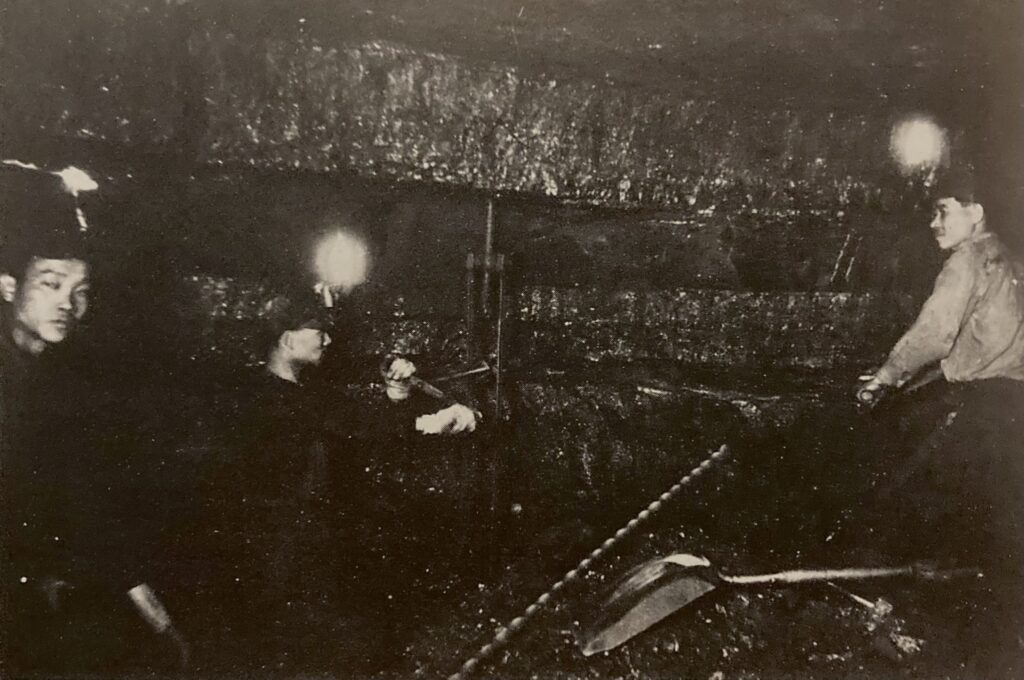
In a rare photograph, Oriental miners work in light of open flame lamps. Two seams of hard coal separated by dirt or soft coal reflect light, photograph, n.d., in Boss Whistle: The Coal Miners of Vancouver Island Remember, by Lynne Bowen (Oolichan Books, 1982), between 96 and 97.
