
Women played a pivotal role in protesting for better conditions in the mines. The safety of their male relatives was the main concern for the women protesters. Women saw the poor mine safety as an issue due to its negative impact on family stability and well-being. These concerns would lead to the women of Vancouver Island protesting for suffrage alongside the issue of safety, not for feminist reasons but because they wished to have a say in the poor workplace safety of the mines where their relatives were employed (Hinde, “‘Stout Ladies and Amazons’” 53). The wives of coal miners’ “primary concern was with the work conditions in the mines or, more precisely, with the safety of their husbands, sons, and brothers, not with union recognition as such” (Hinde, “‘Stout Ladies and Amazons’” 53). In the gas explosion of 1909 “thirty-two men lost their lives, thirteen women were widowed, and thirty-eight children, only two of whom were of an age to provide for themselves, lost their fathers” (Hinde, “When Coal Was King” 93). Women were left to care for their children alone, which brought attention to the difficulties and loss they suffered once their husbands had passed away. As a miner’s wife commented, “you don’t forget when you see thirty graves, all new, dug in a row waiting to be filled with men you’ve known all your life” (Mickleburgh 50). Demonstrating their focus on community, women were significant contributors in the gathering of support from the community for the workers’ strike. Strike pay was not enough money to sustain the families of the strikers, so women took on the responsibility to seek out additional jobs to keep their families from collapsing. Women “[found] jobs outside the home or [became] involved in community-based forms of family assistance, whether child minding or setting up soup kitchens” in order to support their families (Hinde, “When Coal Was King” 166). Additionally, Ellen Greenwell who participated in the strike, remembers thinking “there must be something wrong when a committee is hired to report something and then they report it and they fire these men. That was enough to kill [her]… There must be something wrong with the boss’s side, mustn’t there” (Greenwell 6). She discusses that “up until the 1912 strike… you never thought about these things. I think the women always thought it was men’s business…[I] had wished that of course we would have taken far more interest in those things than you did after” (Greenwell 23). Understanding the concerns women had regarding miner safety and rights show how the Vancouver Island community came together to protest for the members of their community who were being harmed.
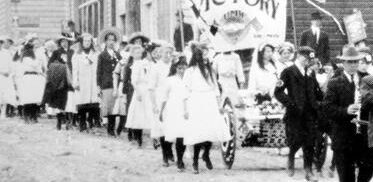
Miners’ wives and children parade behind the union’s brass band as part of a mass procession down the main street of Ladysmith in 1913 during the Great Coal Strike of 1912–14. Their support was crucial to maintaining the long, difficult dispute, photograph, n.d., in On the Line: A History of the British Columbia Labour Movement, by Rod Mickleburgh (Harbour Publishing, 2018), 55.
