The Coal Miners’ Strike of 1912

Canada in the early 1900s saw a high number of strikes due to unrest in the labour movement, which affected employees in the mining industry. Coal miners had their share of grievances, which built the framework for their two year long strike in 1912. The Vancouver Island Coal Miners’ Strike began on September 16, 1912 when a day long holiday in protest of the unfair firing of a union man, Mottishaw, was called (Mickleburgh 51). Mottishaw’s unfair dismissal would be the catalyst for the beginning of the strike, bringing the coal miners’ longtime grievances to light. The United Mine Workers of America international supported the strike by assisting with strike pay and with the miners’ protests. The fight for recognition of miners’ union and rights, wages, and unsafe working conditions were the main concerns of the strikers, and would become the focus of the next two years. Before the strike began, Chinese workers became the enemy of Canadian unions due to Canadian miners’ racist assumptions, although they too wished to support the strike. Female relatives of the coal miners had grievances about the way workers were being treated by the mining companies, and supported the strike. The reasons for the 1912 Vancouver Island Coal Miners’ Strike demonstrate that the coal workers had legitimate grievances that they hoped to solve through striking.

Two miners, underground, in a short seam with large chunks of coal one is holding a safety lamp, photograph, pre 1920, C160-021, Mining – General Photos Album, Cumberland Museum and Archives, Canada, https://www.flickr.com/photos/cumberlandmuseum/6814920438/in/album-72157629438536307.

Miner Rights and the Drive to Unionize

Coal miners’ rights and the drive to unionize were focuses of the 1912 strike which are heavily interconnected. Vancouver Island mine companies refused to recognize any of the coal miners’ unions that sought to organize and obtain the right to collective bargaining with the mining companies (Norris 56). Unionizing would give the miners’ more say in the decisions made about their workplace. In 1903, the government would outlaw the Western Federation of Miners by labeling it a “revolutionary socialist” union which would setback the attempts at union organization (Bowen 133). This set back added to the hostile scene in which the United Mine Workers of America would be invited in to assist Vancouver Island mines in organizing. Miners’ rights were difficult to fight for without a recognized union, they were unable to solve any grievances since the employer was not required to listen or handle any problems the miners may have. The miners wished to have more “control over the organization of the workplace, including the hiring and firing of employees,” and the the recognition of a union would allow for the employees to exercise more control (Hinde, “When Coal Was King” 148). Workers were unwilling to subscribe to the prior method of master-servant relations, as employers could exercise their power over employees without repercussions for unfair treatment (Isitt 40). The ability of companies to fire workers with no justified reason as they held “the right to hire and discharge unquestioned” would lead to Mottishaw being dismissed (Hinde, “When Coal Was King” 150). Mottishaw was a union man and was labelled as an “agitator” which led to his discriminatory firing, demonstrating the lack of control workers had in the workplace. The company Canadian Collieries would respond to attempts to negotiate by announcing: “We don’t want to hear you at all” (Hinde, “When Coal Was King” 151). The refusal to communicate gave miners no other options but to strike, which led to solidarity strikes from other mines that were experiencing similar issues. When asked about the strike, miners involved argued that “prior to the stoppage of work at the Cumberland and Ladysmith mines… considerable friction had been engendered by the treatment that they received” (“Cumberland miners still locked out” 16). This called into question the miners’ rights that had been undermined by the companies. The firing of Mottishaw would expose the agitation that permeated the mining industry due to the power employers held over their workers, and would lead to the beginning of the Vancouver Island Miners’ Strike— a strike which had been brewing in the background for years because of these very issues. Going on strike was a cry for miners’ rights to be heard by the mining companies, and for the recognition of a union so that miners’ rights could continue to be acknowledged in future years.

Small boy holding united mine workers journal, photograph, 1912, C110-128, Ginger Goodwin Labour and Miners Memorial Day Album, Cumberland Museum and Archives, Canada, https://www.flickr.com/photos/cumberlandmuseum/6814898050/in/album-72157629432817125.

Low Pay and Wages

Wages were another concern of the Vancouver Island coal miners. The failure of the 1903 strike, which ended with a twelve percent reduction of wages and worse contracts, had coal miners’ agitated with their recent loss of pay (Hinde, “When Coal Was King” 137-138). With only a select few companies possessing control over the labour market, these companies were able to “keep wages down and hours high” (Norris 57). Miner wages were considered to be generally high due to expectations of miners being the sole breadwinner of their families. Although pay was considered high, miners’ wages were not sufficient enough to support the miners and their families due to employment being irregular and wages not accounting for work stoppages, danger, and lack of security in this field of work (Hinde, “‘Stout Ladies and Amazons’” 40, 41). Local MLA Parker Williams argued that the miners were fighting because of class struggle since the agreement in Nanaimo mines “did not guarantee a living wage” (Hinde, “When Coal Was King” 170). Companies had agreements for different mines to expire on different dates in order to make forming a union harder for the miners, and keep discussion of wages to a minimum. In the workplace, “no discussion of working terms or wages was ever admissible” and wages offered to employees remained to be strictly “take it or leave it” (Hinde, “When Coal Was King” 170). Before the strike began, the Vancouver Sun speculated that there would soon be a general strike due to the agitation over wages. Miners were asking for a wage increase and a standard minimum wage, which was negatively responded to by the premier who expressed that the government would not be assisting their cause (“Miners may strike” 5). A standard minimum wage would allow miners to assure that they would not be underpaid and be able to properly support their families. Without the government or mining companies heeding workers demands for an increase in wages, it was inevitable that conflict would arise in the form of a strike.

2 miners underground working a coal seam, photograph, 1900s, C166-009, No.6 Mine Album, Cumberland Museum and Archives, Canada, https://www.flickr.com/photos/cumberlandmuseum/6961043111/in/album-72157629074146400.

Danger in the Mines

Mining was quite a dangerous job in the 1900s. Companies would not always respond appropriately to the safety concerns brought to their attention about working conditions in the mines. Mottishaw’s discriminatory firing after he reported gas in a mineshaft brought focus to the concern of mine safety as well as worker rights. Because of the mining companies’ full control over worker concerns, they were able to “neglect safety regulations in an industry with very high accident and mortality rates” (Norris 57). Death rates were extremely high due to the poor working conditions in Vancouver Island mines, largely because of the lack of response to safety concerns (Hinde, “When Coal Was King” 158). The problem of safety was in the forefront of miners’ minds due to a gas explosion which had killed thirty-two men in 1909, reminding miners of the consequences that poor safety caused (Mickleburgh 50). The 1909 explosion reminded workers that safety conditions had not improved since their last strike in 1903. Moreover, conditions in the mines were so bad that “contemporary mineralogists and geologists were unanimous in describing the Vancouver Island coalfields as geologically unstable” (Hinde, “When Coal Was King” 100). George Edwards commented that the gas would “cumulate in behind the coal,” which was the cause of many of the explosions he witnessed (Edwards 6). Methane gas was present in all Vancouver Island mines, which caused 63% of miner deaths from 1894 to 1903 due to the explosions it created (Hinde, “When Coal Was King” 96). Edwards believes that another reason there were so many explosions in the mines was because of the “poor ventilation. [Since] in [those] days they didn’t know really what gas would do” (Edwards 5). New machines were also an issue, and caused damage to the health as well as the safety of miners. The machines created coal dust, which heightened the risk of explosions and impacted the miners’ health. They also affected their hearing as the machines “vibrated terribly, were noisy, often causing their operators to become deaf, and prevented the miners from listening to the working of the roof, which made them impractical for the dangerous task of robbing the pillars” (Hinde, “When Coal Was King” 81). When discussing the safety of the mines, Edwards passionately exclaims that “anybody worked in the coal mines, he’s earned every nickel. He’s earned the hard way… Go an’ look at his hands, you’ll see callouses on his hands off the shovel. That’s right. They kill theirself! They killed theirself workin’. Most of the coal diggers” (Edwards 31). The companies put very little thought into the working conditions the miner’s were subjected to, and it caused many health and safety problems with the workers. When miner Jim Galloway was asked if there was a safety committee prior to the strike, he answered that while there was one “it didn’t amount to much at the time— there was no unions or anything” (Galloway 1). A union would allow for a better system to deal with the safety concerns which were being neglected by the committee that mining companies sent, though first the miners would have to get the companies to listen to their grievances.

Mine rescue workers holding a canary in a cage to check gasses in the mine, photograph, n.d., C175-033, Mine Rescue Album, Cumberland Museum and Archives, Canada, https://www.flickr.com/photos/cumberlandmuseum/6814933046/in/album-72157629439073441/.

Women’s Concerns and Activism

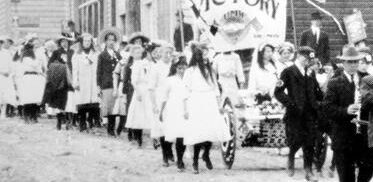
Women played a pivotal role in protesting for better conditions in the mines. The safety of their male relatives was the main concern for the women protesters. Women saw the poor mine safety as an issue due to its negative impact on family stability and well-being. These concerns would lead to the women of Vancouver Island protesting for suffrage alongside the issue of safety, not for feminist reasons but because they wished to have a say in the poor workplace safety of the mines where their relatives were employed (Hinde, “‘Stout Ladies and Amazons’” 53). The wives of coal miners’ “primary concern was with the work conditions in the mines or, more precisely, with the safety of their husbands, sons, and brothers, not with union recognition as such” (Hinde, “‘Stout Ladies and Amazons’” 53). In the gas explosion of 1909 “thirty-two men lost their lives, thirteen women were widowed, and thirty-eight children, only two of whom were of an age to provide for themselves, lost their fathers” (Hinde, “When Coal Was King” 93). Women were left to care for their children alone, which brought attention to the difficulties and loss they suffered once their husbands had passed away. As a miner’s wife commented, “you don’t forget when you see thirty graves, all new, dug in a row waiting to be filled with men you’ve known all your life” (Mickleburgh 50). Demonstrating their focus on community, women were significant contributors in the gathering of support from the community for the workers’ strike. Strike pay was not enough money to sustain the families of the strikers, so women took on the responsibility to seek out additional jobs to keep their families from collapsing. Women “[found] jobs outside the home or [became] involved in community-based forms of family assistance, whether child minding or setting up soup kitchens” in order to support their families (Hinde, “When Coal Was King” 166). Additionally, Ellen Greenwell who participated in the strike, remembers thinking “there must be something wrong when a committee is hired to report something and then they report it and they fire these men. That was enough to kill [her]… There must be something wrong with the boss’s side, mustn’t there” (Greenwell 6). She discusses that “up until the 1912 strike… you never thought about these things. I think the women always thought it was men’s business…[I] had wished that of course we would have taken far more interest in those things than you did after” (Greenwell 23). Understanding the concerns women had regarding miner safety and rights show how the Vancouver Island community came together to protest for the members of their community who were being harmed.

Miners’ wives and children parade behind the union’s brass band as part of a mass procession down the main street of Ladysmith in 1913 during the Great Coal Strike of 1912–14. Their support was crucial to maintaining the long, difficult dispute, photograph, n.d., in On the Line: A History of the British Columbia Labour Movement, by Rod Mickleburgh (Harbour Publishing, 2018), 55.

Chinese Miners’ Concerns

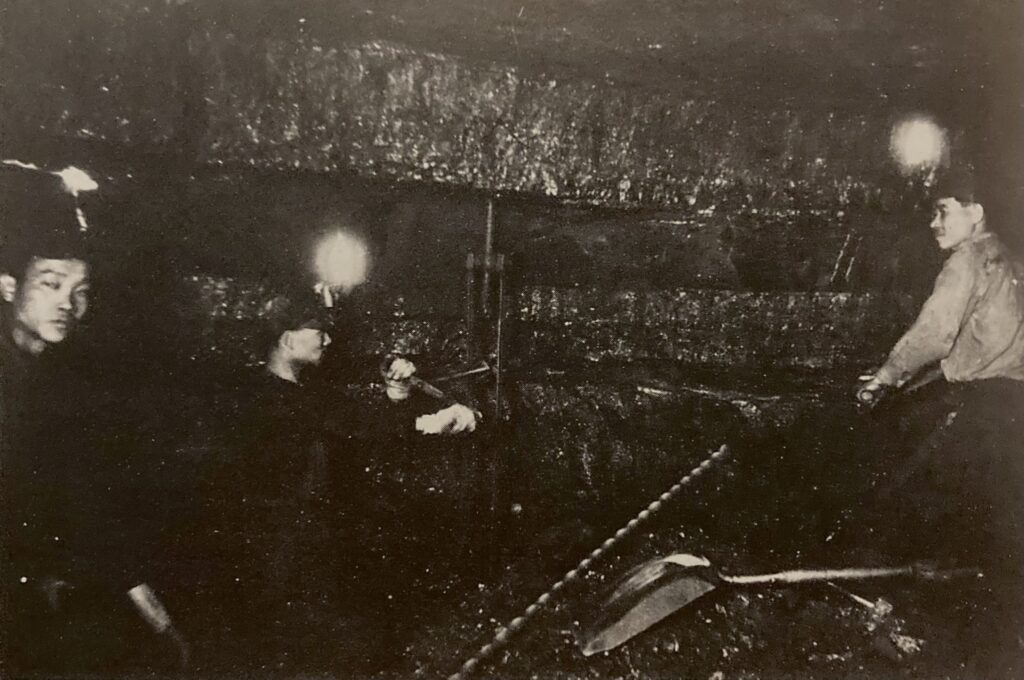
Chinese coal miners were especially harmed by the low wages and bad worker conditions. Mining companies would employ Chinese labourers since they would work for lower wages that the Canadian miners would accept (Norris 57). The low wages of Chinese workers “drew into question the immediate job security of unskilled white oncost workers and the long-term prospects for skilled hewers, whose talents the Chinese might someday acquire” (Belshaw 124-125). Canadian workers were afraid that the Chinese would take their jobs since they were willing to work for lower pay. Chinese workers joined the strike out of interest for the higher wages the strikers were campaigning for, even though the Canadian strikers held animosity towards them. Chinese miners had attempted to go on strike previously in 1906 due to discontent with their lower wages they were offered in comparison to their Canadian counterparts because of their race, and were interested in joining the 1912 strike to fight to raise their extremely low pay. Some Chinese workers were paid only a dollar per day and lived in very poor conditions, which demonstrates how their wage was barely livable (Bowen 138). When the strike first began, Chinese Cumberland workers refused to work, but soon after agreed to a two-year contract (Bowen 138). This agreement fostered distain towards the Chinese from Canadian miners, and their was speculation on what might have made them agree to the contract when they had been interested in striking just before. The fear of Chinese labourers taking Canadian miner jobs had caused Canadians to feel hatred towards them, which grew as the Chinese returned to work as strikebreakers. Although many westerners disliked the Chinese, some recognized their need for higher pay due to the poor conditions in Cumberland’s Chinatown. One worker commented that they “couldn’t blame the Chinaman in a way. Some of them worked for as low as a dollar a day. And that Chinatown, just a bunch o’ shacks” (Bowen 138-139). In one instance in 1912, the union “energetically supported an attempt by striking Chinese stokers working at the pithead at Extension to win a wage increase of twelve cents a day, which would have brought their daily rate to $1.75” (Hinde, “When Coal Was King” 163). This demonstrates that worker solidarity was possible, but was not achieved to a high enough extent. Additionally, Hinde argues that “racism was an essential component of the European worldview and a vital part of ‘popular white working-class mythology’” (Hinde, “When Coal Was King” 132). The union’s refusal to include Chinese labourers is what led them to become the targets of mining companies to act as strikebreakers. The lack of solidarity between Canadian and Chinese coal miners is what “prevented workers from addressing the real causes of their oppression and exploitation” (Hinde, “When Coal Was King” 132). Although the Chinese workers were not accepted into Canadian unions, the 1912 strike remained appealing to the Chinese workforce due to the wage increase they could gain from it so they could afford to live in better conditions and support their families.

In a rare photograph, Oriental miners work in light of open flame lamps. Two seams of hard coal separated by dirt or soft coal reflect light, photograph, n.d., in Boss Whistle: The Coal Miners of Vancouver Island Remember, by Lynne Bowen (Oolichan Books, 1982), between 96 and 97.

Conclusion

The reasons for the Vancouver Island Coal Miners’ Strike demonstrate that the miners’ had rightful concerns that warranted going on strike. The drive to unionize in order to gain more rights, wages, and address safety concerns caused agitation within the miner workforce, which cumulated into the desire to strike. Women joined the drive to improve conditions for their male relatives and community members so that they would make enough money to support their families. Chinese workers were made to work for much lower pay than Canadian miners, and supported the strike although they were often employed as strikebreakers. The 1912 strike came from years of grievances and failures of the mining companies to meet the miners’ demands. Mottishaw’s unjust dismissal was what spurred the strike which had been anticipated for years. The reasons for the strike show the genuine issues labourers had with the mining companies, which caused distain between employers and employees and led to the 1912 strike.

Fire boss with gas indicating safety lamp/coal cutter with power driven chain to pull it around and feed it into the low ceiling seam. Coal. first it was electrically driven but later switched to compressed air, photograph, n.d., C160-039, Mining – General Photos Album, Cumberland Museum and Archives, Canada, https://www.flickr.com/photos/cumberlandmuseum/6814920484/in/album-72157629438536307.

Bibliography

2 miners underground working a coal seam. Photograph, 1900s, C166-009, No.6 Mine Album, Cumberland Museum and Archives, Canada, https://www.flickr.com/photos/cumberlandmuseum/6961043111/in/album-72157629074146400.

Bartley, George. “Cumberland miners still locked out; situation unchanged.” The Vancouver Sun, November 11, 1912. https://www.proquest.com/hnpvancouversun/pagelevelimagepdf/2239598656/pagelevelImagePDF/BDB2D7AE973C4301PQ/1?t:lb=t&accountid=12246&sourcetype=Newspapers.

Belshaw, John Douglas. “Conflicts in the Colonial Setting.” Colonization and Community. McGill-Queen’s University Press, 2002.

Bowen, Lynne. Boss Whistle: The Coal Miners of Vancouver Island Remember. Oolichan Books, 1982.

Edwards, George. Interview by Myrtle Bergren. Coal Tyee History Project, VIURRSpace, January 30, 1979. Audio, 62:16. http://hdl.handle.net/10613/154.

Fire boss with gas indicating safety lamp/coal cutter with power driven chain to pull it around and feed it into the low ceiling seam. Coal. first it was electrically driven but later switched to compressed air. Photograph, n.d., C160-039, Mining – General Photos Album, Cumberland Museum and Archives, Canada, https://www.flickr.com/photos/cumberlandmuseum/6814920484/in/album-72157629438536307.

Galloway, Jim. Interview by Myrtle Bergren. Coal Tyee History Project, VIURRSpace, 1979. http://hdl.handle.net/10613/188.

Greenwell, Ellen. Interview by Howard H. Smith. Interview Collectio, VIURRSpace, 1976. http://hdl.handle.net/10613/3094.

Hinde, John. “‘Stout Ladies and Amazons’: Women in the British Columbia Coal-Mining Community of Ladysmith, 1912-14.” BC Studies: The British Columbian Quarterly, no. 114 (1997): 33-57. Accessed February 14, 2025.

Hinde, John. When Coal Was King: Ladysmith and the Coal-Mining Industry on Vancouver Island. UBC Press, 2003.

In a rare photograph, Oriental miners work in light of open flame lamps. Two seams of hard coal separated by dirt or soft coal reflect light. photograph, n.d. In Boss Whistle: The Coal Miners of Vancouver Island Remember, by Lynne Bowen. Oolichan Books, 1982, between 96 and 97.

Isitt, Benjamin. “Patterns of Protest: Property, Social Movements, and the Law in British Columbia.” PhD dissertation, University of Victoria, 2018.

Mickleburgh, Rod. On the Line: A History of the British Columbia Labour Movement. Harbour Publishing, 2018.

Mine rescue workers holding a canary in a cage to check gasses in the mine. Photograph, C175-033, Mine Rescue Album, Cumberland Museum and Archives, Canada, https://www.flickr.com/photos/cumberlandmuseum/6814933046/in/album-72157629439073441/.

“Miners may strike, is now threatened, unless raise made.” The Vancouver Sun, August 5, 1912. https://www.proquest.com/hnpvancouversun/docview/2239611003/3108BB9E1DEE4D8EPQ/84?accountid=12246&sourcetype=Newspapers.

Miners’ wives and children parade behind the union’s brass band as part of a mass procession down the main street of Ladysmith in 1913 during the Great Coal Strike of 1912–14. Their support was crucial to maintaining the long, difficult dispute. Photograph, n.d. In On the Line: A History of the British Columbia Labour Movement, by Rod Mickleburgh. Harbour Publishing, 2018, 55.

Norris, John. “The Vancouver Island Coal Miners, 1912-1914: A Study of an Organizational Strike.” BC Studies: The British Columbian Quarterly, no. 45 (1980): 56-72. Accessed February 14, 2025. https://doi.org/10.14288/bcs.v0i45.1046.

Ray Knight, The Ladysmith May Day parade. Photograph, n.d. In When Coal Was King: Ladysmith and the Coal-Mining Industry on Vancouver Island, by John Hinde. UBC Press, 2003, 168.

Small boy holding united mine workers journal. Photograph, 1912, C110-128, Ginger Goodwin Labour and Miners Memorial Day Album, Cumberland Museum and Archives, Canada, https://www.flickr.com/photos/cumberlandmuseum/6814898050/in/album-72157629432817125.

Two miners, underground, in a short seam with large chunks of coal one is holding a safety lamp. Photograph, pre 1920, C160-021, Mining – General Photos Album, Cumberland Museum and Archives, Canada, https://www.flickr.com/photos/cumberlandmuseum/6814920438/in/album-72157629438536307.