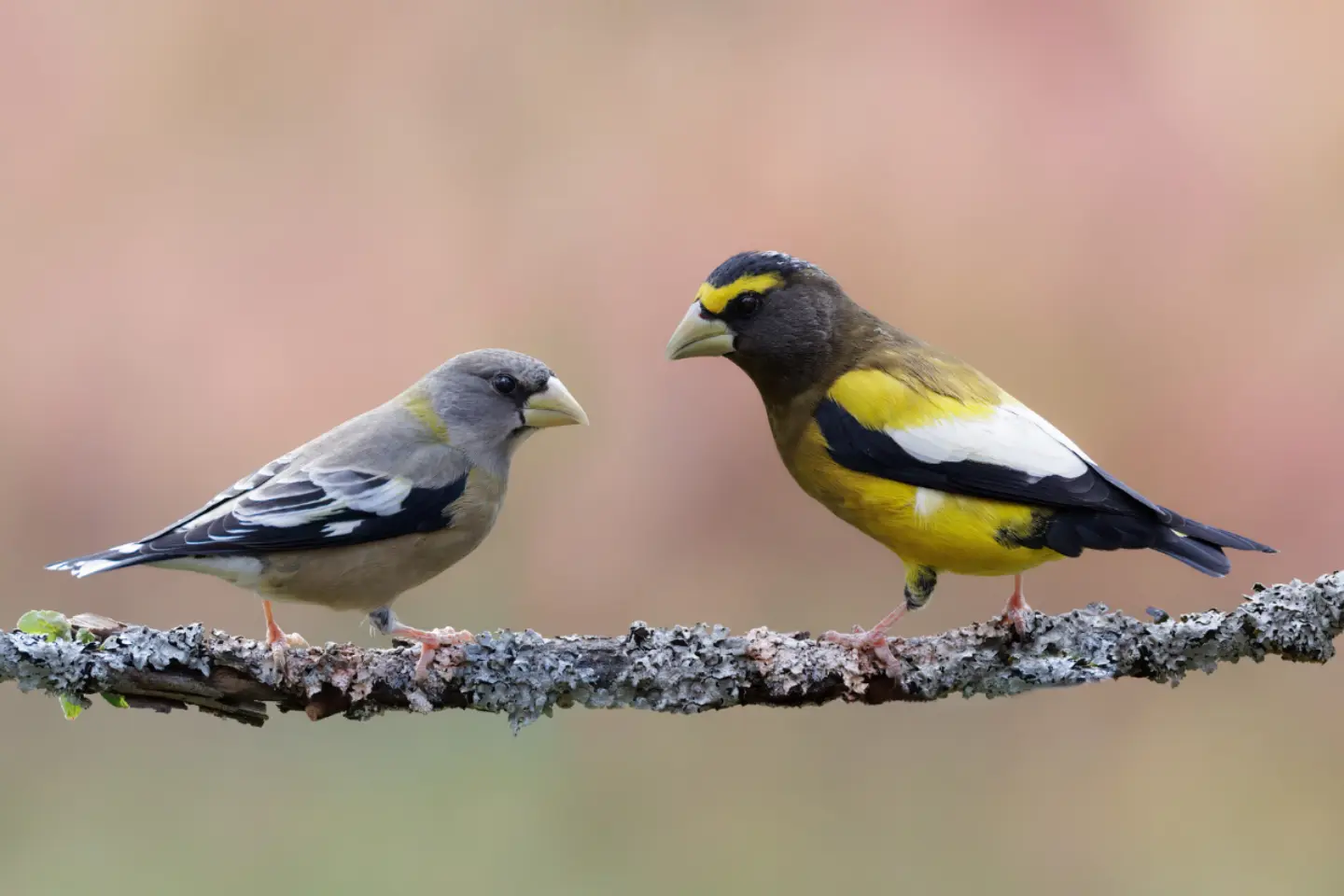
Who’s behind beak #1?
The Evening Grosbeak (Hesperiphona vespertinus) (sometimes depicted as genus Coccothraustes) is one of the larger finch species found in the northern coniferous forests across Canada and some of the northeastern United States. These finches are typically 20 cm long and weigh 60 grams, about the length of a No.2 pencil and the weight of an average tennis ball. (Allair, 2026) The large, nearly cone-shaped bill on Grosbeaks is important in their foraging behaviours. The males’ striking yellow underbelly and “eyebrow” markings, paired with their black-and-white wings, make them a delight to see at bird feeders. Females may not have the flashy yellow, but their gentle gray contour feathers, with the same black-and-white wing pattern, still make them a beautiful bird to spot. (All About Birds)
Finches are a group of birds considered to be songbirds, the ones you hear every morning when the sun rises. The songs and sounds of birds have captivated humans for possibly centuries. The Evening Grosbeak may be a songbird, but it has no song. Grosbeaks tend to use simple calls with piercing notes and burry chirps.
Evening Grosbeak Call
Distribution & Habitat
Evening Grosbeaks have a global population of approximately 3.8 million, with Canada’s forests housing two-thirds of that population. You can spot them along the Pacific coast up to the Yukon border and as far east as the Atlantic coast. (Allair, 2026) These finches spend their winter seasons in forests across Canada, with occasional stops in urban and suburban areas where kind strangers have put out seeds for them or where a woodlot lets them access insects. They particularly enjoy mature and 2nd-growth forests at slightly higher elevations, about 1000-1250 m above sea level, as the following bar graph shows. (Martell, 2015)
Figure 1: Bar Graph Depicting Occurrence of Evening Grosbeaks at Varying Altitudes
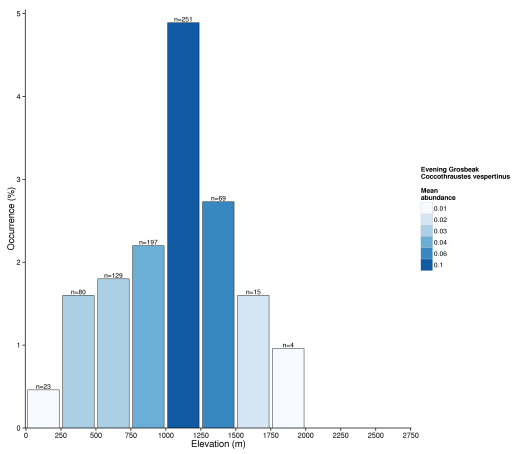

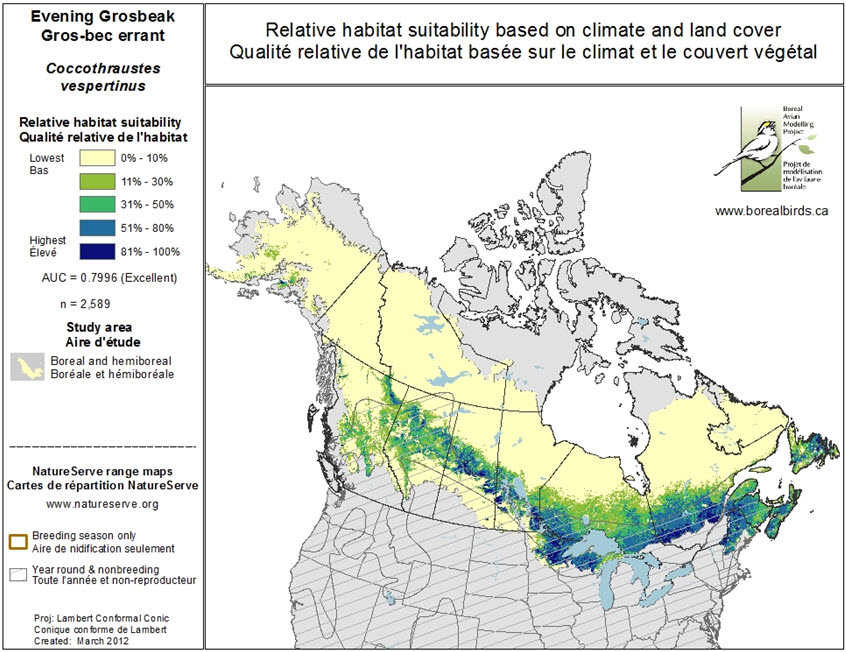
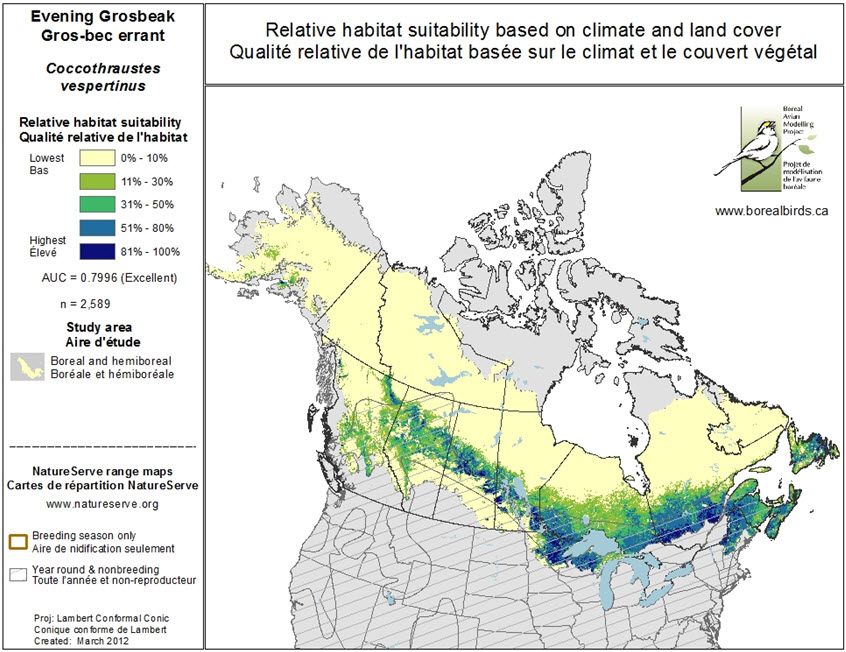
Evening Grosbeaks, like many other birds, have strong preferences for their breeding and nesting sites. Birds in the 1000-1250 m range in the previous figure are found in their ideal nesting and breeding habitats: the mature coniferous forests of Northern North America and the Rocky Mountains. (Martell, 2015) These forest types are predominantly located in the southern and central interior of British Columbia.
Figure 2: Map of suitable habitat for Evening Grosbeaks
Breeding & Nesting
The birds start nesting in those forests around May and finish for the season by mid- to late August. The female builds the nest alone and lays 3-4 eggs in a blue-green base covered in brown, purple, and gray blotches. She incubates the eggs alone for 11-14 days. The male may bring the female food occasionally while she keeps the eggs safe and warm. (Scott, 1991) Once the chicks hatch, both parents will feed the ever-growing babies until they are ready to leave the nest in two weeks. The adult pair may have up to 2 broods a year. (Audubon) When thinking about birds’ breeding behaviours and how they attract mates, you might think of certain songs, dances, special feathers, or even fights between males as examples of courtship behaviours. The male Grosbeak’s bold colours certainly factor into mate preference; however, the real test is his courtship dance.
Courtship dance of male Evening Grosbeak
Diet
We have talked about their appearance, where you can find them, and how they get together to make more beautiful birds for us to watch, but what fuels these big-beaked finches? What delicious snacks do they spend their time foraging for? The answer depends on whether it is breeding or non-breeding season. During breeding season, the birds need protein to maintain body temperature and energy while building nests and producing eggs.
Fortunately, Evening Grosbeaks are master exterminators with a preference for Spruce Budworm, which has historically caused billions of dollars in timber loss, Forest Tent Caterpillar, and other detrimental invertebrate species that damage national forests. (Nealis, 2024; MacLean, 2015) Those big beaks can grab caterpillars or moths climbing on branches and up trees and crush them into a high-protein snack on the go. What happens when it gets colder and darker, the insects disappear, and the air hurts your face? The Evening Grosbeak is no picky eater, and that big beak isn’t just for show or squishing soft insects. During the winter, Evening Grosbeaks feast on a range of seeds, including those from fruits and trees such as maple, ash, elm, pine, and spruce. Their sizable beaks enable them to deftly handle pinecone scales and the winged casings of maple seeds. These seeds have hard outer casings that can be difficult to digest, so Evening Grosbeaks sometimes eat salt and gravel along the road in winter to help digest their seed-filled diets. (Audubon)
Conservation Status
Now that we know all the finer details about this beautiful songbird, let’s get into a slightly heavier topic: the overwhelming loss in numbers these finches have suffered in the last few decades. Many avid birders know Project FeederWatch, a continent-wide citizen science project that lets people engage with nature, count birds, and submit their lists. These lists are compiled, and researchers can use the data to track populations through sightings over time and other parameters used to study birds. In 2008, David Bonter and Michael Harvey studied data collected from 1988-2006 on Evening Grosbeak populations. They unfortunately found that over the 18 years, sightings fell by 50% and flock sizes decreased by an average of 27%. Through their research, they identified an extensive list of possible causes; however, they found no single major threat, and further research was deemed necessary.
Figure 3: Trend Line depicting population decline of Evening Grosbeak from 1970-2022
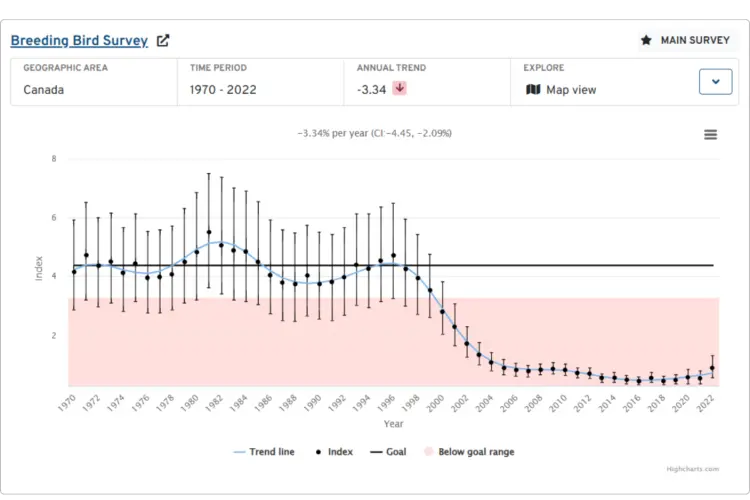
Evening Grosbeaks have taken quite a hit in numbers, but in 2016, COSEWIC in Canada granted them special concern status. They are legally protected by the Migratory Birds Convention Act, 1994, as well as numerous broad provincial regulations meant to prevent hunting, capturing, selling, and damage to nests and eggs. (Savignac, 2016) In 2018, the International Union for Conservation of Nature (IUCN) listed the Evening Grosbeak as a vulnerable species on its red list of threatened species. Like researchers Bonter and Harvey, they believe more research and monitoring are essential to understand the threats facing these birds and their impacts fully. Many of these threats arise from the expanding human industries, such as forestry and agriculture, along with the unintended consequences of people encroaching on previously untouched areas to build roads and homes. (IUCN) This situation reminds us that our actions affect the Earth and all its inhabitants. For example, when we deal with pests that damage our timber, like the Spruce Budworm, we often resort to using pesticides. However, those very worms could have provided a food source for Evening Grosbeaks during their breeding season. As a result, these birds may either skip breeding that year or seek out a more suitable environment elsewhere.
The Flight Call Phenomena: New Discoveries in Evening Grosbeak Flight Calls
Most birds can be differentiated by plumage colour, location and, importantly, by song or calls. Birds may have nearly identical plumage colours and patterns, making them difficult to identify by sight alone, but they will have distinctly different calls. (Kirsch et al., 2025) Evening Grosbeaks are widespread across Canada and parts of the northern United States, and just like us, they have dialects that vary across the continent. William Kirsch and his colleagues conducted a quantitative analysis of 239 flight-call and 167 trill recordings from across the bird’s range.
Figure 4: Spectrograms of the 6 distinct Evening Grosbeak flight calls


When the group analyzed the data, they concluded there were 6 distinct Evening Grosbeak calls. The birds making each call were also found in 6 generally separate areas, with some overlap among types 1, 2, and 4. Type 3 birds were heard exclusively on the east coast, from Ontario to the tip of Labrador and down to Massachusetts. Types 1, 2, and 4 are found from the Pacific Northwest to the Rocky Mountains and down to the Sierra Nevada Mountains. Type 6 is primarily found in Alberta and Saskatchewan. Type 5 is the least recorded and still requires more research; however, it is assumed to be the Mexican variant, which may be migrants from Canada. (Kirsch et al. 2025)
Figure 5: A map illustrating the breeding ranges of the 6 distinct call types of the Evening Grosbeak

The quantitative assessments by Kirsch et al. show that flight calls can be accurately identified and mapped, providing a valuable tool for understanding the movement and behavioural ecology of Evening Grosbeak populations by call type. Additional studies are needed to enhance our understanding of Evening Grosbeak call types. Revisiting subspecies classifications with a broader range of specimens would be beneficial. A research path to improve our understanding of divergence in flight calls would involve integrating genetic data with social behaviour, allowing a deeper look at the mechanisms behind regional vocalizations.
Thank you to All About Birds, Birds Canada, Audubon, and many others for providing the information needed to create this blog post. Many people put many hours into researching, collecting, studying, and writing the reports, articles, and studies I used. Thank you to Vancouver Island University for providing a space for students to interact with the public in a less formal, yet still educational, setting. Finally, thank you to my professor, Dr. Eric Demers, for continuing to provide an environment where curiosity and excitement about birds are not just welcomed but encouraged.
References
Allair, J. 2026. Birds Canada. Evening Grosbeak – Birds Canada’s 2026 Avian Ambassador. https://www.birdscanada.org/news/evening-grosbeak-birds-canadas-2026-avian-ambassador
Audubon. 2016. Evening Grosbeak. Audubon. [accessed 2026 Sep 28]. https://www.audubon.org/field-guide/bird/evening-grosbeak.
BirdLife International. 2018. Species factsheet: Evening Grosbeak Hesperiphona vespertina. https://datazone.birdlife.org/species/factsheet/evening-grosbeak-hesperiphona-vespertina on 25/09/2026
Birds Canada and Environment and Climate Change Canada. 2024. The State of Canada’s Birds Report. Accessed from Nature Counts. DOI: https://doi.org/10.71842/8bab-ks08
Bonter D.N., Harvey M.G., 2008. Winter Survey Data Reveal Range-wide Decline in Evening Grosbeak Populations. The Condor: Ornithological Applications. 110(2):376–381 [accessed 2026 Sep 21]. https://doi.org/10.1525/cond.2008.8463
Cornell Lab of Ornithology. 2026. Evening Grosbeak overview, All About Birds. Ithaca (NY): Cornell University; [accessed 2026 Sep 19]; https://www.allaboutbirds.org/guide/Evening_Grosbeak/overview
IUCN RED LIST. 2018. The IUCN Red List of Threatened Species. [accessed 2026 Sep 21]. https://www.iucnredlist.org/species/22720702/131500502
Ivanov S. 2013. Evening Grosbeak courtship display. YouTube. [published online ahead of print] [accessed 2026 Sep 21]. https://www.youtube.com/watch?v=YU9jAoegB5E
Kirsch W.M., Centanni C.T., Ngo S.H., Young M.A., Hahn T.P., Robinson W.D., 2025. Quantitative analysis of the flight calls and trills of Evening Grosbeaks (Coccothraustes vespertinus). Frontiers in Bird Science. 4. doi:10.3389/fbirs.2025.1613273 https://www.frontiersin.org/journals/birdscience/articles/10.3389/fbirs.2025.1613273/full#s3
MacLean D Prof. 2015. The Economic Reality of Spruce Budworm – Aug 6, 2015 – Healthy Forest Partnership. Https://healthyforestpartnership.ca/. [accessed 2026 Sep 26]. https://healthyforestpartnership.ca/the-economic-reality-of-spruce-budworm-august-6-2015/.
Martell, A. 2015. Evening Grosbeak in Davidson, P.J.A., R.J. Cannings, A.R. Couturier, D. Lepage, and C.M. Di Corrado (eds.). The Atlas of the Breeding Birds of British Columbia, 2008-2012. Bird Studies Canada. Delta, BC http://www.birdatlas.bc.ca/accounts/speciesaccount.jsp?sp=EVGR&lang=en [Sep 19 2026
Nealis, V.G. 2024. Spruce budworm. In J.P. Brandt, B.I. Daigle, J.-L. St-Germain, A.C. Skinner, B.C. Callan, and V.G. Nealis, editors. Trees, insects, mites, and diseases of Canada’s forests. Natural Resources Canada, Canadian Forest Service, Headquarters. Ottawa, Ontario. https://tidcf.nrcan.gc.ca/en/insects/factsheet/12018
Savignac, C. 2016. Evening grosbeak (Coccothraustes vespertinus): COSEWIC assessment and status report 2016. Canada.ca. https://www.canada.ca/en/environment-climate-change/services/species-risk-public-registry/cosewic-assessments-status-reports/evening-grosbeak-2016.html#_02
Scott A.C., Bekoff M. 1991. Breeding Behaviour of Evening Grosbeaks. The Condor: Ornithological Applications. 93(1):71–81 [accessed 2026 Sep 26]. https://doi.org/10.2307/1368608