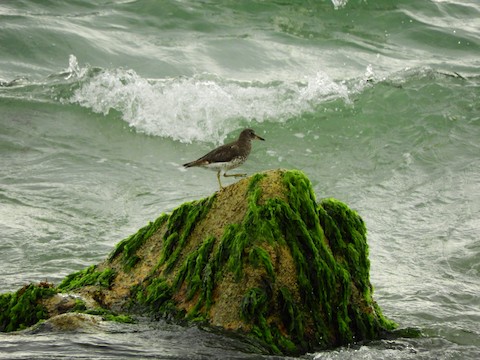
Order: Charadriiformes
Family: Scolopacidae
Genus: Caladris
Species: virgata
Calidris virgata
Surfbird by De Ferari, Cornell Lab of Ornithology | Macaulay Library
So you’re telling me this bird can surf? Well, not quite, but it does do a great job making its living in the surf. These stocky sandpipers are a common sight on Pacific rocky coasts, often found foraging for molluscs among other shorebird species during their non-breeding season (Cornell Lab of Ornithology, n.d.). During breeding season, surfbirds migrate to arctic mountain ranges where males perform display flights to attract potential mates. The surfbird travels from Alaska all the way to the southern tip of Chile each year, weaving a fascinating life history rooted in resilience and cooperation.
Description and ID
Surfbirds are robin-sized members of the family Scolopacidae (sandpipers and allies). They are not as delicate in appearance compared to other members within its genus Calidris. Their bill is stout, their tail short, and their yellow legs are short and stocky. (Cornell Lab of Ornithology, n.d.). For this atypical appearance, it used to be considered a member of a sub-family with turnstones (Jehl, 1968). They are approximately 10” long with a wingspan of 26”, weighing in at 190 grams (Sibley 2016). Males and females are indistinguishable in plumage, but females tend to be slightly larger. Short yellow legs. Base of bill is yellow. Short tail with a white base and a thick black stripe across the tip. This is a useful identification feature in flight (Audubon, n.d. ).
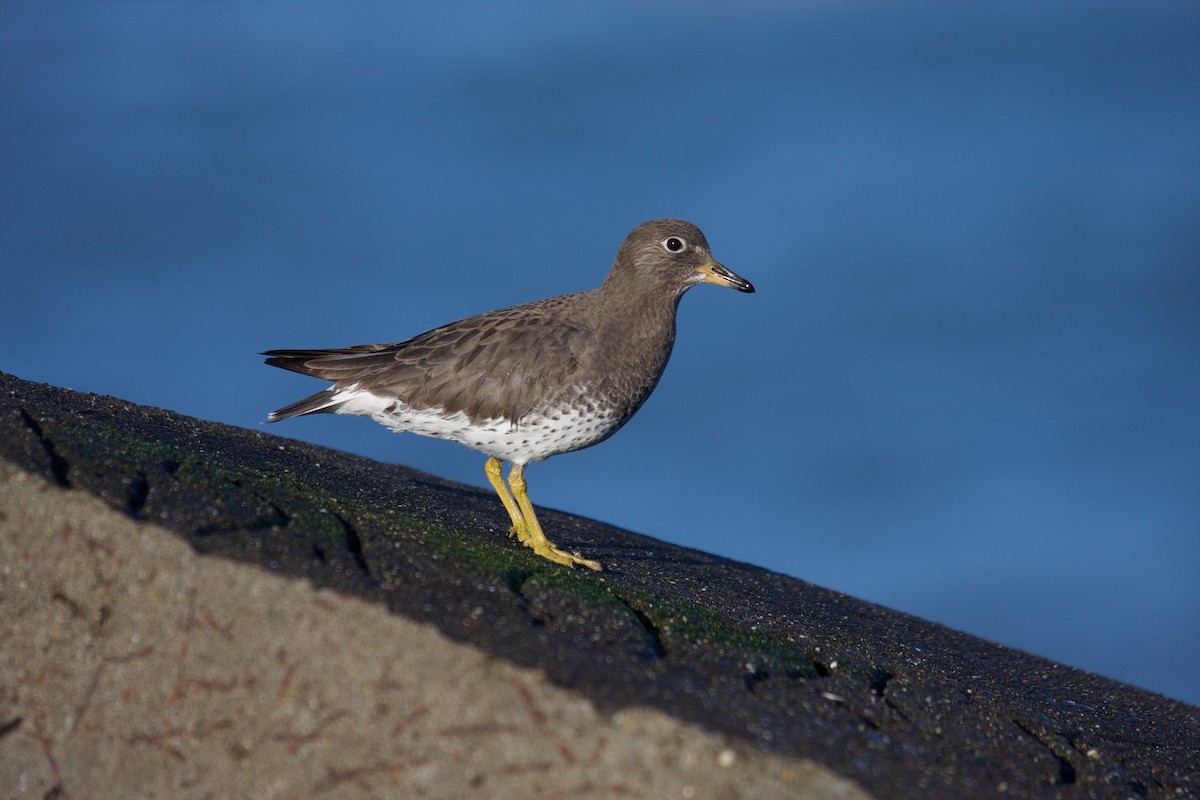

During the winter (non-breeding), displays dark grey coloring on most of its body except for a white belly lightly streaked with grey. Juveniles are a duller coloration, similar to adult nonbreeding. Breeding adults have rufous shoulders and evident black spots on their white belly. their head and back have obvious dark and light stippling compared to the muddled nonbreeding grey (Audubon, n.d.).
Distribution
If bird society was an apartment building, the surfbird would be your friendly neighbour of ten years that you feel confident you know all about, except for those pesky few months annually where they fall off of the face of the earth. The only proof of their existence would be a post it note hastily stuck to your door simply stating “had to go. water my plants plz.” A little annoying, but understandable.
This seemed to be the sentiment of Western scientists towards this bird when trying to figure out where surfbirds were migrating to breed. For a long time, it was known that during their wintering (late July to early April) surfbirds lived along pacific rocky coast shores, all the way from southern Alaska down to the tip of Chile. However, ‘no one’ knew definitively where they went to breed ( Audubon, n.d.). Since the surfbird was never or rarely observed far from the coast, the assumption was that their nesting grounds would surely be somewhere on the coast in the far North. (Dixon, 1927) However, this was disproved.
Surfbird breeding grounds are found on high elevation rocky terrain in the Alaskan tundra (Sibley, 2016). It is important to note that native Alaskans had knowledge about the seasonality and location of surfbird breeding and shared this information with western scientists, but were dismissed for many years before their suggestion was investigated. (Dixon, 1927)
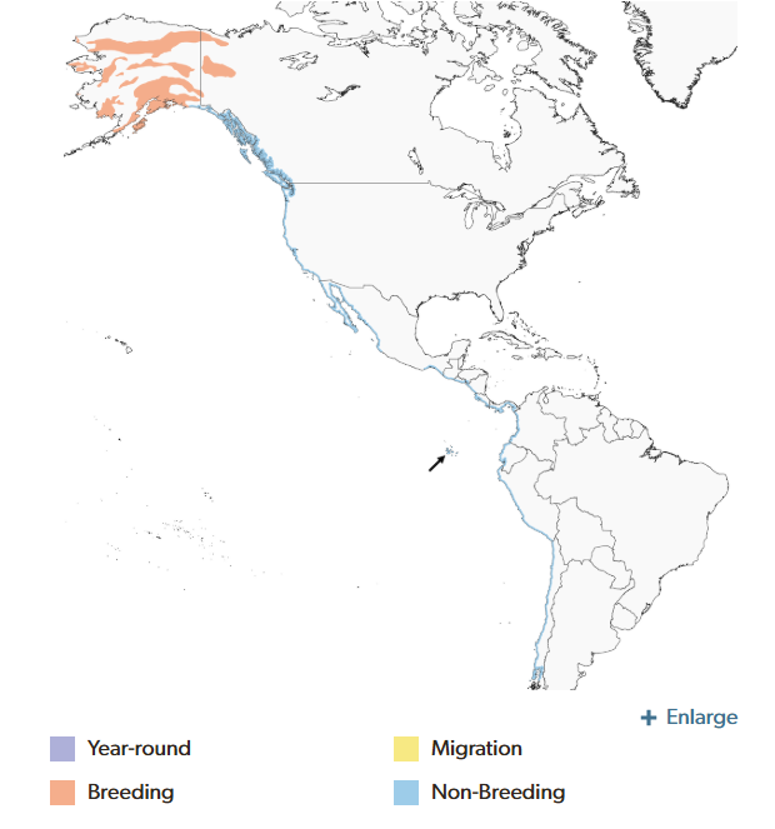
Range of the surfbird. Credit: Cornell Lab of Ornithology and BirdLife International
Habitat
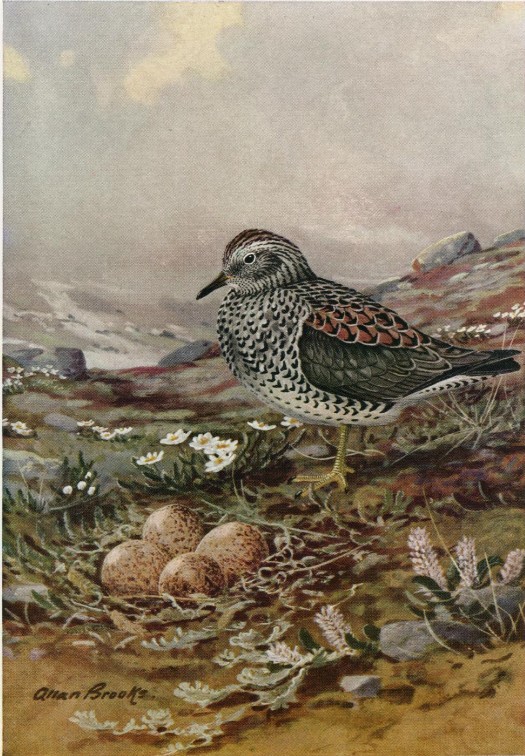
Breeding season: March-August
Surfbirds exclusively live in rocky areas. During their breeding season, they nest in rocky mountain tundra. They lay their eggs into natural indents in the rock. This ‘nest’ is lined with lichen and sticks. (Audubon, n.d.)
Wintering: July-April
During the rest of the year, the surfbird does as its name suggests: it lives in the surf. It is rarely spotted more than a couple meters past the high tide line of any rocky coast it inhabits (Audubon, n.d.).
Behaviour
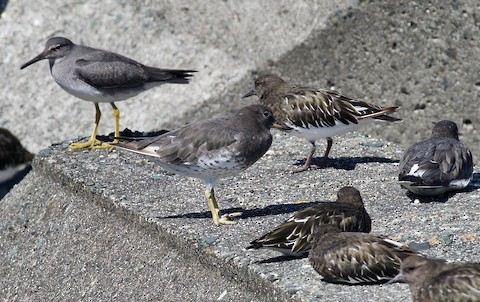
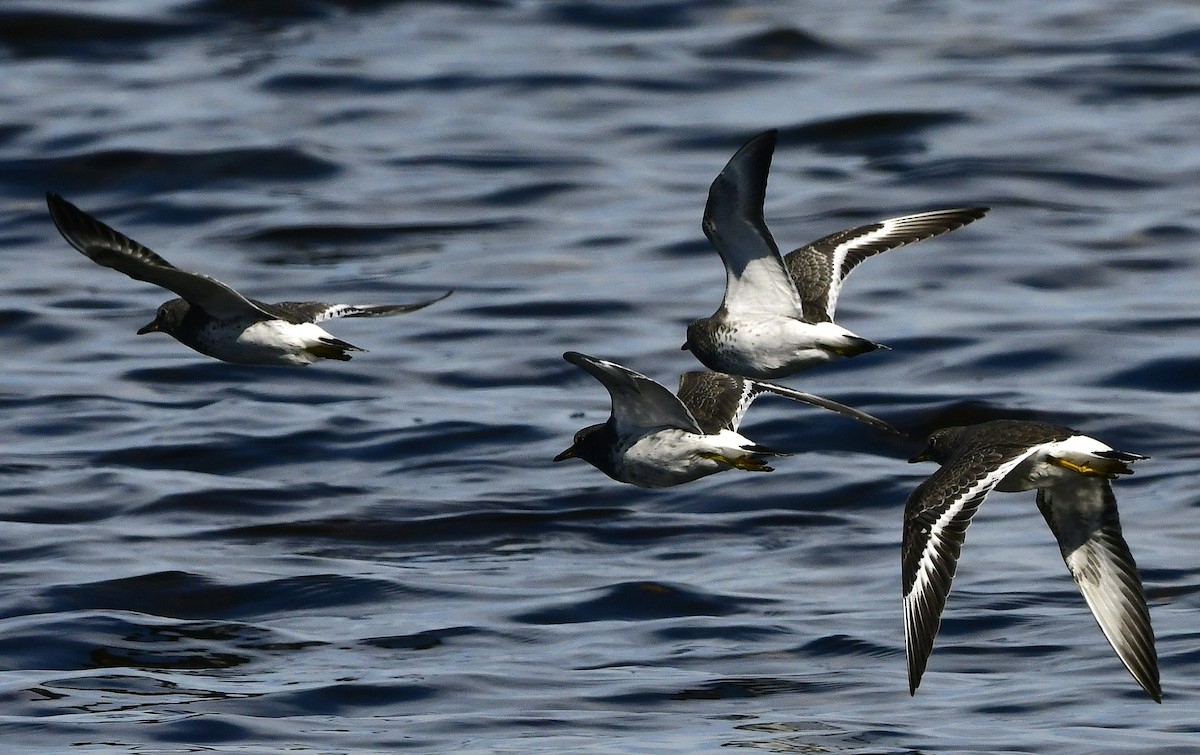
Surfbirds (1 centred, 1 far right) among black turnstones (1 centre right, 3 bottom right ) and another shorebird (top left).
Social life
Back to the neighbour analogy, if you will. The surfbird is the kind of neighbour that you never see wandering the halls alone. It is always with its other surfbird friends, and more often than not, accompanied by its slightly shorter look-alike: the black turnstone.
Surfbirds are social shorebirds. They are found in small flocks which commonly include black turnstones (another member of the family Scolopacidae) and various other small shorebirds (Sibley, 2016).
Conservation
Currently, the surfbird sits at a “Least Concern” status according to the ICUN. Their population is however, on a decreasing trend.(BirdLife International, 2024).
Due to the surfbirds highly specific habitat needs, the surfbird is a great example of how important it is to preserve our coastal ecosystems. Threats to the surfbird include coastal development, industrial and military effluents, and extreme weather events due to climate change (BirdLife International, 2024).
Their ‘tour of the Americas’ migration also raises a valuable issue in conservation of migratory birds. Conservation must become an international initiative. Birds could give less of a snail’s shell about how humans divide land and law. To protect this species -and many others- it is vital that its habitat is protected throughout its range.
Recent research
The Surfbird Project: Satellite tagging to understand breeding migration
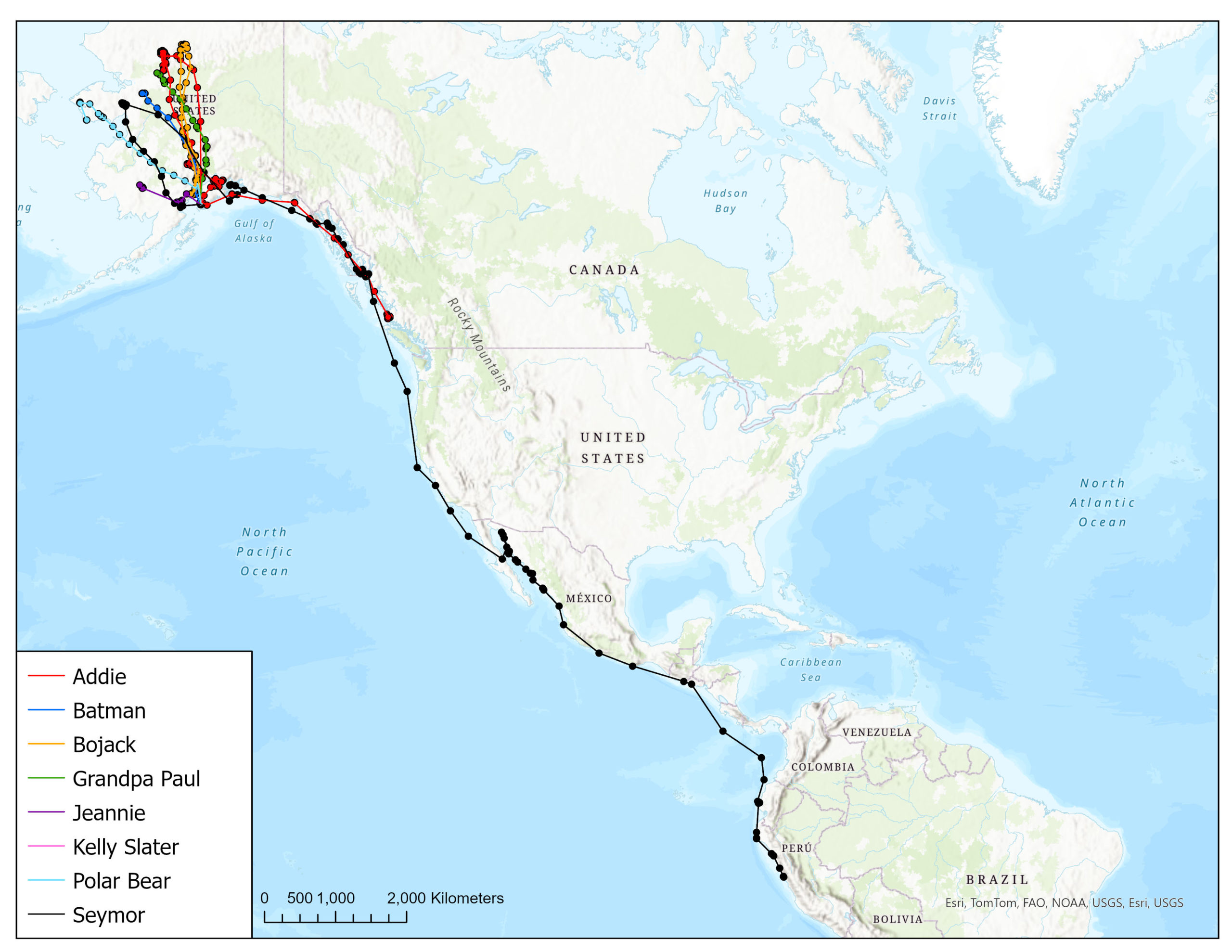
Modern technology is unsurprisingly very helpful in tracking birds that travel long distances in remote locations. Sam Simon’s Masters thesis for the University of Alaska Fairbanks uses lightweight geolocators attached to the birds in order to get a better understanding of where surfbirds travel throughout their breeding season. This project is ongoing, but thanks to the Homer Independent Press (Hoorn, 2026) and the Kachemak Bay Shorebird Festival (2026), the public has the opportunity to keep up with this study. This project was also assisted by junior birders at the Kachemak Bay Shorebird Festival, where they were allowed the privilege to name the eight teched-out surfbirds.
Study is still in progress:
Please follow this link to explore current geolocator data resulting from this study.
Does comparison between breeding calls of three closely related sandpipers agree with current phylogeny?
The study: Structure of breeding calls in three closely related bird species (Calidris Merrem, 1804; Scolopacidae)
This study aimed to compare and contrast the breeding calls of three closely related species within the Scolopacidae family (Miller et al. 2023).
Red Knot: Calidris canutus (Linnaeus, 1758)
Great Knot: Calidris tenuirostris (Horsfeld, 1821)
Surfbird: Calidris virgata (Gmelin, 1879)
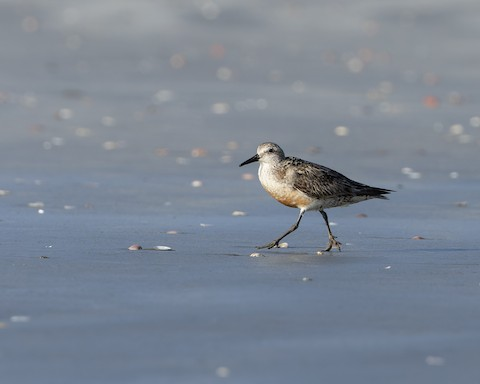
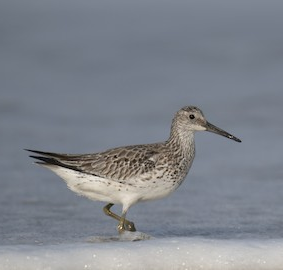
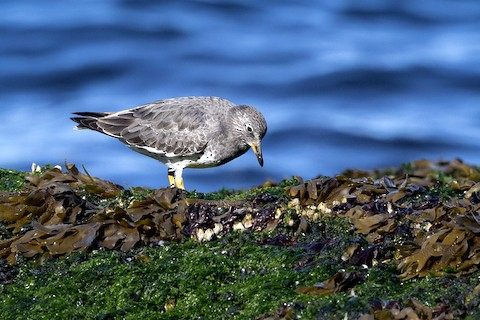

Shorebird phylogeny has vastly changed over the decades as genomics has become a more accurate measurement of classifying groups (Chesser et al. 2013). It is only in 2013 that the American Ornithologists’ Union has reclassified the surfbird under its current genus name Calidris.
These researchers compared three types of breeding calls. Two nuptial calls from males were used: Singing and rhythmically repeated aerial calls (RRC) (Miller et al. 2023). The third call was a general alarm trill (AT) which was used by both parents to protect their nest when threatened.
Their results showed that the surfbird and the great knot shared the most similarities in their calls which agrees with modern phylogeny that these two species are each others closest relatives.
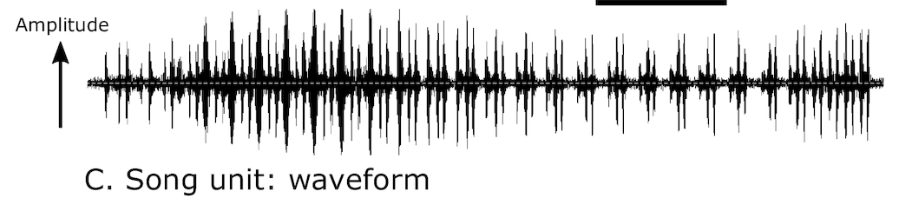
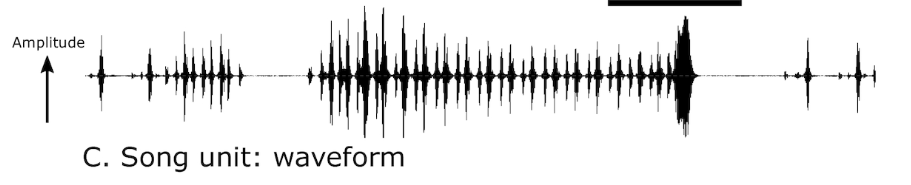
Further, they predicted that song would be the call with the greatest difference between the three species, but this proved incorrect. The great knot and the surfbird have very similar songs. The songs are both harsh because of “rapidly repeated, broadband compound pulsing”, compared to the longer of the red knot (Miller et al. 2023).
Great knot song
Surfbird song
Red knot song

Notice the similarity in short repetitive couplets in the analysis of the great knot and the surfbird, compared to the longer two part drone of the red knot’s song.
Study Conclusion
These three species breed in ecologically similar habitats. The red knot and surfbird both habitate Western Alaska. Their breeding behaviour and biology are also very similar (Senner and McCaffery, 2020). Therefore, differences in vocalisations between these species are likely the consequence of social selection or drift, and not the habitat type that they inhabit (Miller et al. 2023).
References
BirdLife International. (2024.) Calidris virgata. The IUCN Red List of Threatened Species 2024: e.T22693356A154445909. https://dx.doi.org/10.2305/IUCN.UK.2024-2.RLTS.T22693356A154445909.en.
Brady, M. (2011, January 9). ML45159611—Surfbird—Macaulay Library. https://macaulaylibrary.org/asset/45159611
De Ferari, T. (2026, October 7) ML666415012—Surfbird—Macaulay Library. https://macaulaylibrary.org/asset/666415012
Dixon, J. (1927). The Surf-Bird’s Secret. The Condor, 29(1), 3–16. https://doi.org/10.2307/1363003
Gordon. (2025, June 25). Surfbird: A Coastal Marvel of the Avian World. Simply Birding. https://www.simplybirding.com/birds/surfbird-calidris-virgata/
Hennige, K. (2026, September 6) ML666030898—Surfbird—Macaulay Library. https://macaulaylibrary.org/asset/666030898
Hiers, A. (2026, September 14) ML666358863—Surfbird—Macaulay Library. https://macaulaylibrary.org/asset/666358863
Jehl, Joseph R. (1968). “The Systematic Position of the Surfbird, Aphriza virgata” (PDF). The Condor. 70 (3): 206–210. doi:10.2307/1366692. JSTOR 1366692
Miller, E. H., Tomkovich, P. S., Arkhipov, V. Yu., & Handel, C. M. (2023). Structure of breeding calls in three closely related bird species (Calidris Merrem, 1804; Scolopacidae). Canadian Journal of Zoology, 101(10), 869–885. https://doi.org/10.1139/cjz-2022-0211
Monteiro, P. (2025, December 10). Habitat use and foraging ecology of two sympatric shorebirds in coastal British Columbia. Simon Fraser University. https://summit.sfu.ca/item/40291
Senner, S. E. and B. J. McCaffery (2020). Surfbird (Calidris virgata), version 1.0. In Birds of the World (A. F. Poole and F. B. Gill, Editors). Cornell Lab of Ornithology, Ithaca, NY, USA. https://doi.org/10.2173/bow.surfbi.01
Sibley, David A. (2016). The Sibley Field Guide to Birds of Western America. (2nd ed.). Knopf.
Surfbird | Audubon Field Guide. (n.d.). Retrieved October 8, 2026, from https://www.audubon.org/field-guide/bird/surfbird
Surfbird Identification, All About Birds, Cornell Lab of Ornithology. (n.d.). Retrieved October 7, 2026, from https://www.allaboutbirds.org/guide/Surfbird/id
Surfbird Overview, All About Birds, Cornell Lab of Ornithology. (n.d.). Retrieved October 7, 2026, from https://www.allaboutbirds.org/guide/Surfbird/overview
Surfbird—Complete Species Guide | BirdLookUp.com. (n.d.). Retrieved October 8, 2026, from https://birdlookup.com/birds/surfbird