Getting to Know The Smallest Hawk in North America
Let’s set the scene. You find yourself in a dark, closed-canopy boreal forest. Suddenly, a tiny flash of dark brown and grey expertly weaves around a tree and rushes past you. You turn your head just in time to witness it intercept a Rock Dove perched in a nearby tree. In a matter of seconds, you’ve witnessed a Sharp-shinned Hawk (Accipiter striatus) in action! Small and agile, this elusive forest predator can be surprisingly difficult to spot. So, if you’re lucky enough to catch a glimpse, you’d better have your camera ready!
Name sake
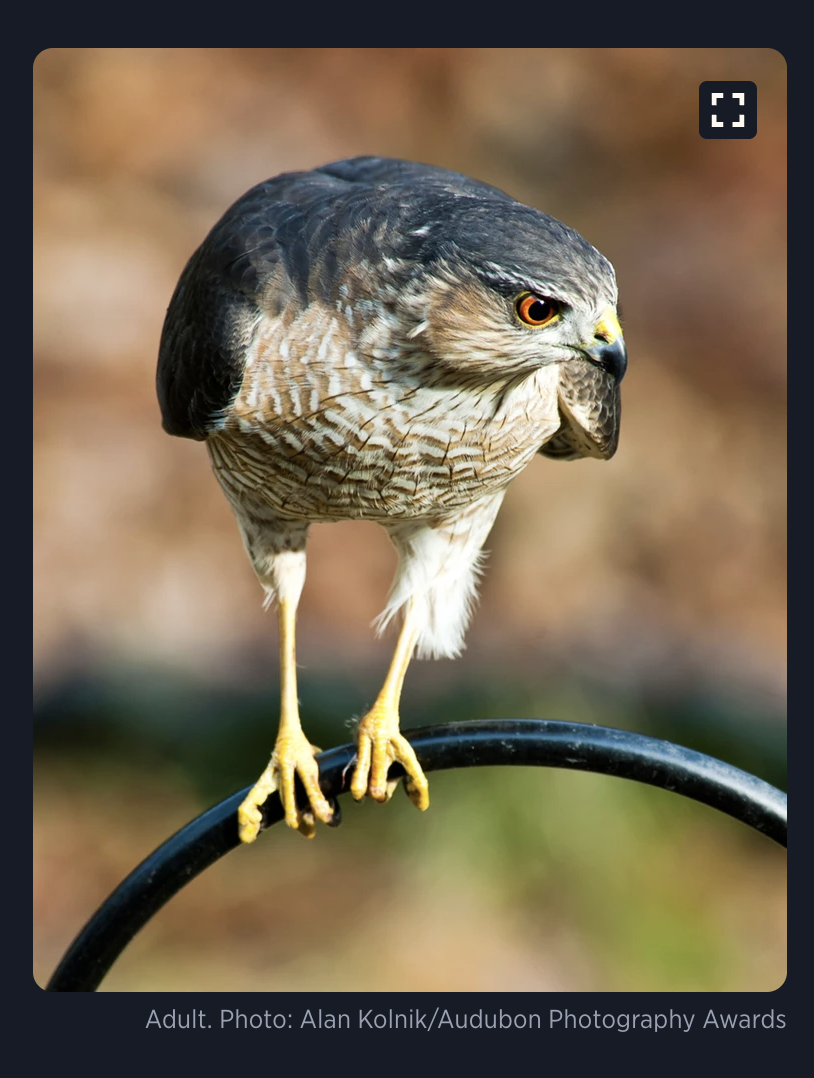
The Sharp-shinned hawk, lovingly nicknamed “Sharpie”, gained it’s English name from it’s unusually long and slender legs which house a laterally compressed keel or ridge along the leading edge of its long, pencil-thin legs. Its binomial, or “scientific” name, Accipiter striatus, comes from the latin words for “hawk” (Accipiter) and striped (striatus). So basically this guy is just a sharp stripy hawk. The below photo is an excellent showcase of their runway ready legs, noticing the shin bone width and length.
Twins?
A big problem with tracking and recording sightings for conservation or education for the Sharp-shinned hawk is their far more common dopplerganger, The Cooper’s Hawk (Accipiter cooperii). It is extremely difficult to tell these two apart, especially as juveniles. Up close, there are a few differences that help us determine which small hawk we are looking at:
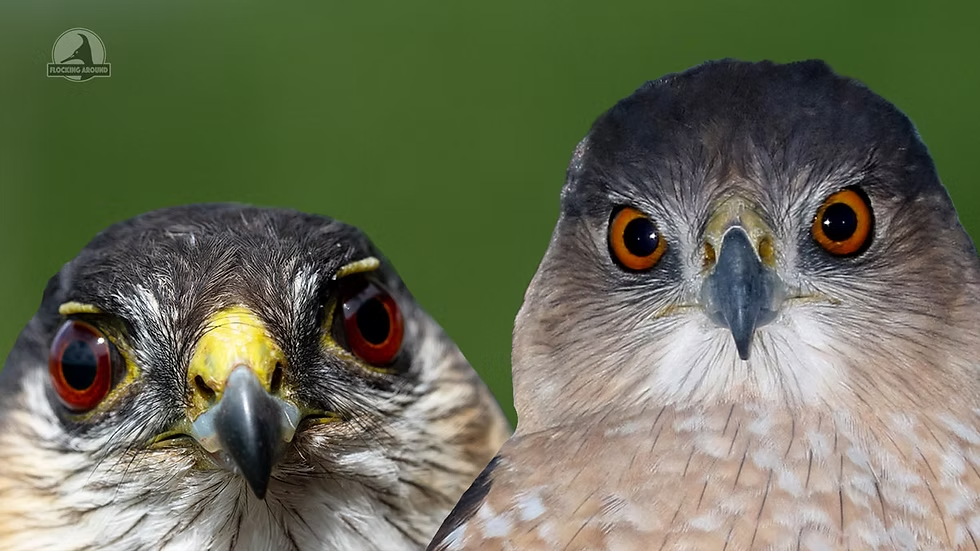
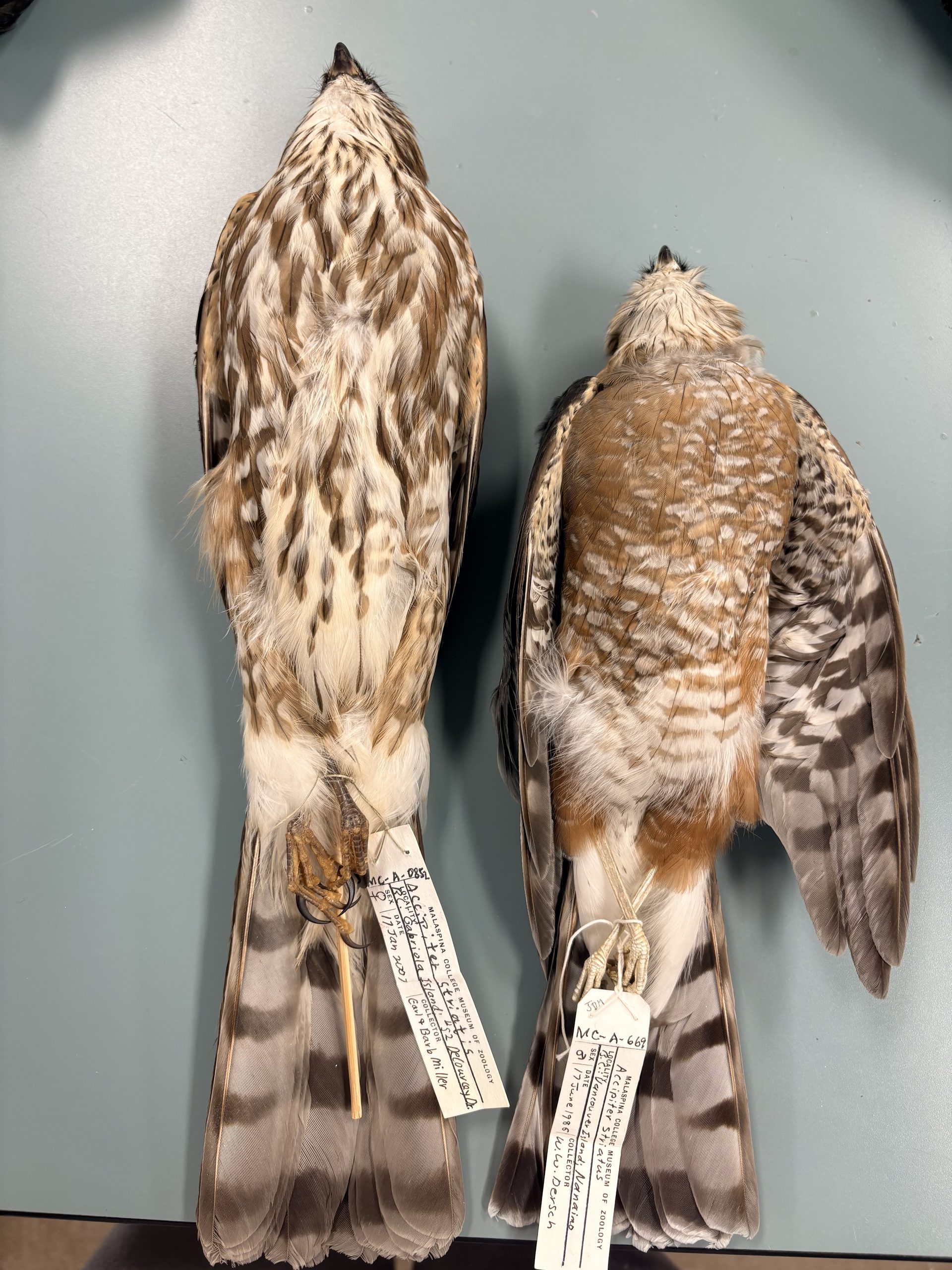
In the above image, we can notice a few key differences. On the left, the Sharpie has a much more intense and off-putting red eye colour when compared to the lighter orange of the Cooper’s on the right (one caviet of that is that the Sharpie has orange eyes as a juvenile). Another big difference is tail shape, the Sharpie has a squared tail shape since all the retrices (tail feathers) are the same length, while the Cooper’s has a much more rounded shape. Finally, the Sharpie is generally quite a bit smaller than the Coopers, however, the females of both species are nearly double the size of the males, showing reverse sexual dimorphism as shown below:
Wardrobe
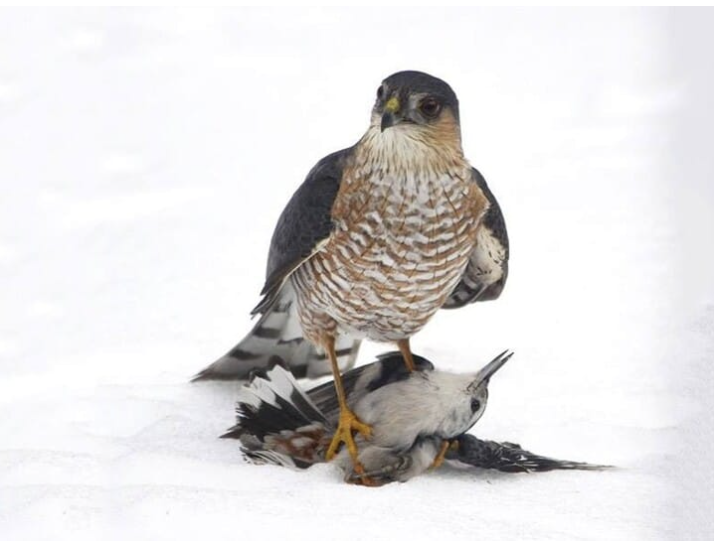
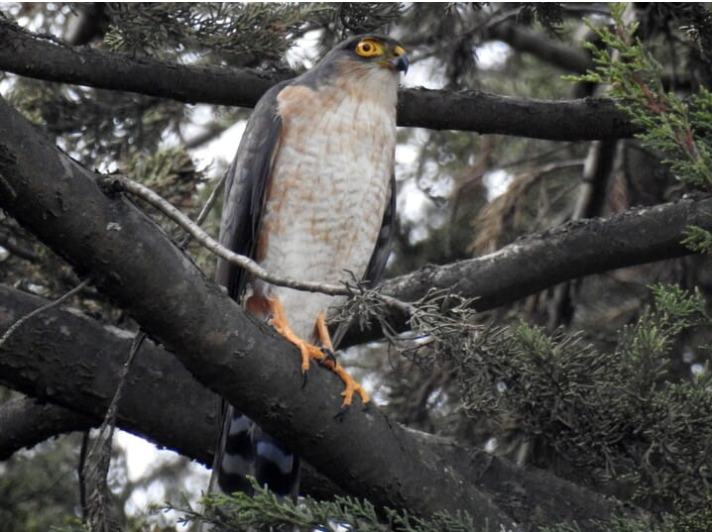
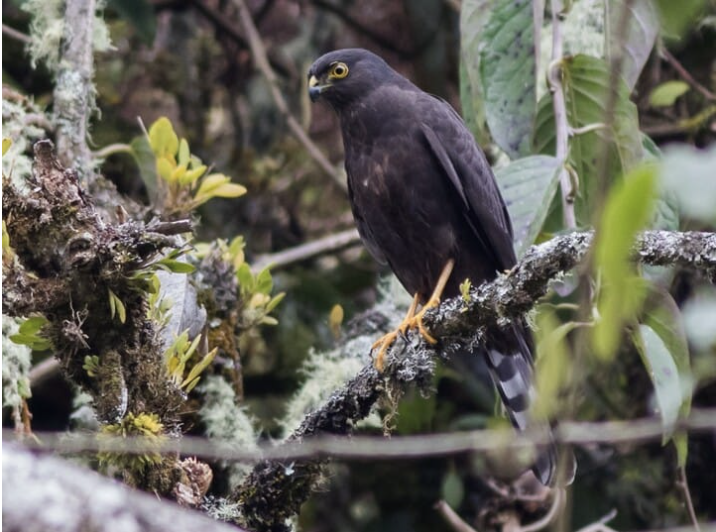
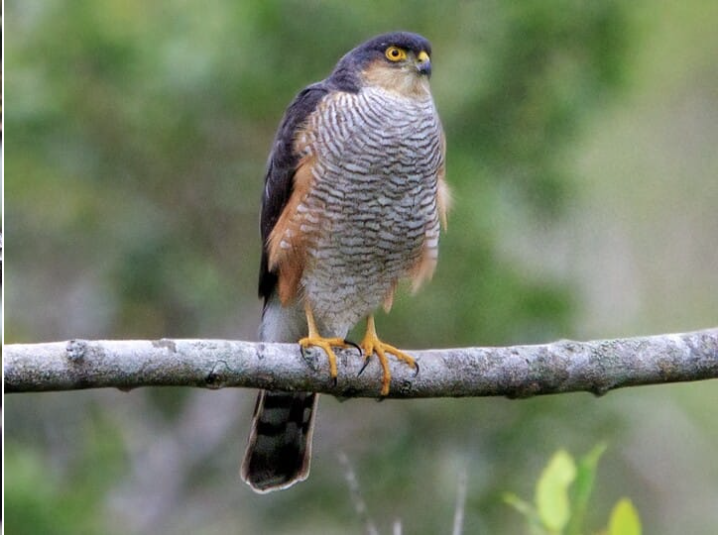
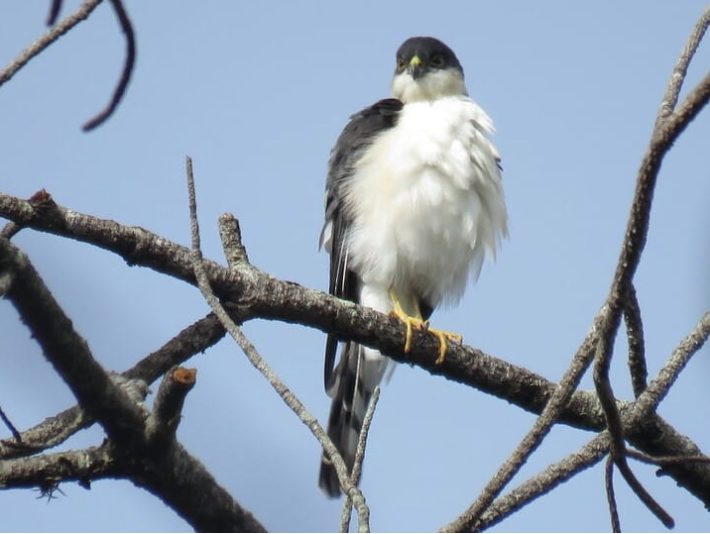
Sharp-shinned Hawks have a few different looks depending on their age and geographic location, so apparently, even hawks like to switch things up! Adults typically have blue-grey backs, dark crowns, and white underparts covered in rusty-red horizontal bars. Their long, banded tails usually finish with a narrow white tip. Juveniles, on the other hand, look like they haven’t quite settled on their adult wardrobe yet, with brown upperparts and pale bellies covered in dark vertical streaks. Plumage also varies between subspecies: the perobscurus subspecies found on Haida Gwaii tends to be darker with heavier markings, while the Mexican suttoni is generally paler. Some populations even have dark colour morphs, proving that these little hunters come in more than one outfit!
Calls and sounds
Sharp-shinned Hawks are generally quiet and inconspicuous outside of the breeding season, but become much more vocal during courtship and nesting. Their most recognizable call is a rapid series of high-pitched, sharp “kik-kik-kik” notes, often used as an alarm or in response to intruders near their nest. They also produce softer calls during courtship and communication between mates. Despite their small size, their calls are surprisingly loud and piercing, making them easier to hear than to spot in dense forest habitat.
Feeding Mode and Diet
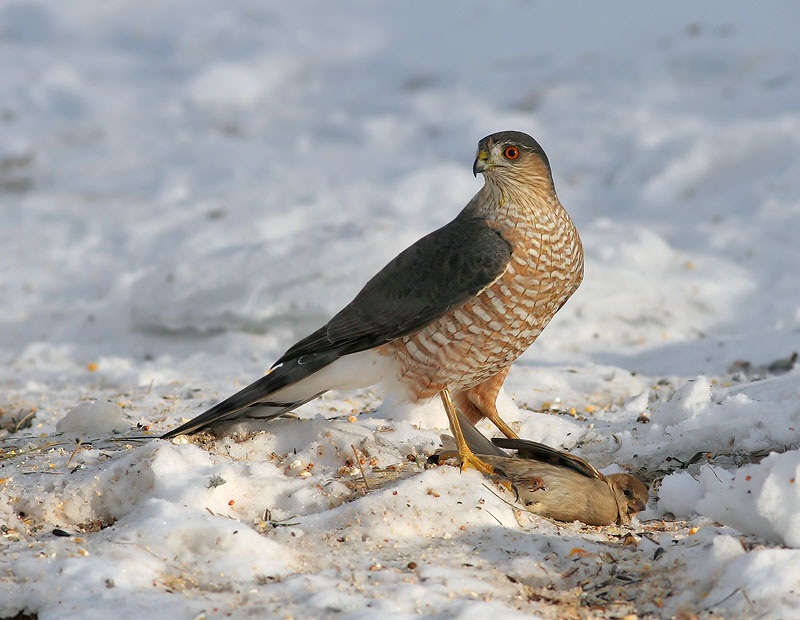
Despite being the smallest hawk in North America, the Sharp-Shinned hawk is a fearsome predator. Named for this ability, these tiny birds of prey have unusually long and slender legs adapted for catching and squeezing smaller birds and sometimes rodents. Being stealth and sneaky hunters, they rely on the cover of dense forest or brush to suprise their prey either in the air or on the ground. It is usually a quick, high speed chase. Their diet mostly consists of songbirds, however, they will also go after birds the same size or bigger than themselves. American Robins, Rock Doves and European Starlings are all frequently on the dinner table.
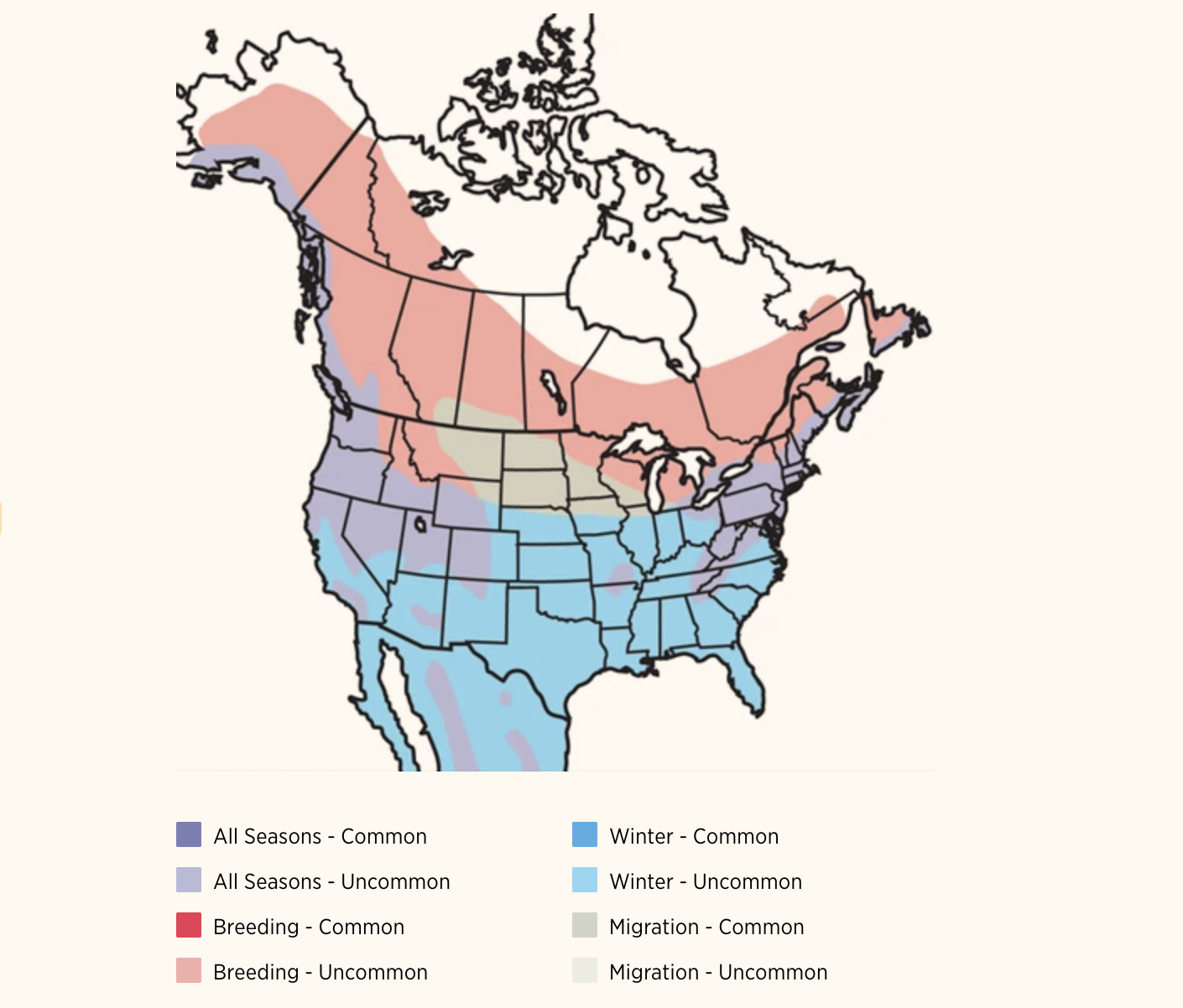
Distribution and Migration
Something you might not know about hawks is that some species will migrate. This includes the Sharp-shinned hawk. Their migration pattern is a broad-front continental movement across North America. They over-winter (they do not do well in the Canadian cold, since their tiny bodies lose heat fast!) in the southern states, all the way down to central America (as far as Panama!) where they become much easier to spot. This is their fall migration (September-November), and the peak time to view them. Northern populations leave Canada and the northern US, moving south in massive numbers (although they are moving as individuals, not in a flock). Once in their summer home, they enjoy backyard or oak forest hunting grounds where they have abundant prey. When the time comes for them to breed, they make their way back up north in a spring migration (March-May) to the boreal forests where they become quite secretive. Because they hug ridges to catch updrafts, they concentrate along famous “hawk highways.” Key viewing points include Hawk Mountain in Pennsylvania, the shores of the Great Lakes, and the Rocky Mountain ridges. Theres an exception to every rule however, and so there is a population of Sharp-shinned hawks in the central U.S. that stay there all year round, and this is a common pit stop for migrating individuals to catch their breath, or even stay over the winter months.
Conservation: A Small Hawk with a Big History
Despite being a skilled predator, the Sharp-shinned Hawk hasn’t always had it easy. During the mid-1900s, populations declined significantly due to widespread pesticide use, particularly DDT, which interfered with reproduction in birds of prey. Following restrictions on these chemicals, populations began recovering. Today, the species is considered relatively secure, although habitat loss, environmental contaminants, and changes in prey availability remain concerns. Their recovery is a good reminder that even the smallest of hunters can be affected by human activity.
What Can Recent Scientific Research Tell Us About the Sharp-shinned Hawk?
1. Diet and Prey Selection: What Is on the Menu?
Although Sharp-shinned Hawks are known primarily as bird predators, understanding exactly what they eat and how they select their prey has been more challenging than it might seem. A 2026 study by Gibson et al. used citizen-science photographs uploaded to iNaturalist to investigate the diets of Sharp-shinned Hawks and Cooper’s Hawks. By examining documented predation events, researchers were able to identify prey species and investigate patterns in prey selection.
The study examined 74,974 photographs of both hawk species and identified 619 predation events involving Sharp-shinned Hawks. The researchers found that Sharp-shinned Hawks primarily selected smaller songbirds (Passeriformes), although pigeons and doves (Columbiformes) were also selected as prey. Interestingly, the study identified differences in prey preferences between the two hawk species, with the smaller Sharp-shinned Hawk showing a stronger preference for smaller-bodied birds. The researchers also found that both species displayed a bimodal pattern of prey size selection, meaning that prey items tended to fall into two general size groups.
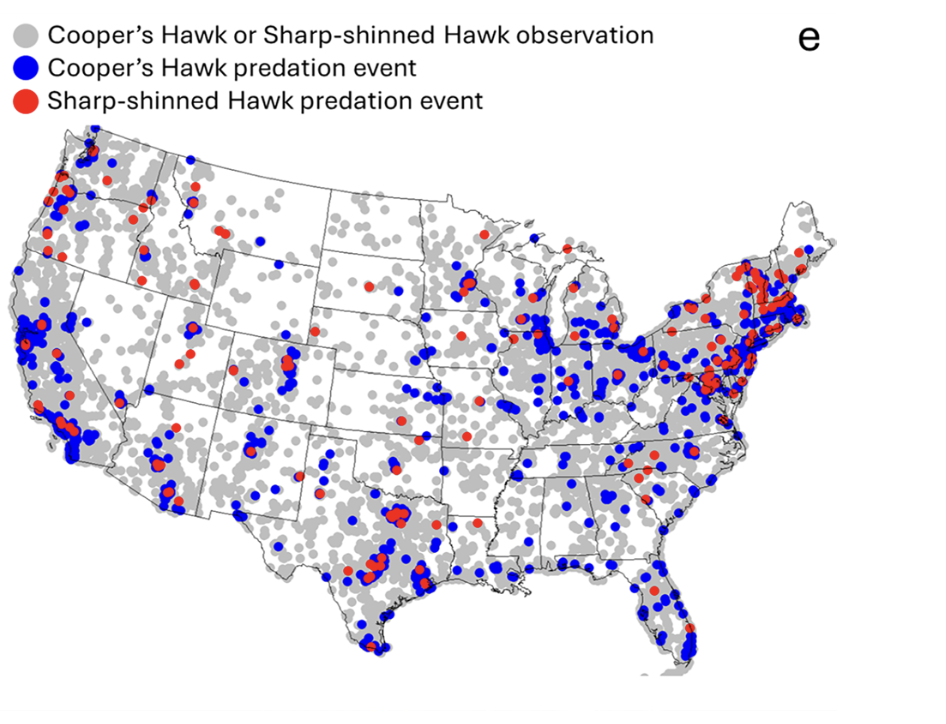
(E) A map of the continental United States showing all Astur
cooperii and Accipiter striatus observations (gray), Astur cooperii predation events (blue), and A. striatus predation events (red). (Gibson et al., 2026).
This research demonstrates how citizen science can contribute to our understanding of wildlife ecology. Photographs submitted by the public provided researchers with a much larger collection of feeding observations than might otherwise be possible through traditional field studies. It also provides further insight into how body size and prey availability influence hunting behaviour in these two closely related predators (Gibson et al., 2026).
2. Environmental Contamination: Mercury in the Food Web
As predators, Sharp-shinned Hawks occupy an important position within forest food webs. However, their position as consumers of other animals can also expose them to environmental contaminants that accumulate throughout the food chain. One example is mercury, a naturally occurring element that can become concentrated in organisms through a process called bioaccumulation.
A 2020 study by Keyel et al. investigated the relationship between feeding habits and mercury concentrations in the feathers of two migratory raptors: the Merlin (Falco columbarius) and the Sharp-shinned Hawk. Researchers examined feather mercury concentrations alongside information about the birds’ diets and feeding positions within the food web.
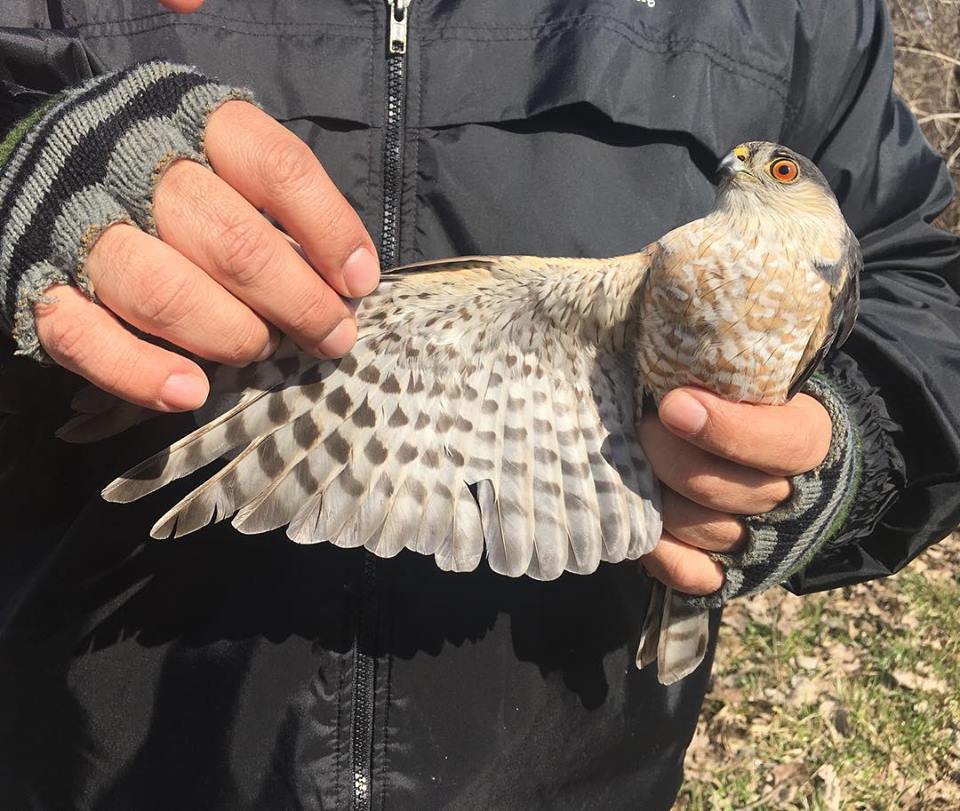
The researchers found that feather mercury concentrations increased with feeding at higher trophic levels. In other words, birds consuming prey from higher positions in the food chain tended to have greater mercury concentrations in their feathers. This is important because mercury can accumulate in organisms and become more concentrated as it moves through food webs, a process known as biomagnification.
Feathers are particularly useful for studying mercury exposure because mercury can become incorporated into growing feathers. This allows researchers to examine contamination without relying entirely on blood or internal tissue samples. The findings demonstrate how a predator’s feeding ecology can influence its exposure to environmental contaminants. They also highlight the importance of understanding food-web relationships when studying the environmental health of raptor populations (Keyel et al., 2020).
References
Birds Canada. (n.d.). Sharp-shinned Hawk. NatureCounts. https://naturecounts.ca/nc/socb-epoc/species.jsp?sp=shshaw
Bourbour, R. P., Aylward, C. M., Meehan, T. D., Martinico, B. L., Badger, M. E., Goodbla, A. M., Fish, A. M., Ely, T. E., Briggs, C. W., & Hull, E. M. (2024). Feeding en route: Prey availability and traits influence prey selection by an avian predator on migration. Journal of Animal Ecology, 93(9), 1176–1191. https://doi.org/10.1111/1365-2656.14122
Ely, T. E., Bourbour, R. P., Dudek, B. M., Fish, A. M., Hull, A. C., Martinico, B. L., Skalos, S. M., Souza, L. E., & Briggs, C. W. (2025). Rings and pings: Band encounters and Motus elucidate the overwintering locations and movements of Sharp-shinned Hawks in western North America. Journal of Raptor Research, 60(1), 1–11. https://doi.org/10.3356/jrr2523
Gibson, W. J., Miller, E. T., Eling, A. M., & McNeil, D. J. (2026). Citizen science provides an unprecedented glimpse into the diets of Astur cooperii (Cooper’s Hawk) and Accipiter striatus (Sharp-shinned Hawk). Ornithology, 143(3), 1–9. https://doi.org/10.1093/ornithology/ukag008
Joy, S. M. (1994). Feeding ecology of Sharp-shinned Hawks nesting in deciduous and coniferous forests in Colorado. The Condor, 96(2), 455–467. https://doi.org/10.2307/1369328
Keyel, E. R., Etterson, M. A., Niemi, G. J., Evers, D. C., DeSorbo, C. R., Hoffman, J. C., Nichols, J. W., Li, Y., & Nicoletti, F. (2020). Feather mercury increases with feeding at higher trophic levels in two species of migrant raptors, Merlin (Falco columbarius) and Sharp-shinned Hawk (Accipiter striatus). The Condor, 122(2), 1–17. https://doi.org/10.1093/condor/duz069
National Audubon Society. (n.d.). Sharp-shinned Hawk. Audubon. https://www.audubon.org/field-guide/bird/sharp-shinned-hawk
Sanchez, A. (2018, April 13). Banding station briefs: Sharp-shinned Hawk (Accipiter striatus). Black Swamp Bird Observatory. https://www.bsbo.org/bsbo-research-blog/sharp-shinned-hawk-accipiter-striatus
Xeno-canto. (n.d.). Sharp-shinned Hawk vocalization [Audio recording]. https://xeno-canto.org/710944
Zach. (n.d.). Sharp-shinned Hawk vs. Cooper’s Hawk identification. Flocking Around. https://www.flockingaround.com/post/sharp-shinned-hawk-vs-coopers-hawk-identification
Wommack, E. A., Marrack, L. C., Mambelli, S., Hull, J. M., & Dawson, T. E. (2020). Using oxygen and hydrogen stable isotopes to track the migratory movement of Sharp-shinned Hawks (Accipiter striatus) along Western Flyways of North America. PLOS ONE, 15(11), e0226318. https://doi.org/10.1371/journal.pone.0226318