It’s early in the morning and you’re sitting outside of your favourite coffee shop. Wisps of steam lazily drift from your cup, climbing toward a sky generously painted in all shades of dawn. You pay no mind to the sluggish jam of traffic as it crawls by, nor do you heed the snippets of chatter from the kindred spirits sitting around you, guided back to life by their own hot beverages. Perhaps too hot. You’ve decided to work on your croissant until your coffee has cooled enough to spare your tongue. It is in that moment, as you are enjoying your pastry, that you hear a cavalry of familiar sounds.
Squee! Chuk, chuk! T-zhreeee!
Despite the paper you spent the better half of the night crying over, you cannot help but smile now, your spirit reinvigorated as you gaze upon the flock of grey-brown and glossy-black birds. Euphagus cyanocephalus, the humble Brewer’s blackbird! They’re not too subtle about their desire for your breakfast; luckily, as an avid birder, you never go anywhere without a handful of birdseed in your pocket. Now, as you sip gingerly at your coffee, watching the little birds peck at their bounty, you begin to feel renewed. It’s hard to have a bad day when you see the sunrise hit those sleek feathers. A chorus of metallic greens and blues shimmering across lustrous black. A modest hymn of foggy greys and browns.
Description & Identification
The Brewer’s blackbird is a member of the Icterid family, otherwise known as the New World Blackbirds, nestled comfortably within the Order Passeriformes (iNaturalist, n.d.) alongside other perching birds. Brewer’s blackbirds are around the size of an American robin—20-25 cm long with a wingspan of 37 cm, weighing in at a whopping 50-86 grams—with males being slightly larger than females on average. Their bodies and heads are round, balanced by a lengthier tail and legs, as well as a pointed bill with a thick base (All About Birds, n.d.). Their wings and tails bear a rounded shape, with the tail being square-tipped (Audubon, n.d.).
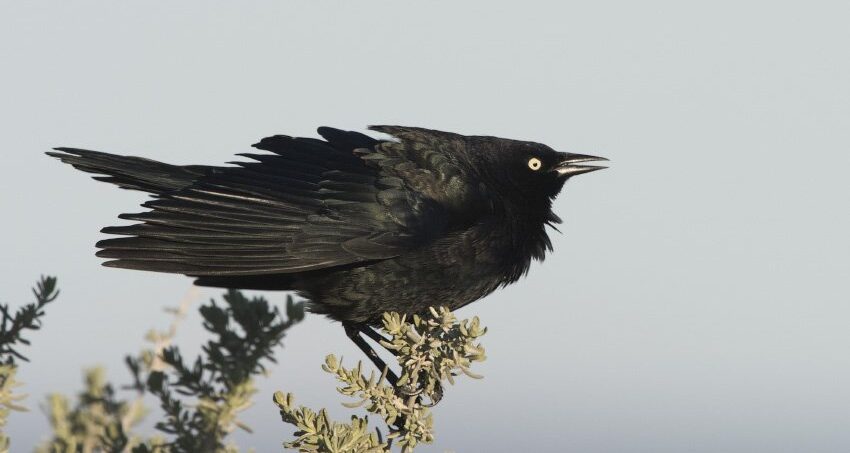
These charismatic little birds are perhaps most recognizable by the plumage of the males, being a deep, shiny black highlighted with an iridescent sheen that ranges from green, to blue, to purple. The head in particular is where that purple really stands out, often darker relative to the rest of the bird. Males also sport striking yellow eyes—a stand-out feature amid the darker shades of their bills, legs, and plumage (All About Birds, n.d.).
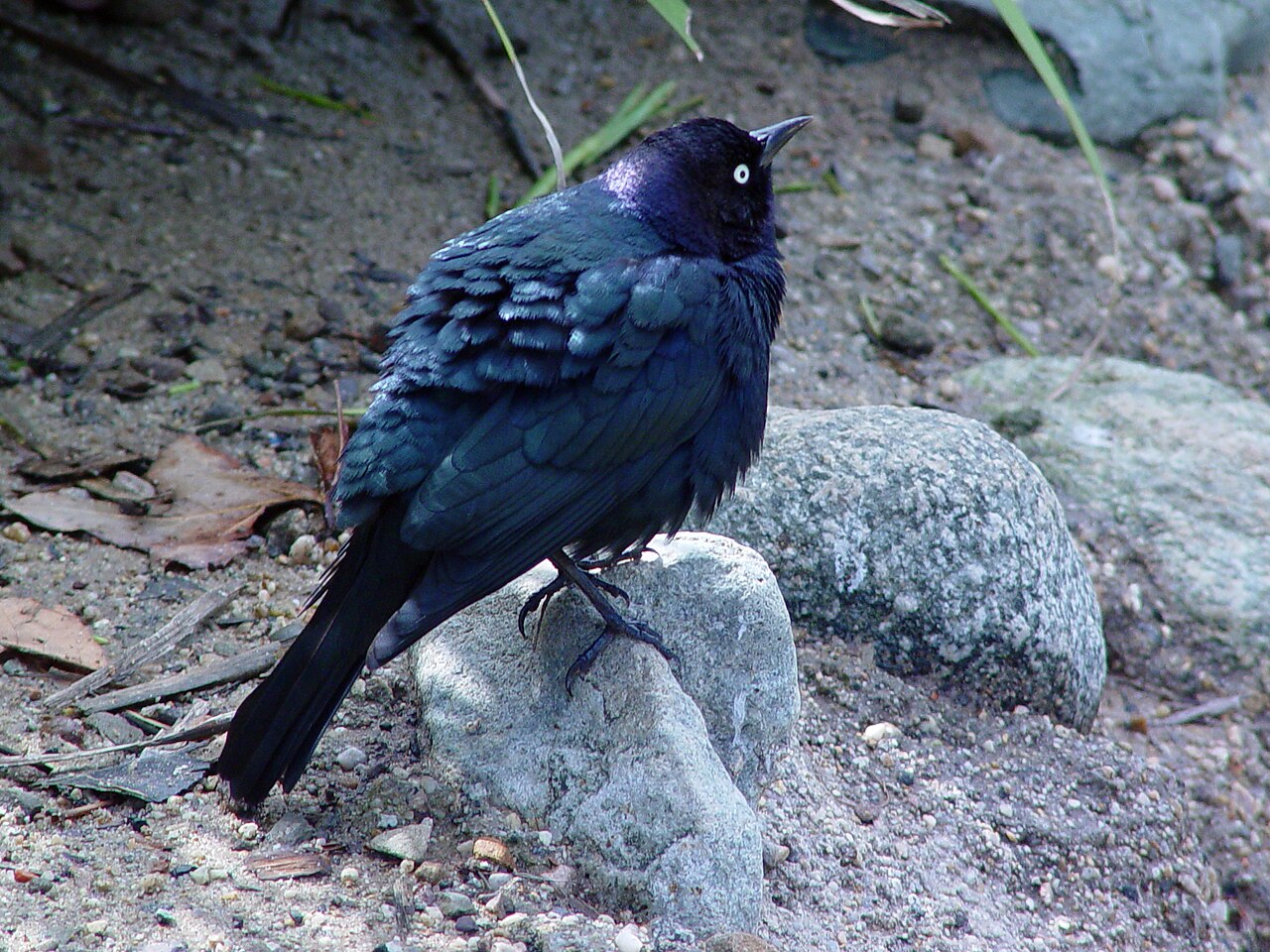

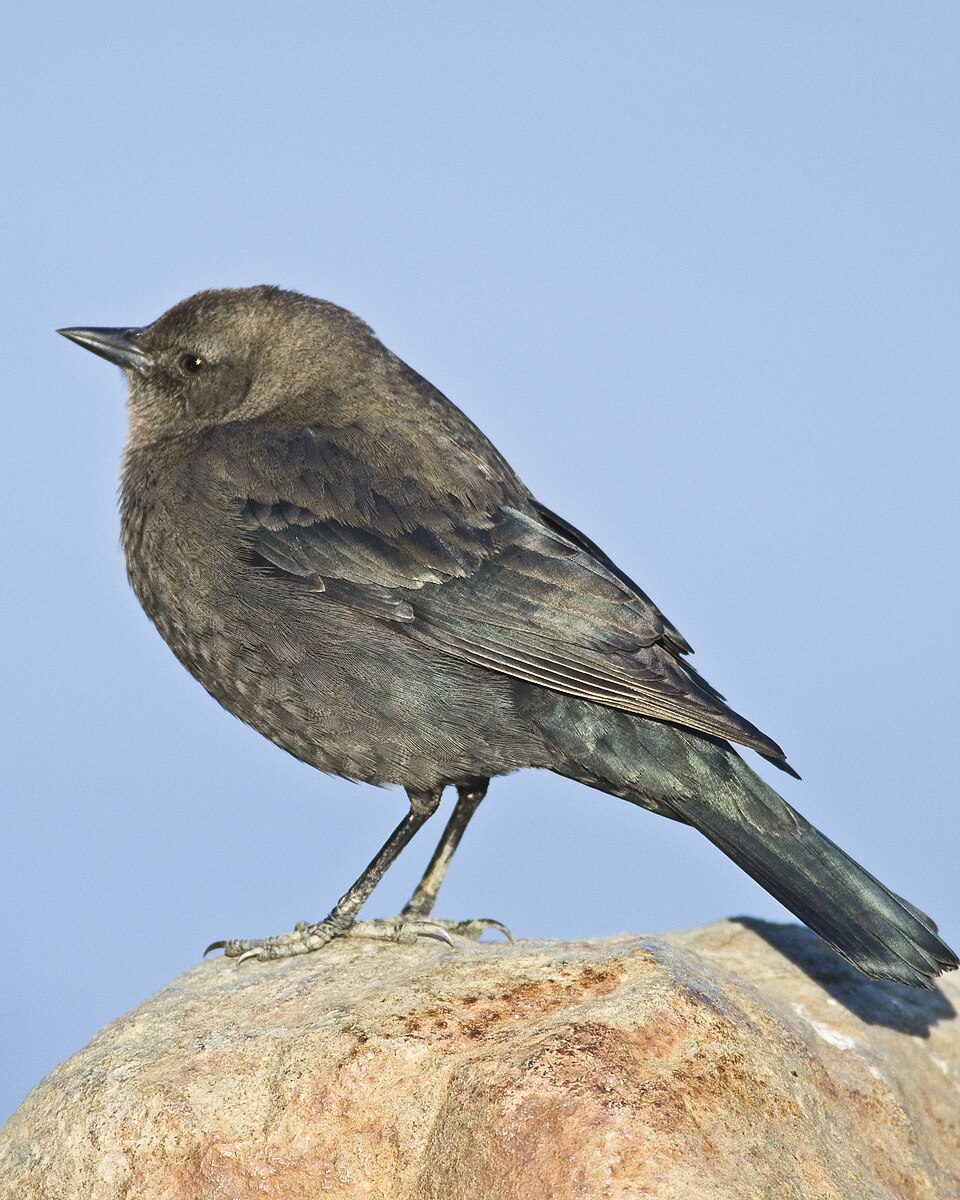

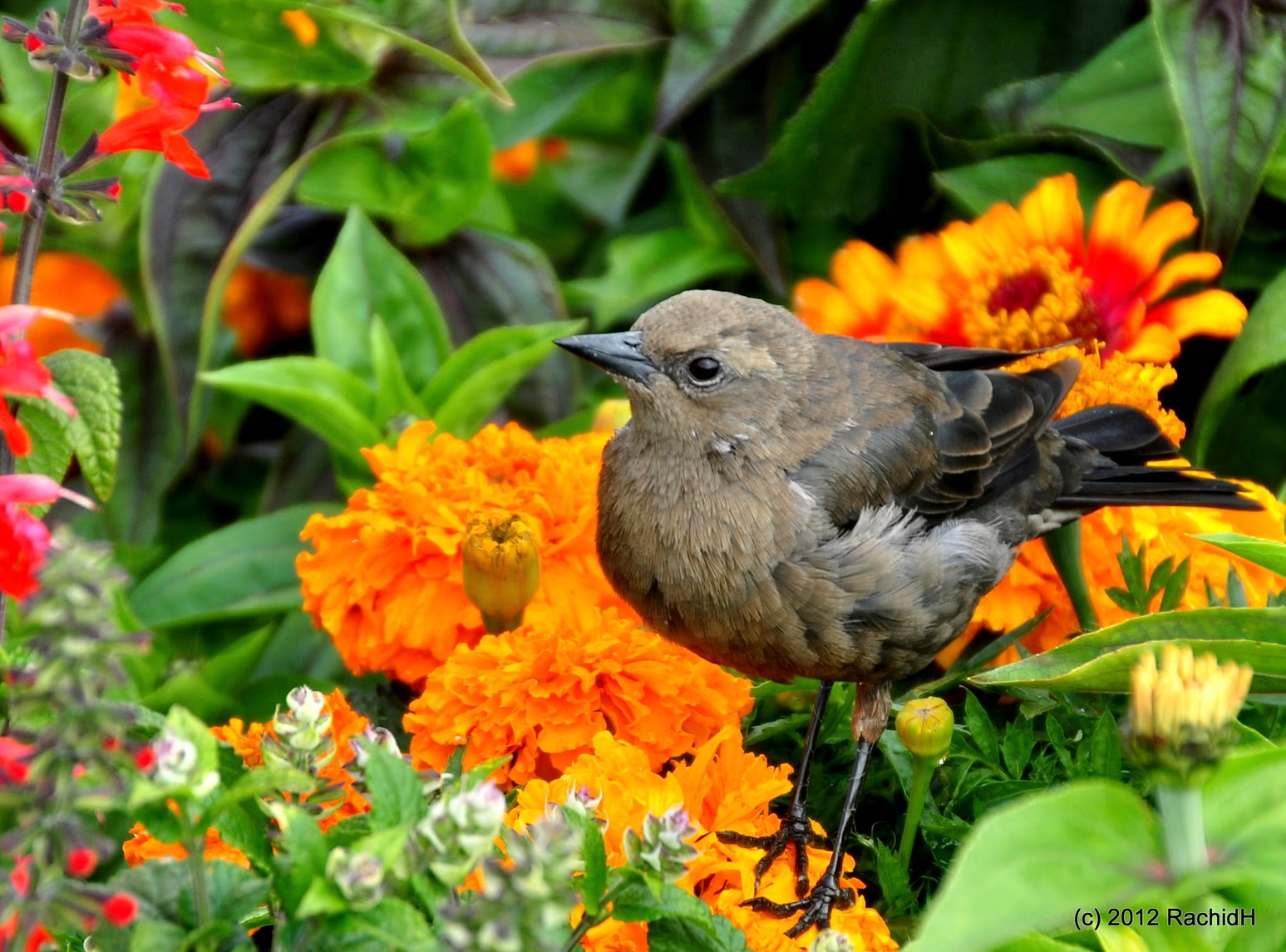
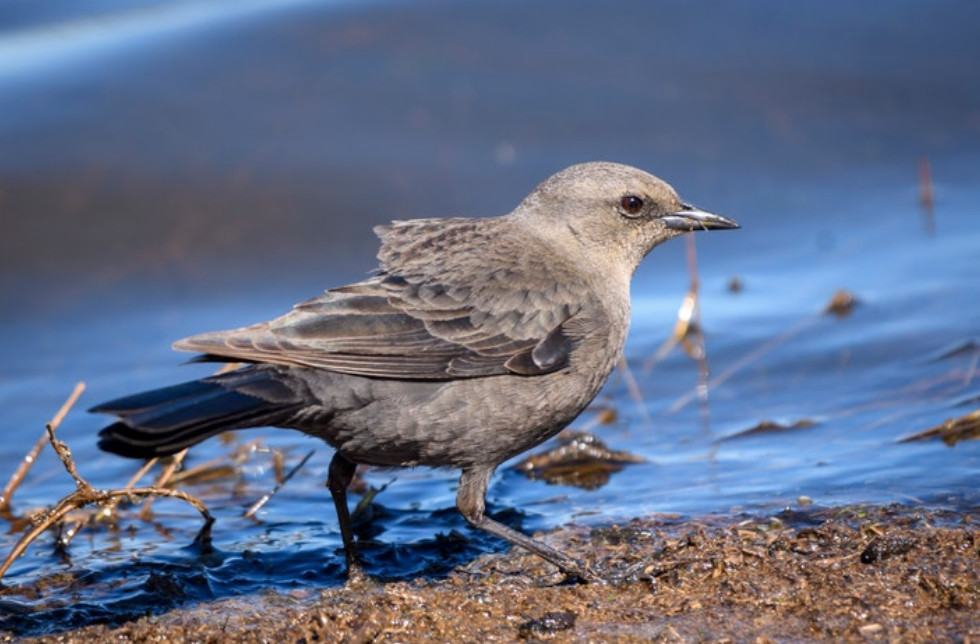
That is of course not to discredit the females, which are often overlooked for their relatively dull colouration. The plumage of female Brewer’s blackbirds is a muted shade of grey-brown, and while females are at large much lighter and less vibrant than their male counterparts, whispers of that glossy iridescence persist along their back, wings, and tail, subtly breaking up their otherwise uniform plumage. Females also do not typically share the bright pale eyes of the males, trading it for a deep shade of brown (iNaturalist, n.d.). Juveniles, too, are grey-brown, although they tend to be lighter than mature females (All About Birds, n.d.).
Males and females alike are identifiable by their shrill, rushing songs and their chittering, whistling calls, bearing a resemblance to those of other blackbird species. Listen for a squee, or a metallic gurgle, or a chuk, and there’s a good chance that the bold Brewer’s blackbird is the culprit (All About Birds, n.d.).
Distribution & Habitat
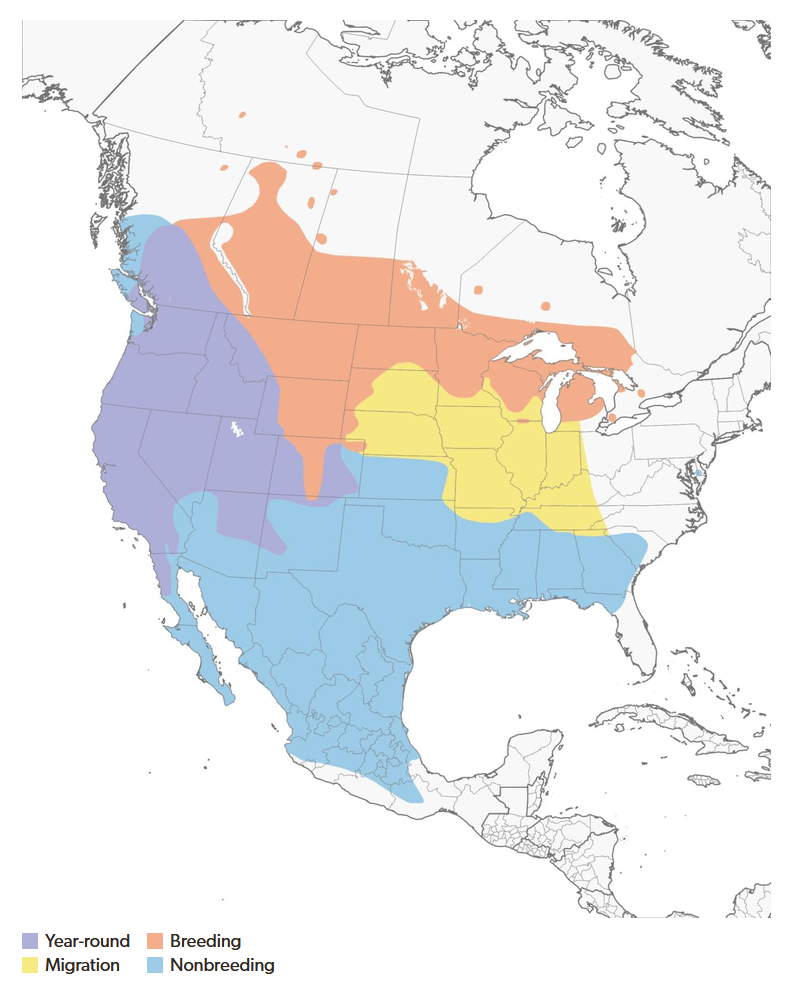
Brewer’s blackbirds have a fairly wide range, their distribution spanning from permanent residences in western North America, through breeding and migratory regions across the centre of the continent, and to the Southeastern United States and Mexico, where many reside in the nonbreeding season (iNaturalist, n.d.) during the winter months. Their migration back North generally occurs early in the spring season, and their range shifts East when the autumn months arrive again (Audubon, n.d.).
Across this wide expanse, Brewer’s blackbirds tend to favour open or semi-open habitats, particularly grasslands and meadows—or parks, lawns, and golf courses, where areas of human development are concerned (All About Birds, n.d.)—along with farmland, shrubby waterside spaces, and some woodland areas (Audubon, n.d.). While Brewer’s blackbirds aren’t associated as strongly with forests and shrubland in comparison to more open habitats, they nevertheless display an impressive level of flexibility when it comes to selecting habitats, able to benefit from essentially any semi-natural or semi-productive area (Strassburg et al. 2015, p. 174). This adaptability is perhaps most remarkable in the face of human-developed lands, where even the city streets serve as a common stage for the Brewer’s blackbird, minimally perturbed by the presence of people.
Ecology
Behaviour
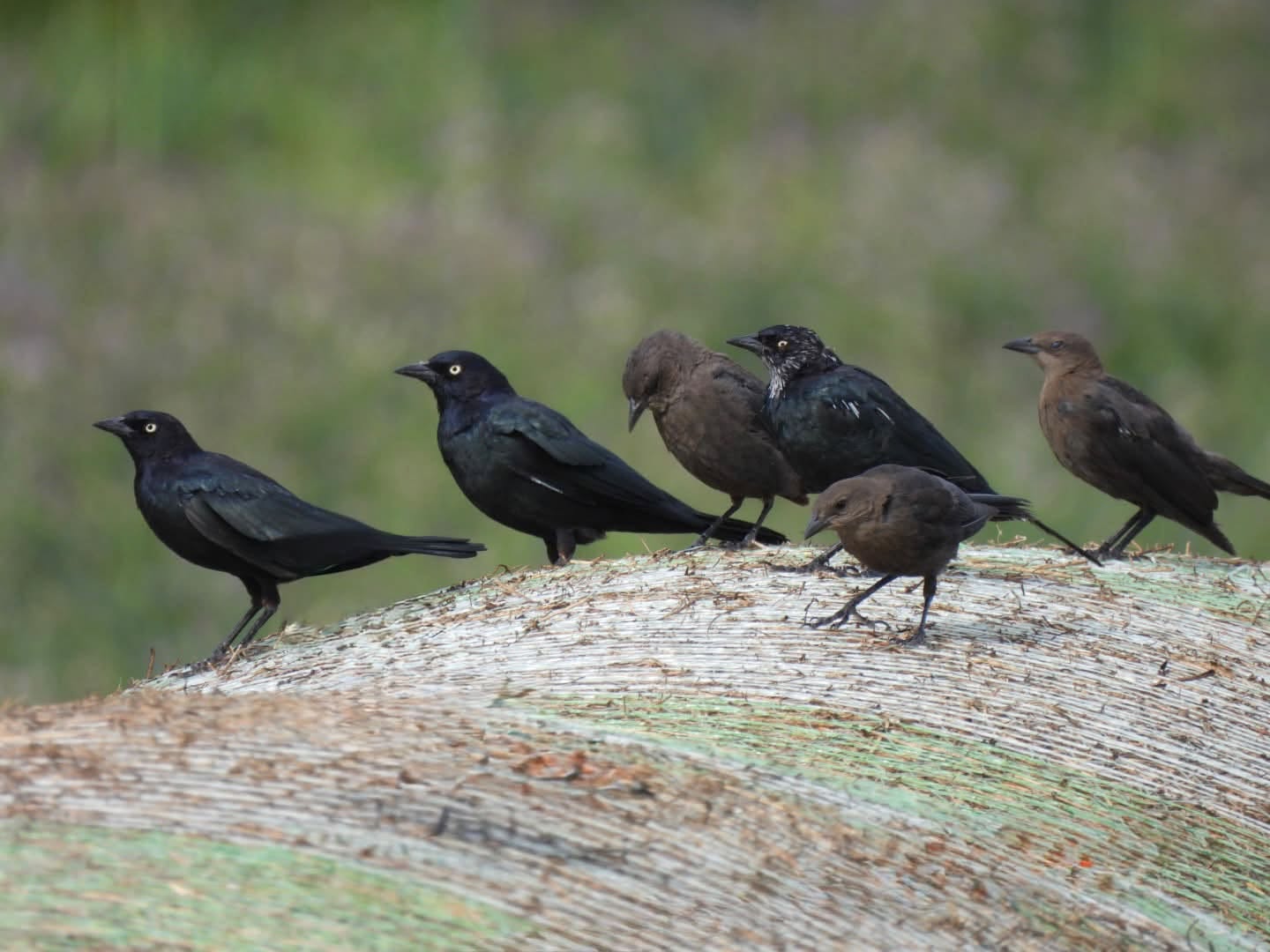
Brewer’s Blackbirds are social birds, more often than not spotted in small flocks. This is especially true during the colder parts of the year, where they may forage together, sometimes accompanied by other blackbird species, while their foraging behaviour becomes more independent during the nesting season (iNaturalist, n.d.). They can be spotted strutting around open-ground areas, heads bobbing and jerking along the way, or perching together in trees and on power-lines. While flocks are searching for food, often accompanied by other foraging species, males will stand guard and call out—or sometimes attack—when they notice predators nearby (All About Birds, n.d.).
Diet
As Brewer’s blackbirds are an adaptable, generalist species, it’s no surprise that their diet is incredibly variable. Brewer’s blackbirds favour insects, as well as other small invertebrates, such as arachnids and snails. They are also partial to seeds, grains, berries (Audubon, n.d.), and whatever has been dropped beneath the tables outside of restaurants. Brewer’s blackbirds will even eat small vertebrates, such as frogs, voles, and a selection of nestlings from other bird species (All About Birds, n.d.). In addition to feeding on the ground or in shallow water, Brewer’s blackbirds have even been known to follow plows across fields to snatch the insects left in their wake (iNaturalist, n.d.).
Reproduction
After a male has successfully impressed a female by puffing out his feathers and making himself look large, a pair is formed. While mated birds do not stick together year-round, they will often reunite when the next mating season comes around, both parents involving themselves in nestling care (iNaturalist n.d.). Nests will often house clutch sizes of 3-7 speckled eggs; remarkably, once the first few females have chosen a site to nest, they may soon be joined by others nearby, forming colonies of up to 100 pairs (All About Birds, n.d.). This colonial nesting behaviour may also serve to help nesting birds forage, for food, as when one bird finds a rich food source, other birds are soon to follow (Horn, 1968, p. 692).
Conservation Status
Brewer’s blackbirds are currently classified as “Near Threatened” on the IUCN Red List. While Brewer’s blackbirds boast an impressive range, adaptive behaviours, and population between 15,000,000 and 25,000,000 adults, their numbers have declined 12-24% over the past decade (IUCN, 2025). While the decline in Brewer’s blackbird populations is not exactly known, collisions, nesting disruptions, and direct human interference (in the case of trapping, shooting, or poisoning) are believed to be the main issues (IUCN, 2025). Climate change, too, may present as a challenge to Brewer’s blackbirds, threatening the species with wildfires and a loss of range (iNaturalist, n.d.).
Interesting Tidbits
Prey Dunking
While many smaller species of birds are known to soak their feathers to bring water back to their nests, Brewer’s blackbirds may possibly take a more creative approach to hydrating their nestlings. Koenig’s (1985) study observed the behaviours of Brewer’s blackbirds during the nesting season, where nearly three-quarters of birds arrived at a pond to repeatedly dunk their grasshopper prey in the water before flying off with them, a behaviour carried out by males and females alike (p. 444). While it is important to note that this study did not directly observe Brewer’s blackbirds feeding this prey to nestlings, this behaviour could account for about a quarter of the water obtained from a grasshopper for a nestling. This understudied behaviour may serve as an important method of watering nestlings in dry environments (p. 445).
Hybridization
Flocks of Brewer’s blackbirds have been observed foraging and roosting with other species, including grackles and red-winged blackbirds, behaviour which can, in rare circumstances, result in hybridization. In 1999, an individual was identified as a potential hybrid of a Brewer’s blackbird and a Great-tailed grackle; this individual is likely not alone, as similar birds have been spotted in subsequent years (Powell et al., 2021, pp. 73-4). The call of this hybrid was recorded, highlighting a fascinating quirk of nature.
Current Research
The Influence of Grassland Burning on Brewer’s Blackbirds
Current research around the Brewer’s blackbird is unfortunately somewhat sparse, although a recent study published by the Polish Academy of Sciences sought to examine the ecology of these birds and how they are impacted by grassland fires. In this study, Duquette et al. (2019) examined disturbance regimes—temporary yet substantial changes to an ecosystem—to better understand how the characteristics of surrounding vegetation impacted the survivability of Brewer’s blackbirds in recently burned areas.
While fire can be a destructive and devastating force for a landscape to contend with, it may also serve to benefit grassland ecosystems. When select patches of a grassland are burned, the structure and composition of the vegetation and soil in these areas changes, increasing the availability of certain nutrients and subsequently attracting grazing species (Camuy-Vélez et al., 2025, p. 1). This then alleviates the pressure of grazing on unburned patches, allowing the landscape to harbour greater biodiversity and ecological stability; this is a process known as pyric herbivory (Duquette et al., 2019, p. 171). In the case of Brewer’s blackbirds, as birds that often nest on the ground, the question remains as to how exactly pyric herbivory affects their nesting behaviours.
The Study
Brewer’s blackbirds are very flexible where nesting is concerned—that is to say, they will nest in a variety of spaces, including trees and shrubs, and most significantly, open ground. These nesting behaviours are believed to contribute to the species’ expansion; however, Duquette et al. note that little research has been done in this area. As such, the team monitored a selection of nests built in prairies that experienced a semi-recent wildfire, analyzing the sites by the years since the fire (YSF) and the impact of pyric herbivory on blackbird nesting (p. 172). By dragging ropes across the open ground to startle the birds from their nesting locations and marking them via GPS, the team was ready to observe.
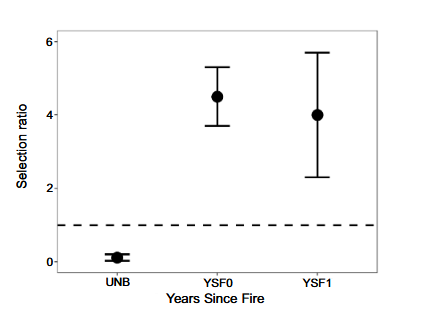
To analyze the success of these nests, Duquette et al. visited the sites every 2-4 days and monitored blackbird calls, feeding behaviours, and the presence of fledglings nearby. As a result, they found that 88% of documented nests had been built in recently burned areas (p. 176). At the end of the 783-day exposure period, Duquette et al. found that this significant preference for recently burned areas did indeed have a survival benefit for Brewer’s blackbird nests; these results point not only to the potential benefits of pyric herbivory, but to the remarkable adaptability of the Brewer’s blackbird (p. 177).
References
All About Birds. (n.d.) Brewer’s Blackbird. Cornell Lab of Ornithology. Accessed September 24, 2026. https://www.allaboutbirds.org/guide/Brewers_Blackbird/overview
Audubon (n.d.) Brewer’s Blackbird. National Audubon Society. Accessed September 25, 2026. https://www.audubon.org/field-guide/bird/brewers-blackbird
Camuy-Vélez, L.A., Sedivec, K., Kjaer, E., Hovik, T. (2025). Effects of patch-burn grazing on above- and belowground communities in invaded grasslands. Applied Soil Ecology, 215. https://doi.org/10.1016/j.apsoil.2025.106413
Duquette, C.A., Hovik, T.J., Limb, R.F., McGranahan, D.A., & Sedevic, K.K. (2019). Restored fire and grazing regimes influence nest selection and survival in Brewer’s Blackbirds Euphagus cyanocephalus. Acta Ornithologica, 54(2), 171-180. https://doi.org/10.3161/00016454AO2019.54.2.004
Horn, H.S. (1968). The Adaptive Significance of Colonial Nesting in the Brewer’s Blackbird (Euphagus Cyanocephalus). Ecology, 49(4), 682-694. https://www.jstor.org/stable/1935532
iNaturalist (n.d.). Brewer’s Blackbird. iNaturalist. Accessed September 24, 2026. https://www.inaturalist.org/taxa/10325-Euphagus-cyanocephalus
Koenig, W.D. (1985). Dunking of Prey by Brewer’s Blackbirds: A Novel Source of Water for Nestlings. The Condor, 87(3), 444-445. https://www.jstor.org/stable/1367239
Powell, A.F.L.A., & Kirkley, J.S. (2021). An instance of hybridization with Common Grackle (Quiscalus quiscula) and male parental care by Great-tailed Grackle (Q. mexicanus). The Wilson Journal of Ornithology, 133(1), 73-81. https://www.jstor.org/stable/10.2307/27129800
Strassburg, M., Crimmins, S.M., Linz, G.M., McKann, P.C., Thogmartin, W.E. (2015). Winter habitat associations of blackbirds and starlings wintering in the south-central United States. Human-Wildlife Interactions, 9(2), 171-179. https://www.jstor.org/stable/10.2307/24874134
The IUCN Red List of Threatened Species (2025). Brewer’s Blackbird. IUCN. Accessed September 28, 2026. https://www.iucnredlist.org/species/22724332/136648804#habitat-ecology