Class – Aves
Order – Charadriiformes (Shorebirds, Gulls, and Allies)
Family – Laridae (Gulls, Terns, and Skimmers)
The Iceland Gull is further differentiated by its three subspecies; the Nominate Iceland Gull, Kumlien’s Gull, and Thayer’s Gull.
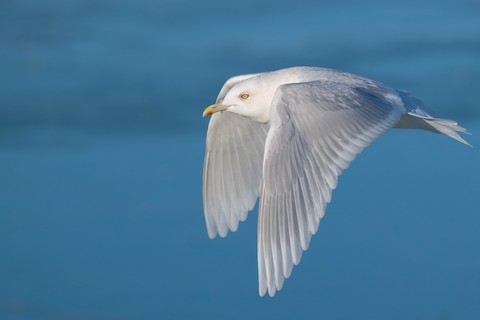
Larus glaucoides glaucoides
The nominate Iceland Gull can be identified by the entirely white primary wingtips, clean white head, and bright yellow eyes.
Photo by Tarik Shahzad. January 19, 2025.
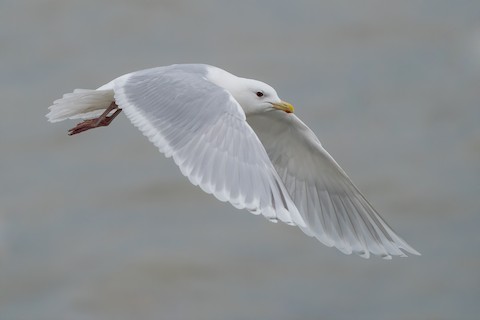
Larus glaucoides kumlieni
The Kumlien’s Gull is distinguishable by its primaries, which have variable shades of grey streaking, spotting, or other marking. They also have a darker eye than the nominate Iceland Gull. They may have a darker or streakier head.
Photo by Ryan Sanderson, February 15, 2020.
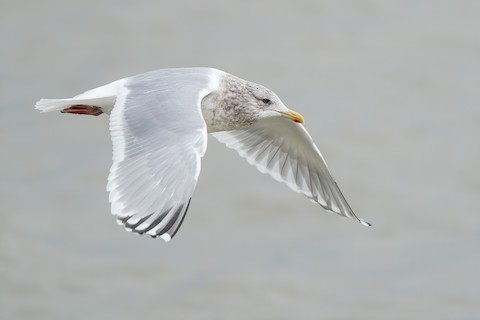
Larus glaucoides thayeri
The Thayer’s Gull has prominent dark grey or black markings on its wingtips. It has a significantly darker and more streaked head. It often has dark brown eyes.
Photo by Ryan Sanderson, February 15, 2020.
Overview – Thayer’s Gull
The Thayer’s Gull was formerly considered to be its own distinct species, but evidence of Thayer’s Gulls breeding with Kumlien’s Gulls prompted reintroduction as a subspecies of the greater designation of Iceland Gull. Throughout the year, Iceland Gulls are present in different areas of the Arctic, North America, and Europe (Snell et al., 2020). There are estimated to be approximately 41,000 breeding individuals in Canada, which represents 47% of the estimated global population (Environment). They have characteristically smooth flight that can be observed as they fly over bodies of water, prior to swooping and diving to catch prey both from and beneath the surface (Audubon).
Regions
The Iceland Gull is one of the least known of all North American Gull species. This is due, in part, to their habitat and the corresponding difficulty in conducting and recording research. Each subtype tends to breed in a slightly different habitat, which can be helpful for proper identification. The nominate Iceland Gull often breeds on the coasts of Greenland, whereas the Kumlien’s Gull breed to the southern east and west of the Baffin Islands, the Digges Sound area, and across Southampton Island. The Thayer’s Gull breeds in scattered colonies in northwestern Greenland and in the Canadian Arctic Archipelago (Snell et al., 2020). The Thayer’s Gull is the subspecies of Iceland Gull most commonly and likely to be seen in Canada, making it the most relevant to our regionally and nationally focused interest.
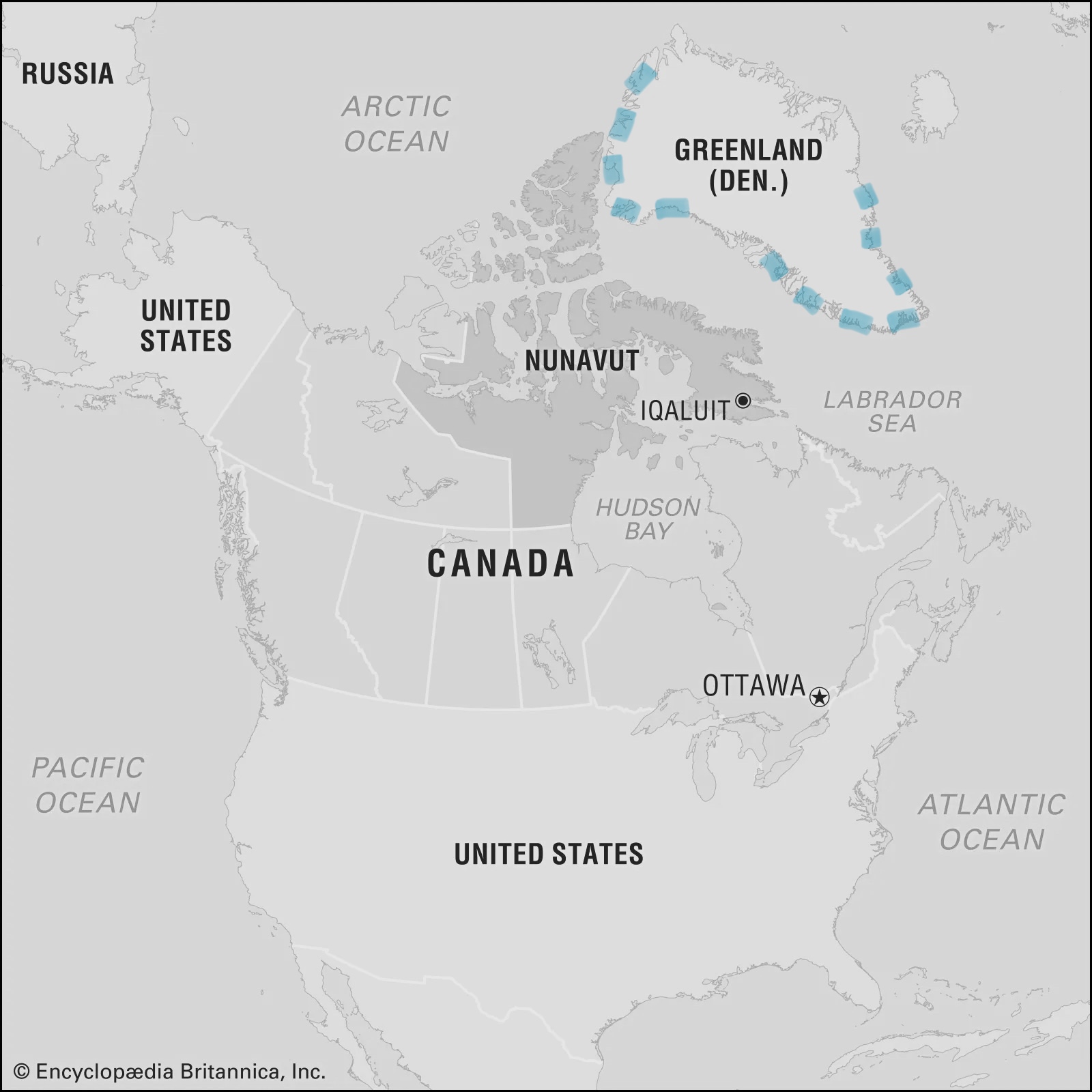
Breeding Range: Nominate Iceland Gull
Original image sourced from Encyclopaedia Brittanica
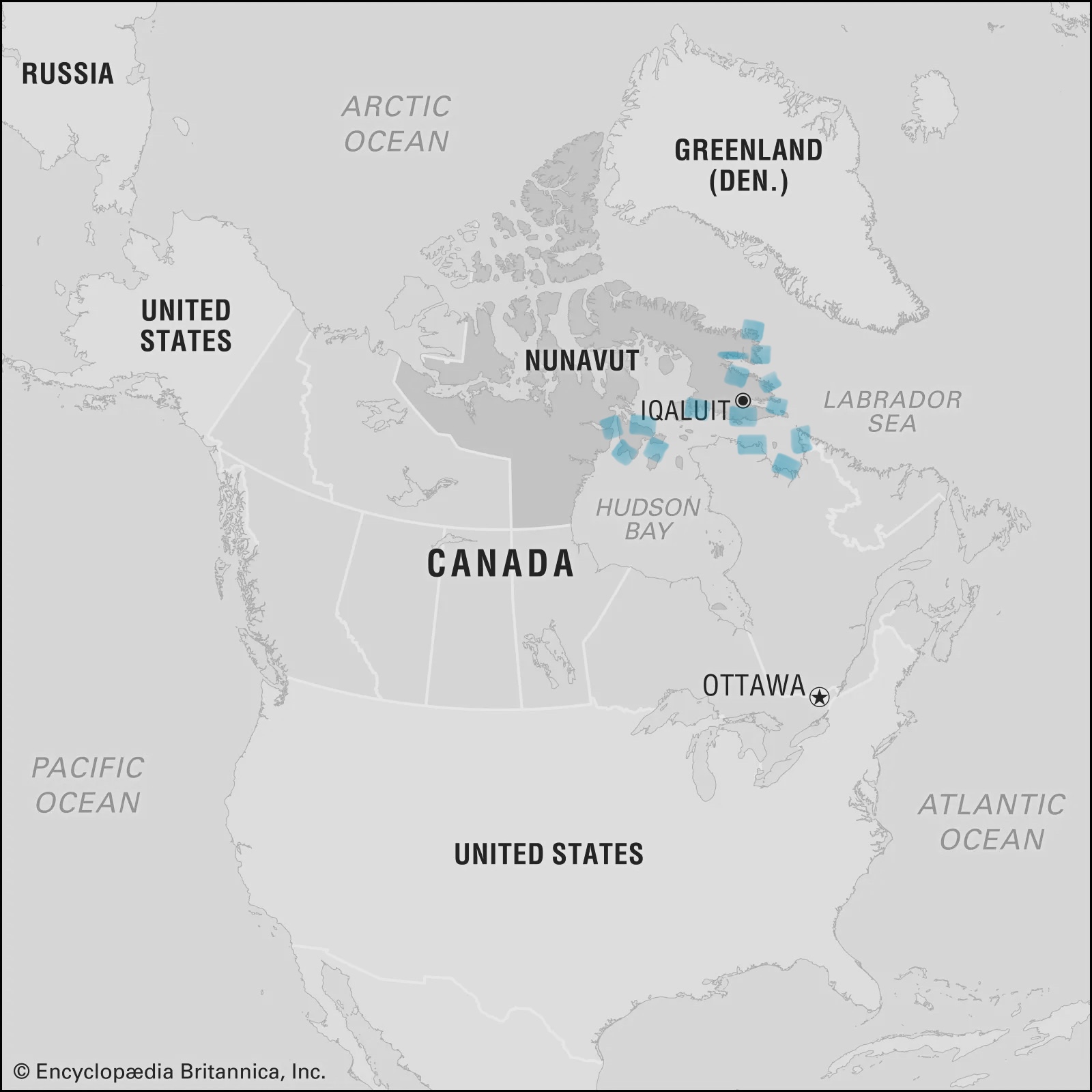
Breeding Range: Kumlien’s Gull
Original image sourced from Encyclopaedia Brittanica
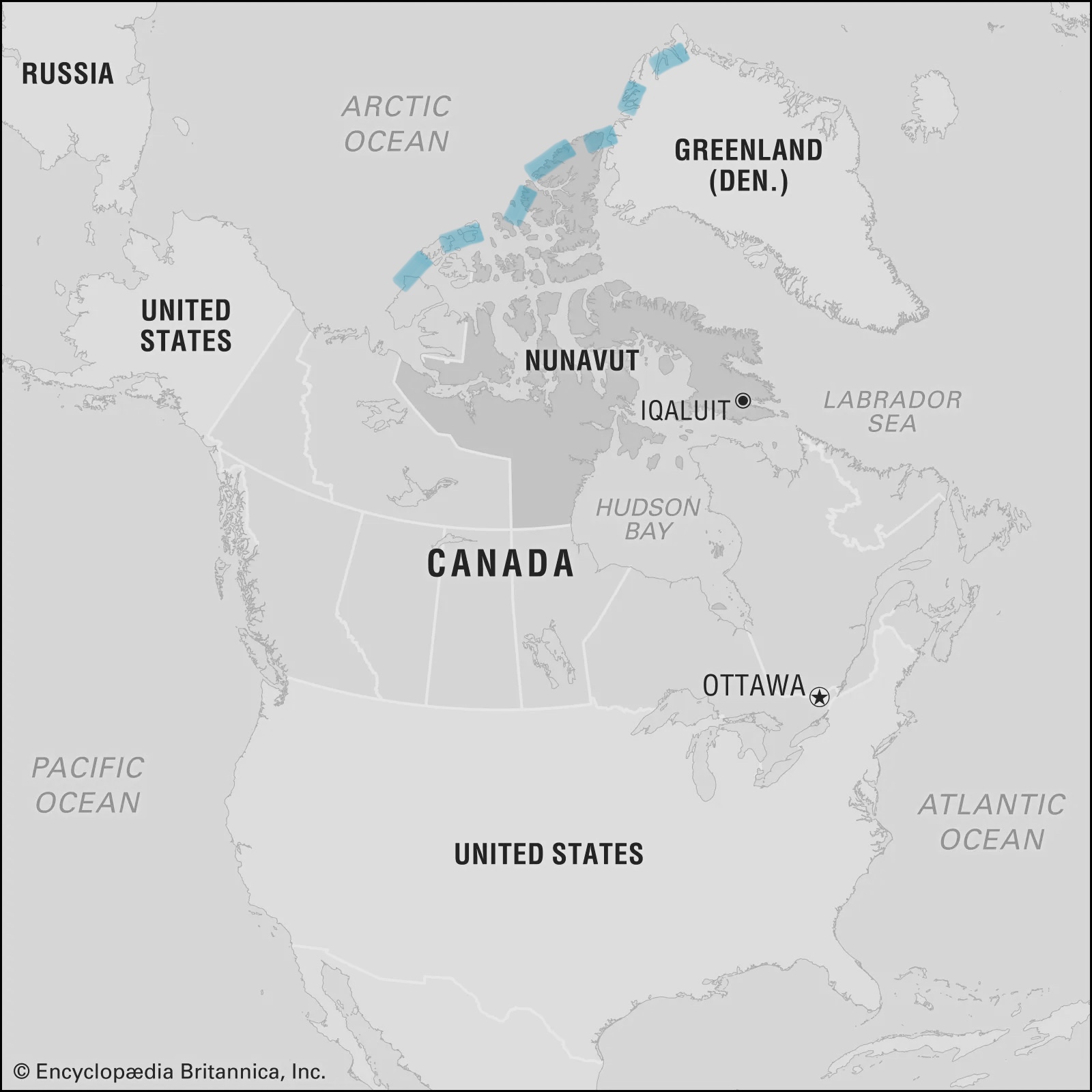
Breeding Range: Thayer’s Gull
Original image sourced from Encyclopaedia Brittanica
The Gulls become much more regionally diverse outside of breeding season, when they migrate to their overwinter destinations. The map below denotes breeding and winter locations. Note that the map is not differentiating by subspecies, and does not represent Gulls that overwinter in Europe. This map gives an excellent idea of range, but is not an accurate representation of the movement patterns of the entire species.
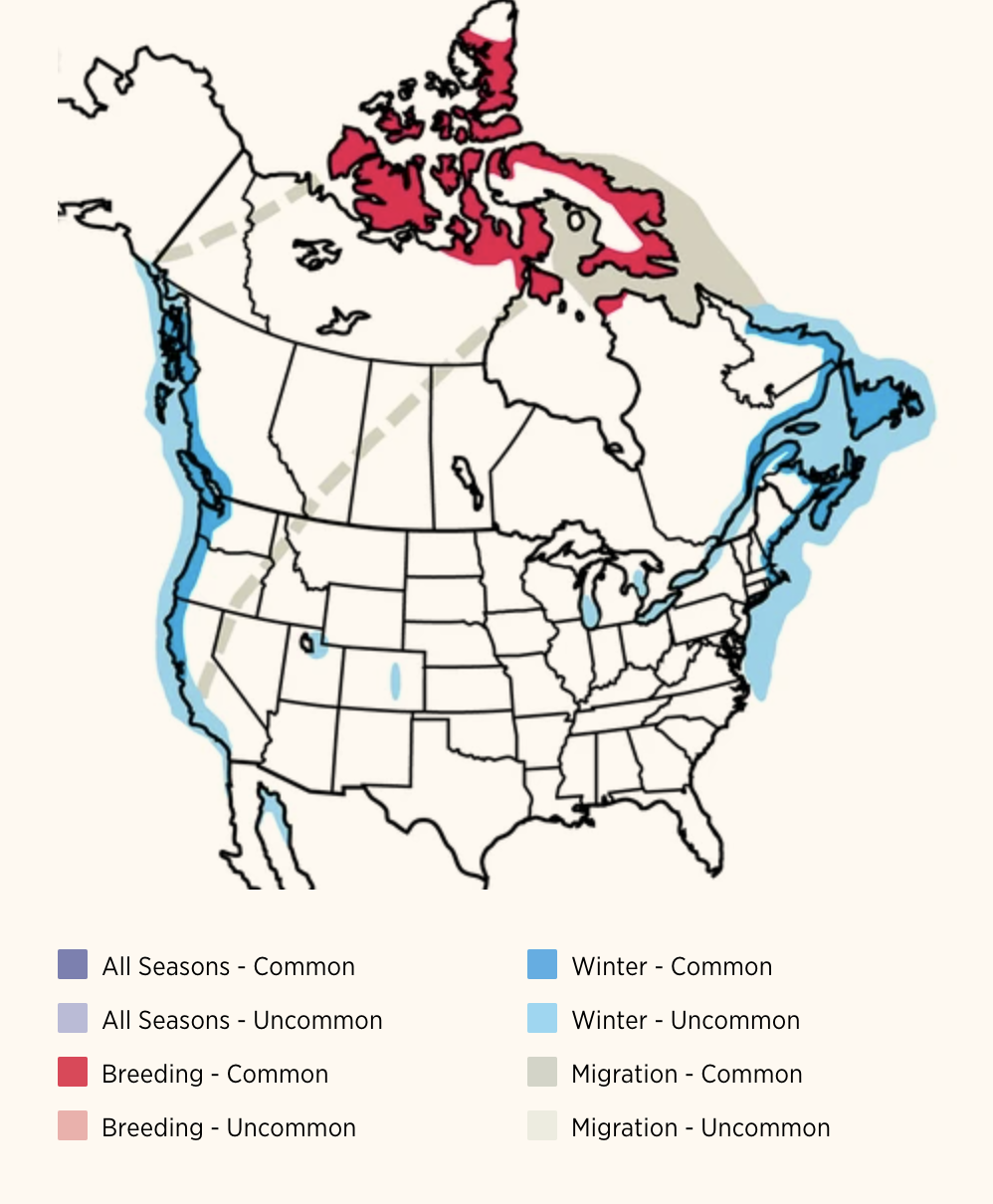
Details
Photo sourced from Audubon
Appearance
Thayer’s Gulls are slightly smaller than Herring Gulls. You can also differentiate them from American Herring Gulls by paying attention to eye color. Male and Female sexes present as similar sizes. All subtypes of Iceland Gulls have a characteristic slender, yellow beak with a red spot on the underside. Thayer’s Gulls have pink legs and unusually dark eyes that appear as different shades of brown. Their plumage makes them easily identifiable in comparison to other subtypes of Iceland Gull. Their heads are often streaked and/or spotted with brown and grey. This marking becomes even more prominent in the winter. They have dark grey to black wingtips; the color can darken depending on their preferred individual geographic range (CornellLab).
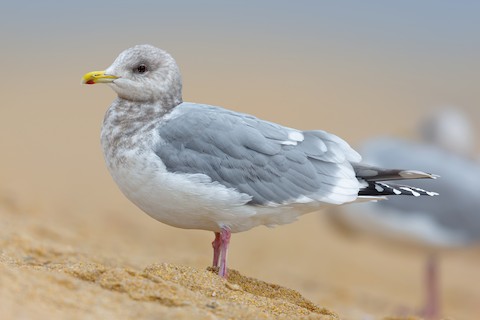
This individual exhibits all of the trademark characteristics of a Thayer’s Gull.
Details
Photo by Woochan Kwon, Janaury 5, 2025
Listen
Audio Details
Recording by Mary Keleher, January Sixth, 2023
Breeding
Due to the remote location of breeding for the Iceland Gull, there is little information about their breeding behaviors and preferences. It is known that they breed on rocky coastal cliffs and fjords with a range up to a few miles inland. Iceland Gulls breed in colonies of 50-100 nests, which are often located on narrow and steeply elevated cliff ledges. Occasionally, they will nest at the bases of cliffs or on rock islands. They produce between one and four eggs that are blue or green in hue and accented with brown spots (Boreal). Nests are often lined with grasses, mosses, and/or lichens. They are bowl shaped to prevent eggs from falling out of the nest, which is a particular concern due to proximity to cliff edges (Environment). Both adults are responsible for incubation (Seattle). Little is known about how young are raised or interact with each other and their parents.
Migration
The Thayer’s Gull breeds primarily in the Canadian High Arctic, and occasionally in scattered colonies in northwestern Greenland (Snell et al., 2020). They then migrate south and dwell across the pacific northwest in the winter. Southern British Columbia and Washington are the central location of their wintering range. This is an example of a short distance migration. It is important to note that this breeding and migration geography is specific to the Larus glaucoides thayeri, and does not remain the same for the other subspecies of Iceland Gull.
📍 Vancouver Island
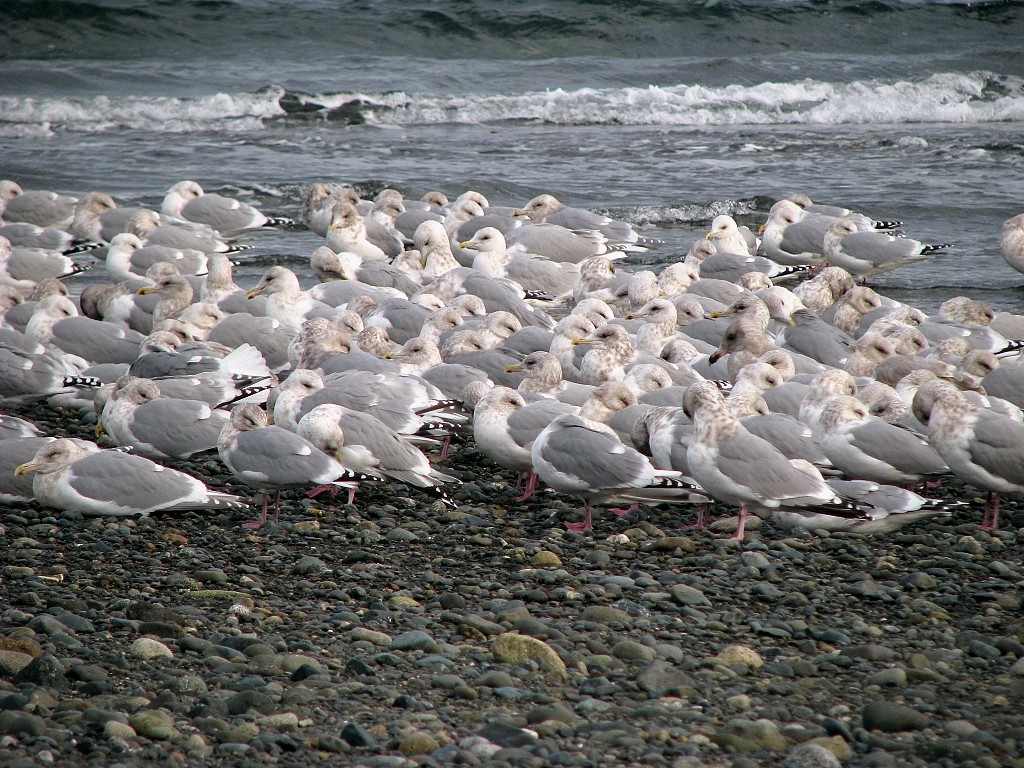
This photo shows a massive flock of Thayer’s Gulls near Qualicum Bay! This was in January of 2008. A massive percentage of the population of these birds gather in the area to feed on Pacific Herring during the annual spawn.
Details
Photo by Guy Monty, 2008. Nile Creek, Vancouver Island
Research
In 2019, authors Gutowksy, Hipfner, Maftei, Boyd, Auger-Méthé, Yurkowski, and Mallory published a study on the migratory and overwinter patterns of the Thayer’s Gull. Prior to this study, no subspecies of Iceland Gull had been tracked through the non-breeding period. In addition to the Thayer’s Gull representing a lesser known Gull species, they are also an arctic breeding species. Arctic breeding species are at immediate risk of facing consequences and challenges of climate change. The more information that is available, the greater chance of introducing effective conservation measures.
The Study
5 adult breeding Thayer’s Gulls were trapped and attached with a 12g solar-powered satellite transmitter. These transmitters sent at least one signal daily. Additionally, all banding and recovery records for Thayer’s Gulls were obtained from the North American Bird Banding Program database.
Results
One tracking device stopped working prior to the bird completing its migration. Data was interpreted from the remaining four birds and trackers. Some interesting findings include:
- All four birds initiated their southern post-breeding migration within a four day period.
- The mean distance travelled for their southbound migration was 3513km.
- Overwinter destinations had a huge variation. Birds settled as far North as Yakutat Bay, Alaska, and as far South as Monterey Bay, California.
- It was generally observed that the birds spent very little time in areas that had high human population densities.
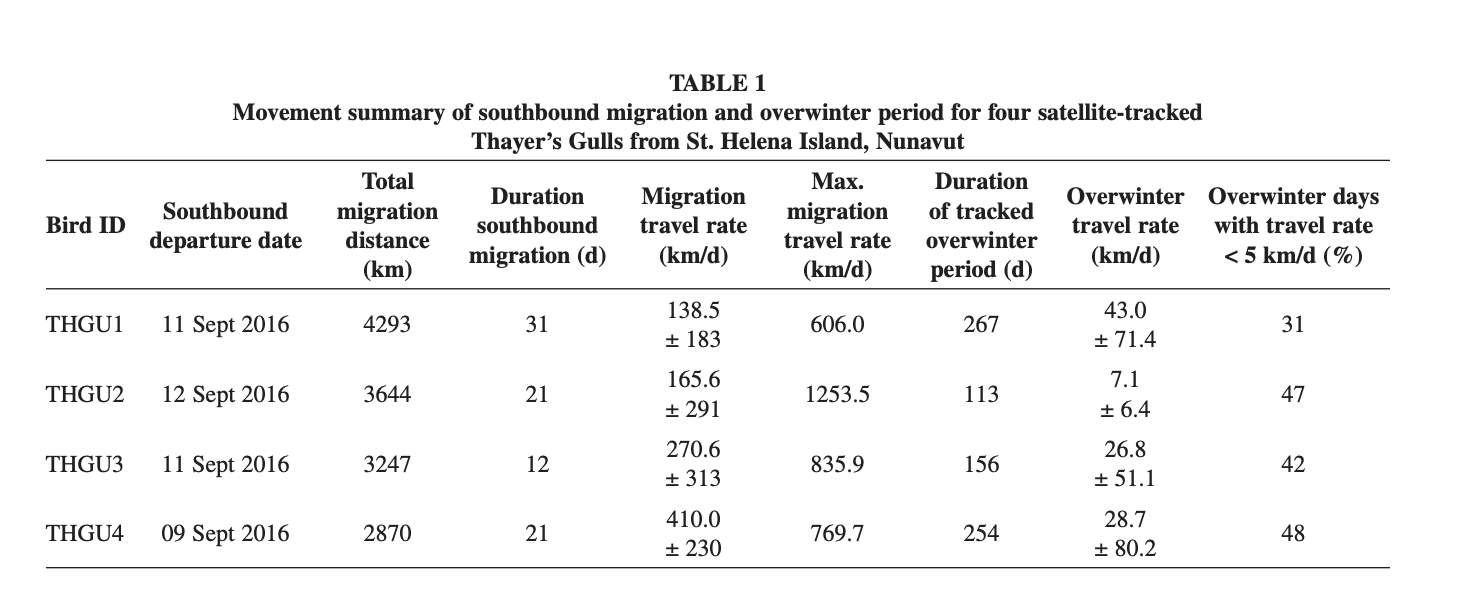
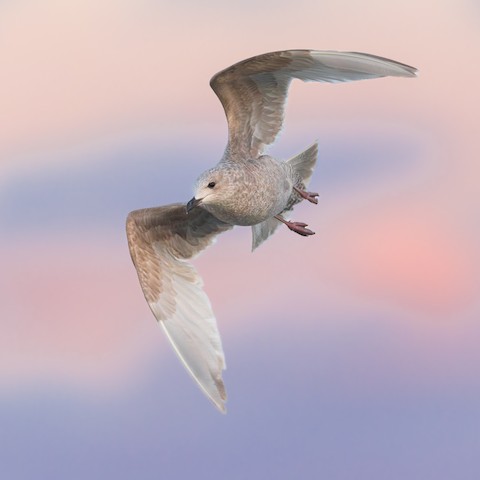
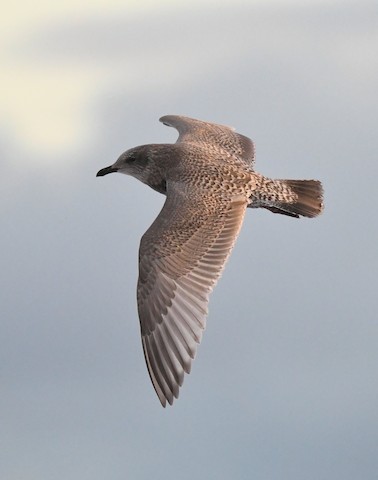
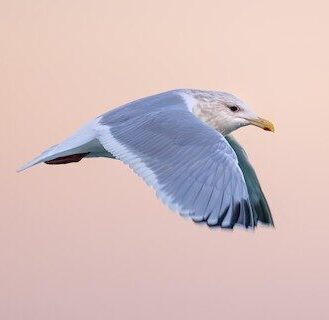
Photo details, in order from left to right
Immature Thayer’s Gull, photo by Ryan Sanderson, February 16, 2025. Hatch Year Thayer’s Gull, photo by Buzz Scher, October 13, 2022. Mature Thayer’s Gull, photo by Simon Tolzmann, January 9, 2025.
References
Audubon. (n.d.). Iceland Gull. Audubon Field Guide.
https://www.audubon.org/field-guide/bird/iceland-gull
Boreal Songbird Initiative. (n.d.). Thayer’s Gull (Larus thayeri).
https://www.borealbirds.org/bird/thayers-gull
Cornell Lab of Ornithology. (n.d.-a). Iceland Gull photo gallery. All About Birds.
https://www.allaboutbirds.org/guide/Iceland_Gull/photo-gallery/37761271
Cornell Lab of Ornithology. (n.d.-b). Iceland Gull sounds. All About Birds.
https://www.allaboutbirds.org/guide/Iceland_Gull/sounds
Environment and Climate Change Canada, & Birds Canada. (2024). The State of Canada’s Birds: Iceland Gull. NatureCounts.
https://www.naturecounts.ca/nc/socb-epoc/species.jsp?sp=y00478
Gull Research Organisation. (n.d.-a). Iceland Gull (Larus glaucoides): Rings.
https://gull-research.org/glaucoides/rings.html
Gull Research Organisation. (n.d.-b). Thayer’s Gull (Larus thayeri): 5CY January.
https://gull-research.org/thayers/thayers5cy/5cyjan06.html
Gutowsky, S. E., Hipfner, J. M., Maftei, M., Boyd, S., Auger-Méthé, M., Yurkowski, D. J., & Mallory, M. L. (2020). First insights into Thayer’s Gull Larus glaucoides thayeri migratory and overwinter patterns along the Northeast Pacific coast. Marine Ornithology, 48(1), 9–16.
https://www.sfu.ca/biology/wildberg/NewCWEPage/papers/GutowskyetalMarOrnithol2020.pdf
Ramel, G. (2025, October 1). Thayer’s Gulls. Earth Life.
https://earthlife.net/thayers-gulls/
Seattle Audubon Society. (n.d.). Thayer’s Gull. BirdWeb.
https://birdweb.org/birdweb/bird/thayers_gull
Snell, R. R., Pyle, P., & Patten, M. A. (2020). Iceland Gull (Larus glaucoides), version 1.0. In P. G. Rodewald & B. K. Keeney (Eds.), Birds of the World. Cornell Lab of Ornithology.
https://birdsoftheworld.org/bow/species/y00478/cur/introduction
Very interesting! Do you know if the reintroduction of the Thayer’s gull into a subspecies of the Iceland gull was supported by genome studies as well?
Gulls! Ever so tricky so many subspecies and hybridization makes the ID-ing ever so difficult. I find they’re range fascinating! (but as you said breeding grounds are understudied). I find it interesting that in they’re over-wintering range they tend to avoid people. Typically I associate many gulls species being tied to urban environments. As there is lots of things to exploit for food (landfills, stealing, etc). I wonder why that is?
Keva, you make a really interesting observation! I did not include the differences in feeding behaviors in this blog post as the focus was on the Thayer’s Gull. However, it was repeatedly noted by my sources that both the nominate and Kumlien’s Gull will be found in more urban areas and scavenging from landfills or other areas with accessible garbage. The Thayer’s Gulls are unique in their exclusive reliance on more natural and coastal food sources. There was no specific reason linked to or given for this, but it may be associated with the fact that these Gulls are rarely seen far inland and may not have encountered the same kind of urbanization and scavenging availability.