Getting to Know the Hairy Woodpecker
Meet the Bird Behind the Tapping
A steady tap-tap-tap can make a patch of woods feel occupied, even before you spot who’s making the noise. Follow the sound to a tree trunk and you might find a Hairy Woodpecker, upright against the bark, moving with the confidence of a bird that knows exactly where to look for its next meal.
The Hairy Woodpecker (Leuconotopicus villosus) lives in British Columbia year-round and is found across much of North America. Its black-and-white markings make it stand out against a tree trunk, and if it’s a male you’re looking at, you might even spot a small red patch on the back of its head (BC Breeding Bird Atlas, 2015).
Its large bill helps it reach insects hidden beneath bark and outer wood layers. Though they are experts at debarking there’s more to the tapping than finding food. Hairy Woodpeckers also use their bills to excavate nest cavities and make calls that carry through the woods (Cornell Lab of Ornithology, 2021).
Hairy or Downy?
The Hairy Woodpecker wears a crisp black-and-white pattern, with a white stripe down its back and white markings on its wings. Adult males have a red patch on the back of the head that females lack. In western North America, the plumage can be darker and look less sharply contrasted than in eastern birds, sometimes taking on a brownish tinge.
For an inexperienced birdwatcher such as myself, the Hairy Woodpecker can be easy to confuse with its smaller look-alike, the Downy Woodpecker. Both have similar black-and-white patterns, but the Hairy Woodpecker is larger and has a longer, heavier-looking bill. Its bill is roughly as long as its head, while the Downy’s looks shorter and more delicate. Their tails also differ. The Hairy’s outer tail feathers are plain white, while the Downy’s usually have small black spots(Cornell Lab of Ornithology, 2021). Since size can be hard to judge, checking both the bill and tail can make the two much easier to tell apart (see Figure 1).
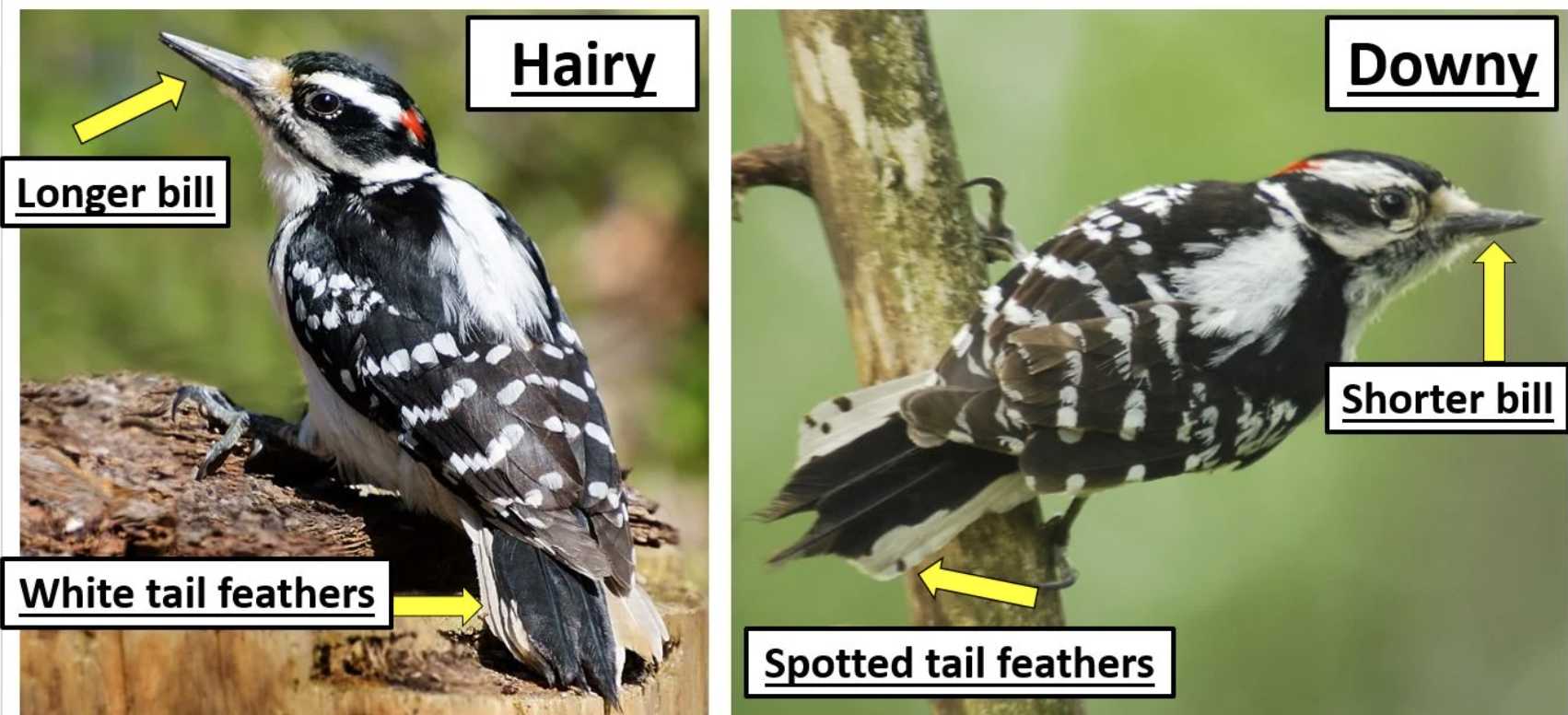
Figure 1. Comparison of the Hairy Woodpecker and the Downy Woodpecker, highlighting bill length and markings in the outer tail feathers. Credit: Bird Watching HQ
You might hear a Hairy Woodpecker before you spot it. Its sharp peek call and rapid, rattling stutter are two sounds that can give it away. Both can be heard in the recording below (Figure 2).
Figure 2. Hairy Woodpecker tweek and sputter call. Credit: Audubon
A Wide Range of Homes
The Hairy Woodpecker gets around. Its range stretches across much of North America, from Alaska and Canada through the United States and Mexico, and south through Central America as far as Panama (Figure 3). In British Columbia, it’s a widespread resident breeder found in many forest types, especially coniferous and mixed forests and along forest edges. Hairy Woodpeckers have also been known to make opportunistic use of woodlots, wooded parks and suburbs (BC Breeding Bird Atlas, 2015).
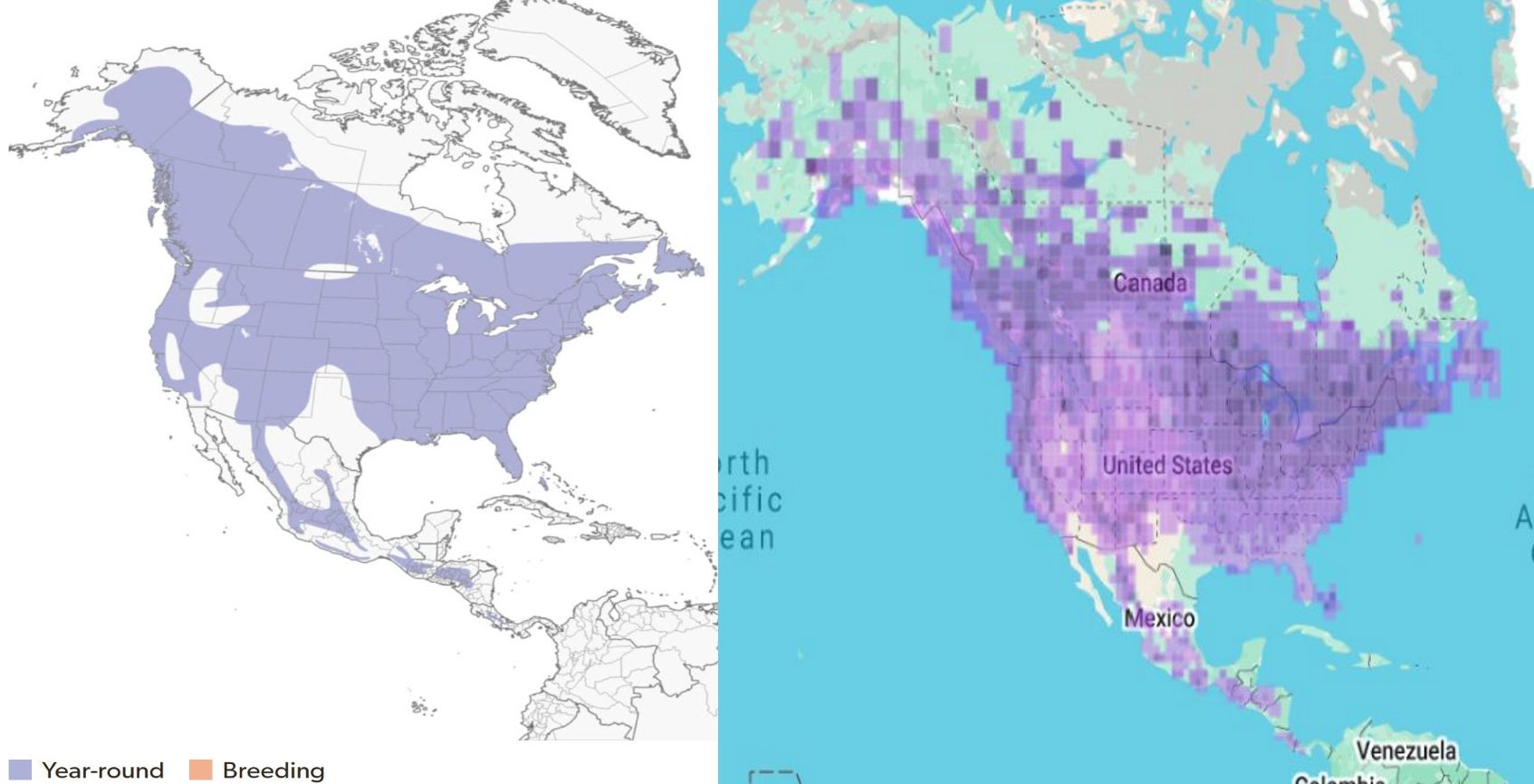
Figure 3. Hairy Woodpecker Distribution and Sightings Across North and Central America. Distribution map (left) and recorded sightings (right), from the Cornell Lab of Ornithology’s All About Birds. Credit: All About Birds
Finding Food and Making a Home
Hairy Woodpeckers feed mainly on insects, including beetle larvae beneath bark or inside wood, and ants. In a study of nestlings in burned forests, wood-boring beetles were an important part of their diet, showing how the birds take advantage of prey available in a particular habitat. They find food by inspecting trunks and large branches, then probing or chipping at spots that may hide prey.
A woodpecker’s tongue helps retrieve food from narrow crevices. It is supported by an elongated hyoid apparatus, a structure of bones and tissues that extends back around the skull. Jung et al. (2016) examined this arrangement in other woodpecker species, so it’s best understood as a woodpecker adaptation rather than a feature studied specifically in Hairy Woodpeckers. Research on another woodpecker has also found that some have specialized barbs and sticky saliva which can help grip and pull out grubs or other small insects (Villard and Cuisin, 2004).
Built for the Job
Woodpeckers have several adaptations that help them work against hard wood. Their feet have two toes pointing forward and two pointing backward, giving them a strong grip on tree trunks. Their stiff tail feathers provide another point of support, bracing the bird against the bark while it climbs and feeds. Their skull and neck are also adapted for repeated impacts, helping distribute the forces produced when the bill strikes wood. This is especially important when a Hairy Woodpecker drums, rapidly striking its bill against a tree to communicate with other woodpeckers.
Hairy Woodpeckers also put their bills to work when communicating. The rapid drumming heard in Figure 4 is different from the slower taps and chips made while searching for food. Instead, this rhythmic series of strikes is used to communicate with other woodpeckers.
Figure 4. Hairy Woodpecker drumming. Rapid strikes against a tree used for communication. Credit: Audubon
Their climbing posture supports this close-up search. Hairy Woodpeckers grip the bark with their feet and brace against the trunk with their stiff tail feathers as they move along trunks and branches. The taps and chips they make while probing for food are different from the more rhythmic drumming used to communicate.
Hairy Woodpeckers also excavate nest cavities in dead trees or dead sections of living trees. These cavities can outlast the nest that created first occuied. A long-term study in British Columbia found that sites with more excavator nests had more available cavities and greater diversity among animals that use existing cavities (Trzcinski et al., 2021). Woodpeckers are therefore not just using trees for food and shelter; their excavation can help create nesting opportunities for other species.
A Widespread Bird with Local Differences
Across its large range, the Hairy Woodpecker uses many kinds of forest, but its appearance can vary depending on where you find it. Some populations differ in the shade of their plumage and how strongly their black-and-white markings contrast. Figure 5 shows some of this variation, with four different colour forms found across the Hairy Woodpecker’s range.
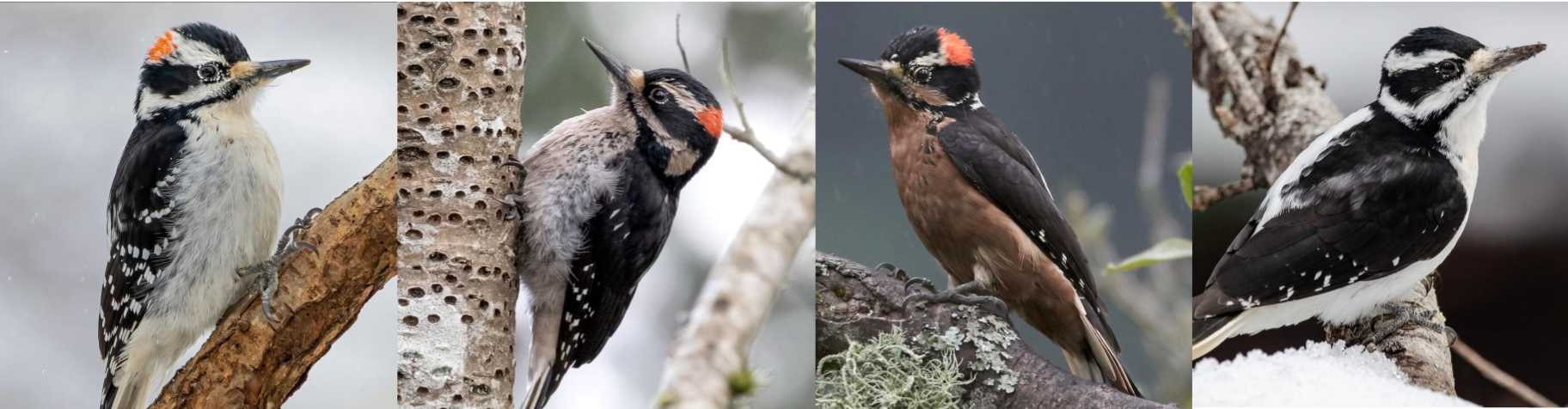
Figure 5. Variation in Hairy Woodpecker plumage across its range. From left to right: eastern male, Pacific male, Costa Rican adult, and Rocky Mountain female. Credit: Matthew Plante, Anthony Gliozzo, Carlos Bolaños, and Mason Maron / Macaulay Library, Cornell Lab of Ornithology.
For readers in British Columbia, the Hairy Woodpecker is both a familiar neighbor and a window into the variety found across its wide range. The next time you hear tapping, pause before assuming you know which woodpecker is there. Look for the long bill, check the back and wings, and listen for a call. A few clues can turn a quick glimpse into a closer encounter.
Life After the Flames
How Hairy Woodpeckers make use of a changing forest
Wildfire can completely change the look of a forest, leaving behind scorched ground, open patches and stands of dead trees. At first glance what’s left may seem desolate and lifeless. For a Hairy Woodpecker, though, some of what a fire leaves behind can actually be quite useful. Recent research suggests that these birds are not simply using burned forests, but are selecting particular parts of them for nesting.
Not All Burned Forests Are the Same
Campos et al. (2020) studied nesting woodpeckers following three wildfires in the northern Sierra Nevada and southern Cascades of California. Between 2009 and 2016, the researchers monitored 313 woodpecker nests during the first one to five years after fire. 97 of these nests belonged to Hairy Woodpeckers, giving the researchers a substantial number of nests to examine specifically for this species.
One important part of the study was recognizing that a burned forest is not one uniform habitat. Wildfire can leave behind a patchwork, with some areas burning severely while others experience much less damage or escape the fire almost entirely. The three fires included in the study show just how much those conditions can vary, both within a single fire and between different burned landscapes.
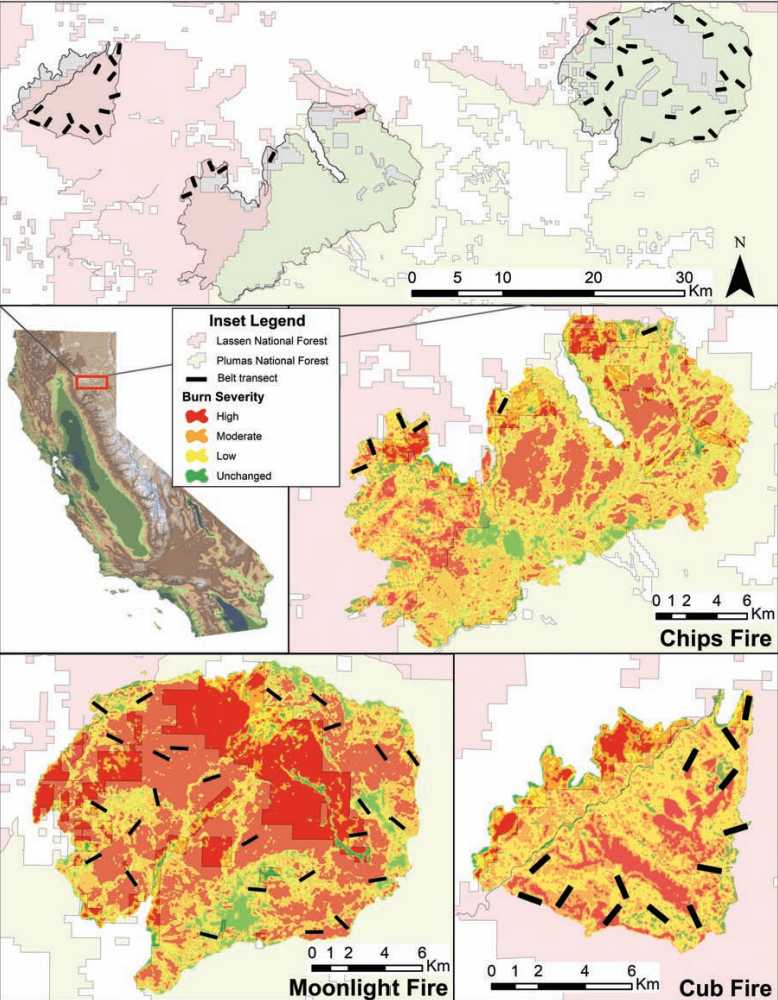
Figure 6. Burn severity across the Chips, Moonlight and Cub wildfire study sites. The three fires show the patchwork of different burn severities found within each burned landscape. From: Campos et al. (2020).
With so much variation left behind by a fire, the researchers wanted to know whether woodpeckers were using certain parts of that landscape more than others. To find out, they compared actual nest sites with locations where the birds were not nesting, then looked more closely at which features were associated with suitable nesting habitat for each species.
Using What the Fire Leaves Behind
For Hairy Woodpeckers, the answer was more specific than simply finding a burned patch of forest. Their predicted nesting habitat became more suitable as local burn severity increased. The condition of the trees left behind mattered too. Hairy Woodpeckers were associated with larger individual nest trees and showed a preference for snags with broken tops. Other strongly supported models also suggested that having more snags surrounding the nest could make an area more suitable (Campos et al., 2020).
These relationships can be seen in Figure 7, which shows how several features of the burned forest affected the researchers’ predictions of suitable Hairy Woodpecker nesting habitat.
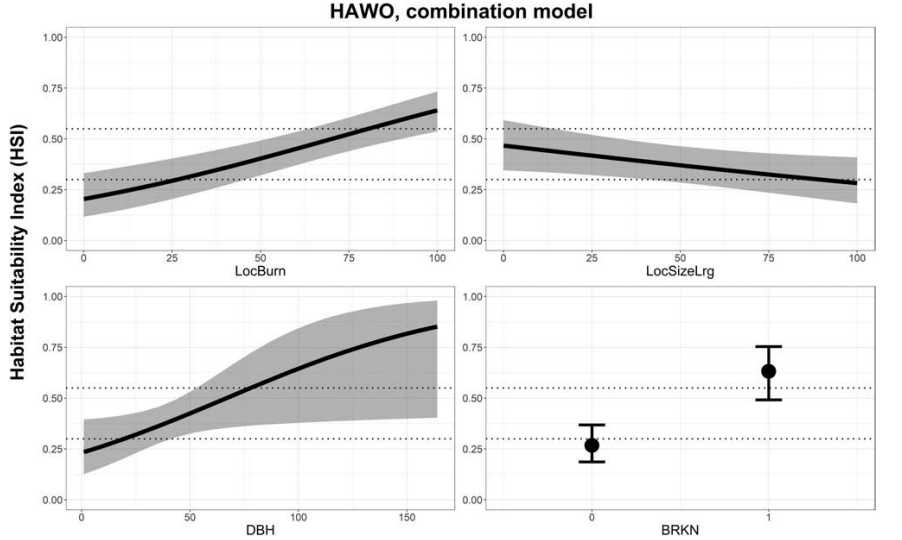
Figure 7. Hairy Woodpecker nesting-habitat suitability after wildfire. Predicted habitat suitability in relation to local burn severity (LocBurn), surrounding large-tree dominance (LocSizeLrg), nest-tree diameter (DBH), and broken-topped trees (BRKN). From: Campos et al. (2020).
The vertical axis in Figure 7 is the Habitat Suitability Index (HSI), an estimate of how suitable the habitat is predicted to be for nesting. Values closer to 1 represent higher predicted suitability, while values closer to 0 represent lower suitability. As local burn severity and the size of the individual nest tree increase, so does the predicted suitability. Broken-topped trees also have a higher predicted suitability than trees with intact tops. Interestingly, the amount of large trees in the surrounding area shows the opposite pattern. In simpler terms, Hairy Woodpeckers may benefit from having a large tree to nest in without needing the entire area around it to be dominated by large trees.
These findings matter when deciding what happens to a forest after wildfire. Dead and damaged trees may be removed through salvage logging, but some of those same trees still provide places for Hairy Woodpeckers to feed and nest. The researchers developing these models may help to identify important woodpecker habitat that could be considered when making post-fire management decisions.
There may also be another part of the story worth exploring as these forests recover. Earlier, we saw that Hairy Woodpeckers excavate cavities that can remain after they leave and may later be used by other animals. Could the same thing happen in forests recovering from wildfire? Fire creates dead and damaged trees, Hairy Woodpeckers make use of some of them, and their abandoned cavities could eventually provide habitat for other species. Future research could look more closely at this connection and ask whether Hairy Woodpeckers are not only taking advantage of what fire leaves behind, but also helping shape the habitat available as the forest recovers.
References
BC breeding bird atlas. (2015). Birdatlas.Bc.Ca. https://www.birdatlas.bc.ca/accounts/speciesaccount.jsp?sp=HAWO&lang=en
Campos, B. R., Latif, Q. S., Burnett, R. D, & Saab, V. A. (2020). Predictive habitat suitability models for nesting woodpeckers following wildfire in the Sierra Nevada and Southern Cascades of California. The Condor, 122(1). https://doi.org/10.1093/condor/duz062
Hairy woodpecker identification, all about birds, Cornell Lab of Ornithology. (2021). Allaboutbirds.Org. https://www.allaboutbirds.org/guide/Hairy_Woodpecker/id
Jung, J.-Y., Naleway, S. E., Yaraghi, N. A., Herrera, S., Sherman, V. R., Bushong, E. A., Ellisman, M. H., Kisailus, D., & McKittrick, J. (2016). Structural analysis of the tongue and hyoid apparatus in a woodpecker. Acta Biomaterialia, 37, 1–13. PubMed. https://doi.org/10.1016/j.actbio.2016.03.030
Trzcinski, M. K., Cockle, K. L., Norris, A. R., Edworthy, M., Wiebe, K. L., & Martin, K. (2021). Woodpeckers and other excavators maintain the diversity of cavity‐nesting vertebrates. Journal of Animal Ecology, 91(6). https://doi.org/10.1111/1365-2656.13626
Villard, P., & Cuisin, J. (2004). How do woodpeckers extract grubs with their tongues? A study of the Guadeloupe woodpecker (Melanerpes Herminieri) in the French West Indies. The Auk, 121(2), 509–514. https://doi.org/10.1093/auk/121.2.509
Awesome blog! I was wondering if the research you talked about mentioned which species use the abandoned cavities the Hairy Woodpecker’s leave behind? I’d also be curious to know the proportion of their cavities that get reused vs. abandoned forever. Super neat to learn how they can be somewhat of a pioneer species and make homes for others.
I really love the inclusion of the side-by-side comparison of the hairy vs downy woodpecker. I always look at the beak but didn’t know there was also a difference in the tails! Also neat to learn more about they’re range, I didn’t realize how expansive they are. What important home builders! For all the animals that use the excavated sites. I’d also be curious to learn more about they’re roll in forest recovery after forest fires.