Meet The Pied-billed Grebe
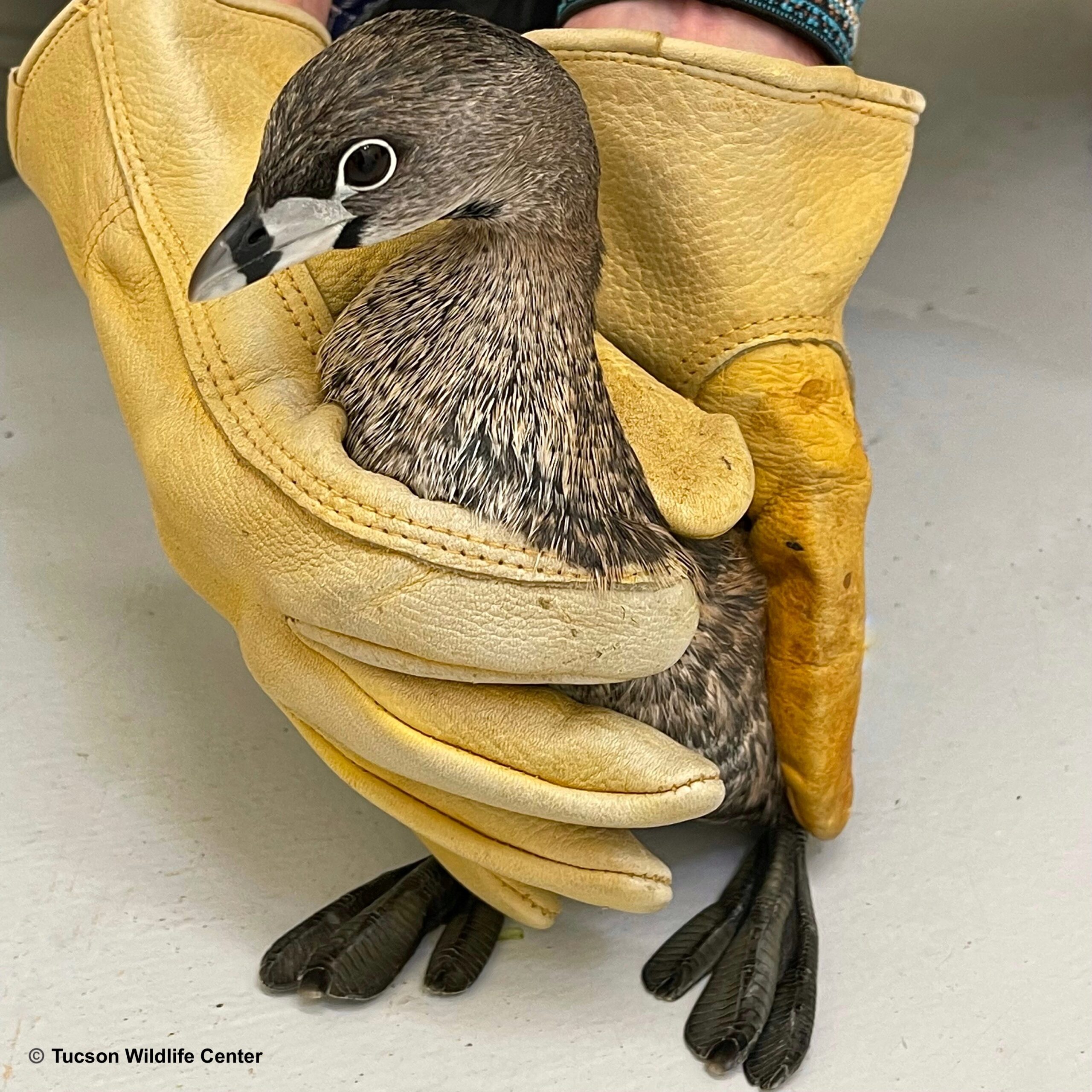
Pied-billed grebes (Podilymbus podiceps) are fun-sized waterbirds; their chunky bodies are smaller than a crow (Corvus brachyrhynchos) but larger than a robin (Turdus migratorius) (Cornell University, 2026). At first glance, they can appear to lack a tail because it is so small, and they get their name from the dark, vertical stripe on their bill during breeding plumage (Cornell University, 2026). In winter plumage, they are mainly brownish, with a thick bill and short neck (Cornell, 2026). It could be speculated that they “lack a tail” because the pied-billed grebe is not a bird at all, but a submarine. When they want to go below the water’s surface, they squeeze air out of their feathers and internal air sacs to hunt more easily underwater (Sundstrom, 2018). Essentially, they fold like a lawn chair and drop like an anchor.
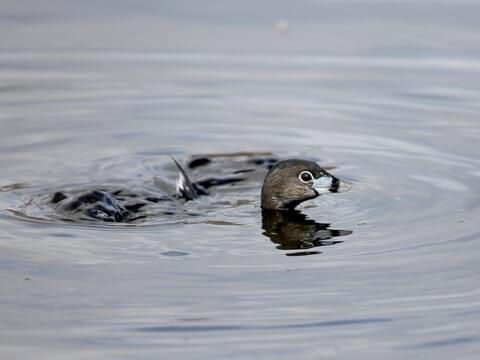
These submarine birds are also highly adaptable. One example of this is where they can be found: in water. They really are not picky, living in any slow body of water ranging from fresh to brackish, as long as adequate vegetation and prey are available (Cornell University, 2026). This can be ponds, lakes, estuaries, and everything in between.
This easy-to-please outlook also translates to their diet of anything that happens to be in their vicinity. As opportunistic predators, they will eat a variety of things from crustaceans to fish and frogs (Cornell University, 2026). Further, in 2016, Scholz witnessed a pied-billed grebe (PBG) swallowing a live common yellowthroat (Geothlypis trichas) like a pill that was fighting for its life (Scholz & Hayes, 2017).
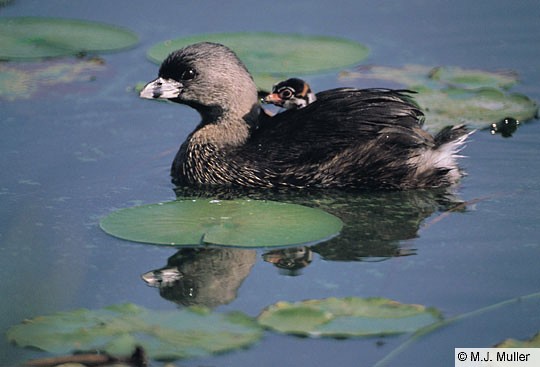
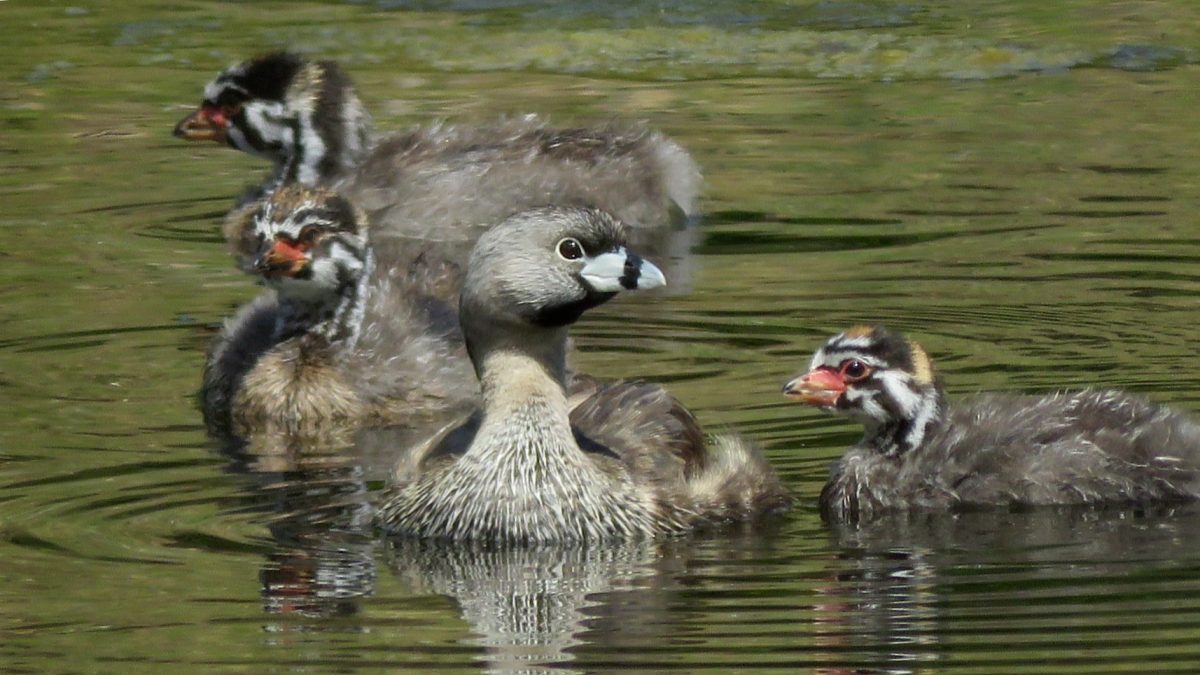
PBGs aren’t just foodies; they are wonderful parents. They build nests on floating vegetation for their broods of two to 10 eggs, with both parents expressing parental care (Cornell University, 2026). When their chicks hatch, all bright-eyed and downy-feathered, they climb onto their parent’s back for their first week of life (Cornell University, 2026). When the parents need to dive with their fluffy children, they throw them under their wing like a textbook when your bag and hands are full. Occasionally, chicks will pop out from under a clamped wing, but no parent is perfect.
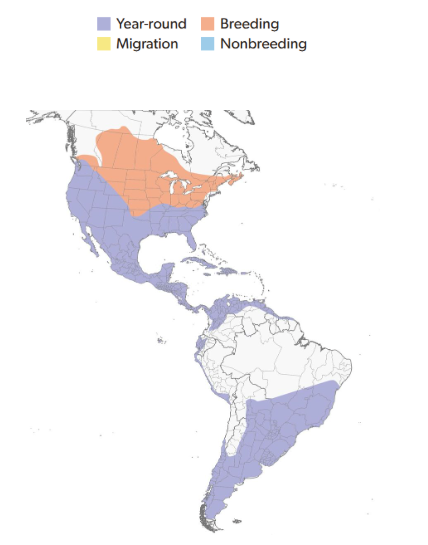
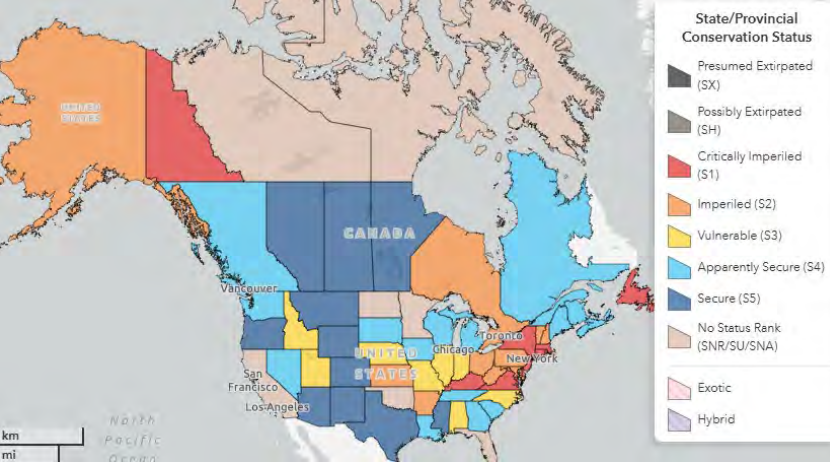
These birds can be found from Northern Canada to southern South America, claiming the title of grebe with the widest distribution (Muller & Storer, 2020). Their annual range goes as far north as Central America, with their breeding range extending further. This wide distribution, variety of habitats, as well as their generalist diet, are all contributing factors to why PBGs are listed as low concern for their conservation status on the IUCN list (Cornell University, 2026). A low status on the IUCN means that the species are at a low risk of extinction, but there could still be local declines in certain areas. PBGs are actually considered special concern/threated/endangered in New York, Connecticut, Massachusetts, New Jersey, and Vermont, USA as of 2024 (Hayden). This is mainly attributed to habitat degradation and loss (Hayden, 2024).
My First Encounter
I first saw a PBG and knew I was witnessing one, about five years ago. I was walking alongside a pond on Prince Edward Island (PEI) in May when I heard a cacophony of monkeys howling from the water. You can imagine my surprise when I looked over and saw a PBG instead. It was alone, hooting and making a series of “kuk-kuk-kuk” noises. When I approached to confirm it was indeed a PBG, and not PEI’s first monkey, it sank below the water and stared at me with nothing but its eyes above the surface.
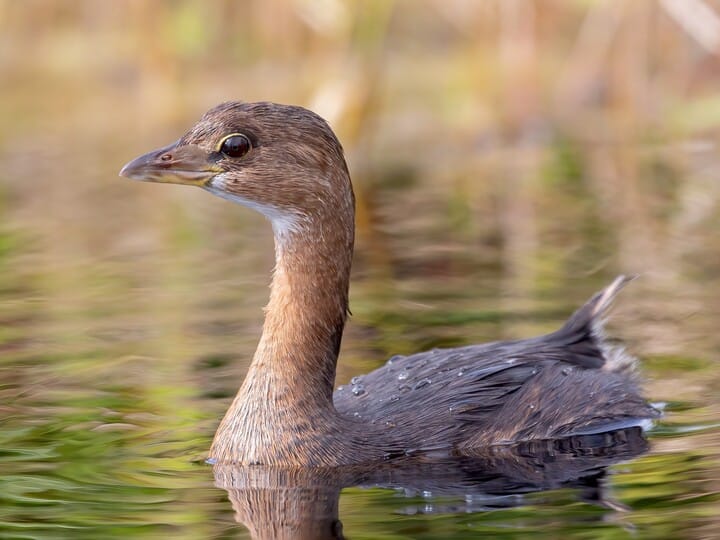
You can often hear PBGs when they are courting or when they are defending their territory. The S.S. PBG is an attack vessel, preferring a solitary lifestyle, which explains why I only saw one. They will chase and attack any bird invading their territory, including other PBGs, especially during breeding season, which ranges from early spring to mid-autumn (Muller & Storer, 2020). As most other submarines, they will often attack from below, causing many birds to flee when a PBG dives towards them (Muller & Storer, 2020).
Pied-billed Grebe Interactions and Effects
Why Are Alligators So Cranky?
“My Mama says that alligators are ornery because they got all them teeth and no toothbrush.” — Bobby Boucher, The Waterboy (1998)
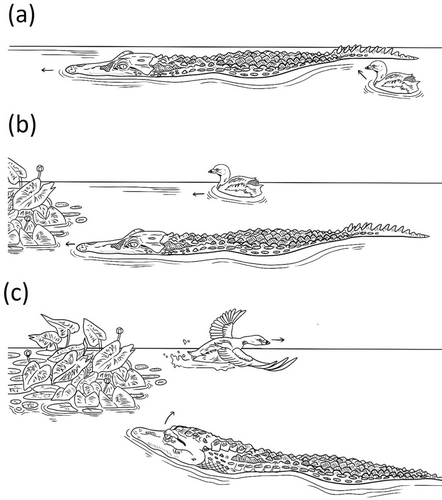
Bobby and I will have to disagree. I think it is possible that the American alligator (Alligator mississippiensis) is ornery because it’s being followed around by PBGs. Romer et al. conducted a study on the ‘Coordinated movement of multiple pied-billed grebes in association with an American alligator’. One day in January, they set off to survey Palm Beach, Florida. During their study, they observed two PBGs following an alligator at a very close distance for around 10 minutes. Maintaining the same distance from the alligator throughout the observation, the birds would dive repeatedly behind the large predator. The dives were very consistent with PBG foraging dives, but the researchers did not confirm any prey capture.
The authors suggest that this study may document a previously unrecognized nuclear follower foraging association between the two species. In this association, the nuclear species (in this case, the alligator) flushes prey while the follower eats what has been disturbed (Somaweera & Somaweera, 2021). This interaction can be seen in many other animals, like when crows follow wolves, anticipating scavenging the leftovers of a hunt. The interesting part of this dynamic, to me, is that alligators are known predators of PBGs. At one point in this survey, one bird even fled from the alligator, highlighting their predator-prey dynamic. If I were the alligator, I would not be impressed to have my lunch following me around.
Build It, and They Will Come
Everything in nature is connected, so it is not a surprise that when grebes (Podicipedidae), like PBGs, build floating nests, it ripples through the community. From 2010 to 2017, Hayes et al. studied vertebrates other than grebes using the nests of western grebes (Aechmophorus occidentalis) in California. They noted that 47 vertebrate species utilized these nests, from fish to mammals. Western grebe nests can be two to three feet in diameter, whereas PBGs are only 38 cm in diameter (Cornell University, 2026; Hammerson, 1995). This small size could potentially limit the types of species that can utilize PBG nests, but there has still been evidence of use.
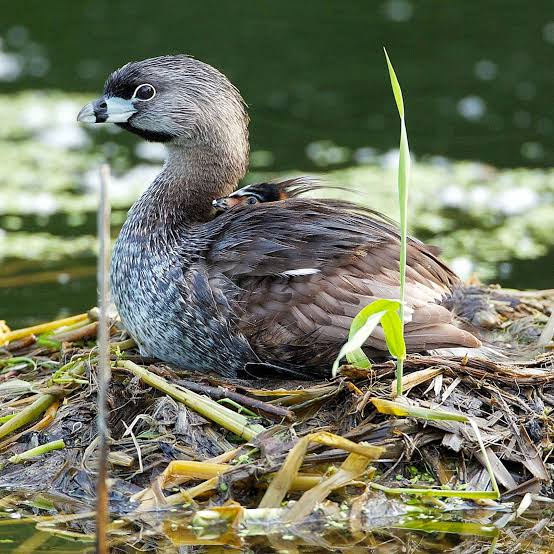
In fact, Hayes et al. note that marsh wrens (Cistothorus palustris) have been known to use PBG nests. They would search the nests for insects within the vegetation (Chamberlin, 1977). When they weren’t getting their fill, they were also seen using these nests for their mating displays (Deusing, 1939). The males would use the nest as their stage and put on a show by flapping and fluttering their wings.
Deusing also watched a turtle try to climb onto a PBG nest, possibly intending to use it to soak up the sun, but unfortunately for the turtle, the attack submarine was on the nest and denied its entry with a quick bill strike (1939).
Teach a Bird to Fish…
Brown looked at floodplains, flooding, and salmon-rearing habitat in British Columbia, and found an interesting association with PBGs. When considering juvenile coho salmon (Oncorhynchus kisutch), the two most active predators in Washington, USA were belted kingfishers (Megaceryle alcyon) and juvenile PBGs (Brown, 2002). Around 93% of the belted kingfisher’s coho prey were at depths of less than 0.6m, where the PBGs caught them from deeper below.
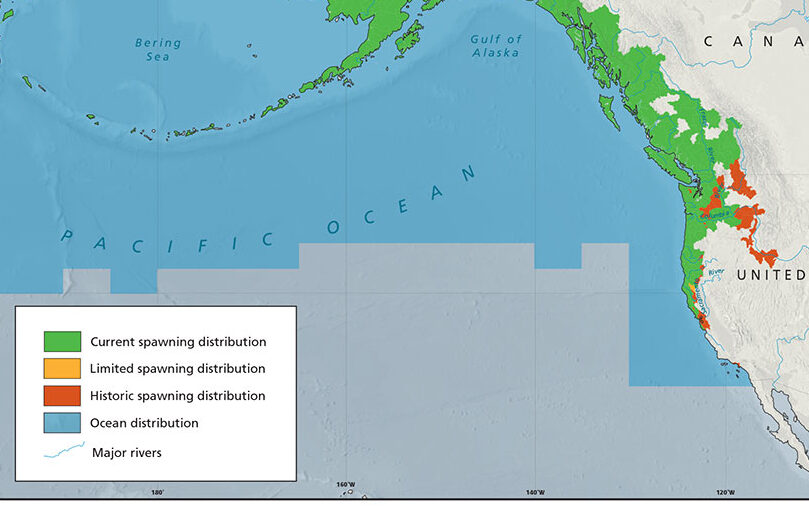
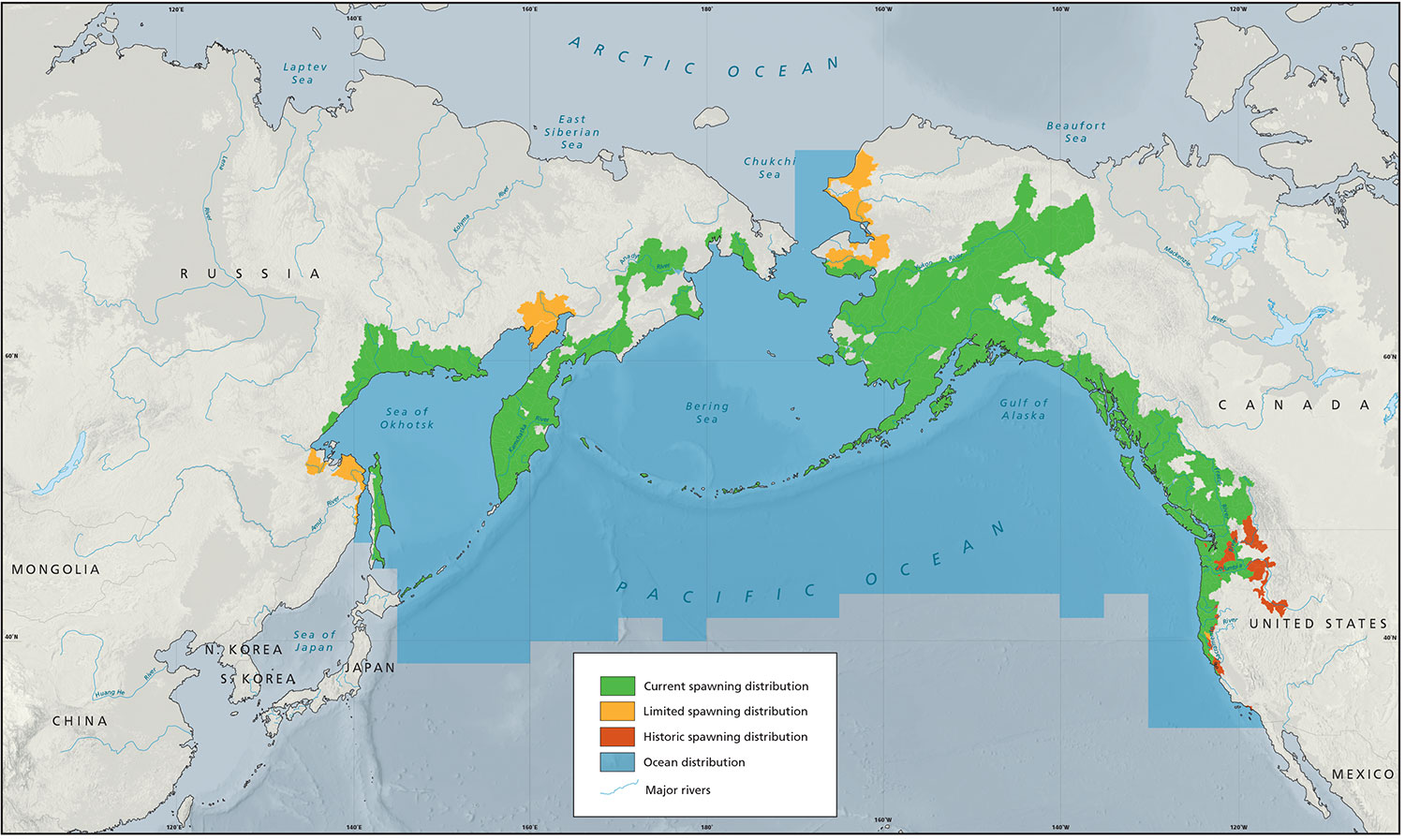
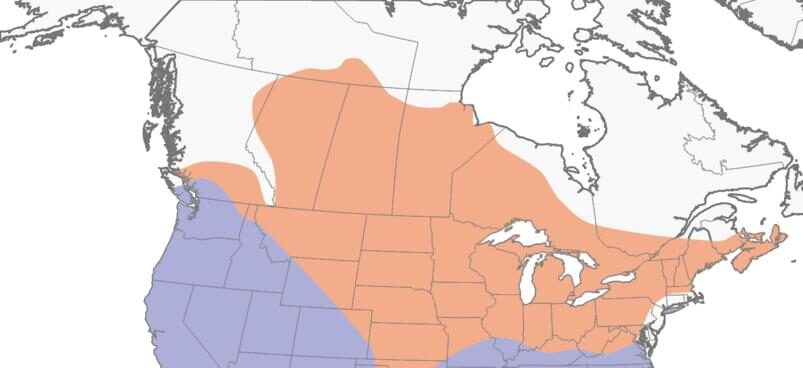
I would like to note that the coho spawning distribution (green) overlaps very closely with the divide between PBG annual (purple) and breeding (pink) distribution. Coho return to spawn as early as October, and eggs are deposited from November to January (Wild Salmon Center, n.d.). Eggs will incubate for 1.5 to four months before emerging, where they will live in freshwater for 12-18 months (Wild Salmon Center, n.d.). During this time, they go from alevins to fry to parr before becoming smolts and heading towards the sea (Wild Salmon Center, n.d.). These small stages need slow-moving streams, which happen to be one of the habitat types utilized by PBGs.
PBG chicks start to hunt for their own prey around June to July; at this time, any coho spawned in January may be at their fry stage (Hugh, 2016). It cannot be said that young PBGs intentionally seek out fry and parr, but it would be a very interesting idea for future research and study to explore this predator-prey relationship in depth. It is also important to note two things:
A Summary of Your New Friend: The Pied-billed Grebe
This relatively solitary grump of a bird can often be found singing in sluggish water full of vegetation, like marshes (Sundstrom, 2018). If a PBG is spooked or disturbed, it will sink low into the water; this allows them to hide from perceived threats, as well as hunt prey and sneak up on unsuspecting individuals.
PBGs are secretive by nature; they migrate at night, take to the long vegetation during breeding, and even cover up eggs with vegetation when leaving the nest (Sundstrom, 2018).
As is any vessel of worth, PBGs are highly efficient. They can build nests in one to five days, egg incubation is complete in 23 to 27 days, and once they are hatched, the chicks are precocial and ready to swim and catch a ride on their parent(s) (Sundstrom, 2018).
Their generalist diet and ability to use a variety of habitats may help PBGs persist across a wide range, but they are still threatened by habitat loss and degradation. If their wetland habitats continue to be damaged or lost, local populations may decline. Theoretically, a PBG could occupy any habitat where water, food, vegetation, and other necessary environmental conditions are available. However, competition, predation, and other ecological factors restrict where it can successfully live and reproduce. This difference between the habitats a species could potentially occupy and those it actually uses is the difference between its theoretical and realized niche. We must protect their realized niche to keep our attack submarines thriving.
Pied-billed Grebe Fun Facts
Thank you for reading!

References
Brown, T. G. (2002). Floodplains, flooding, and salmon rearing habitats in British Columbia: A review (Research Document 2002/007). Fisheries and Oceans Canada. https://psf.ca/wp-content/uploads/2021/10/Download-PDF805-1.pdf
Chamberlin, M. L. (1977). Observations on the red-necked grebe nesting in Michigan. Wilson Bulletin, 89(1), Article 3. https://digitalcommons.usf.edu/cgi/viewcontent.cgi?article=7775&context=wilson_bulletin
Cornell University. (2026). Pied-billed grebe. https://www.allaboutbirds.org/guide/Pied-billed_Grebe/id
Cornell University. (2026). Western grebe. https://www.allaboutbirds.org/guide/Western_Grebe/lifehistory
Deusing, M. (1939). Nesting habits of the pied-billed grebe. The Auk, 56(4), Article 1. https://digitalcommons.usf.edu/cgi/viewcontent.cgi?article=14580&context=auk
Hammerson, G. (1995). BC Conservation Data Centre: Species summary (Podilymbus podiceps). BC Ministry of Environment. https://a100.gov.bc.ca/pub/eswp/speciesSummary.do;jsessionid=e7cbe553d4b3bac3fe016ae2ceb47e9d54e84824c91240f28b14a63e02d93a60.e3uMah8KbhmLe34NaN4KaNyTaNj0n6jAmljGr5XDqQLvpAe?id=14132
Hayden, J. (2024). Pied-billed grebe species status assessment. New York Department of Fish and Wildlife. https://extapps.dec.ny.gov/fs/programs/dfw/SWAP2025/Birds/Pied-billed%20grebe.pdf
Hayes, F. E., Turner, D. G., McIntosh, B. J., Weidemann, D. E., Zimmerly, N. D., Peralta, M. B., Stoppelmoor, D. B., & Hellie, M. E. (2018). Floating bird nests provide resources for wildlife: ecological roles of vertebrates using Aechmorphus grebe nests at Clear Lake, California. Wetlands Ecology and Management, 26, 1061-1072. https://doi.org/10.1007/s11273-018-9631-x
Hugh, J. (2016, September 1). Pied-billed grebe. Flathead Audubon Society. https://flatheadaudubon.org/bird-of-the-month/pied-billed-grebe/
Muller, M., & Storer, R. (2020, March 4). Pied-billed grebe. Birds of the World. https://birdsoftheworld.org/bow/species/pibgre/cur/introduction
Romer, A. S., O’Carroll, H., Bonilla-Liberato, E. D., Mazzoti, F. J., & Balaguera-Reina, S. A. (2025). Coordinated movements of multiple pied-billed grebes in association with an American alligator. Ecosphere, 16(10), e70416. https://doi.org/10.1002/ecs2.70416
Scholz, S., & Hayes, F. (2017). Pied-billed grebe predation on a common yellow-throat. Western Birds, 48(1), 56-57. DOI:10.21199/WB48.1.4
Somaweera, R., & Somaweera, R. (2021). Nuclear-follower foraging behaviour between Western Australia common octopus and brown-spotted wrasse. Marine & Freshwater Research, 72(11), 1679-1681. https://doi.org/10.1071/MF21059
Sundstrom, B. (2018, March 19). Pied-billed grebes sink like submarines. Audubon. https://www.audubon.org/news/pied-billed-grebes-sink-submarines
Wild Salmon Center. (n.d.). Coho salmon. https://wildsalmoncenter.org/salmon-species/coho-salmon/
Very interesting facts about PBGs! I enjoy how you describe them as submarines. Do PBGs eat other kinds of fish also?
Thank you, Tyler! Yes, PBGs are opportunistic feeders, meaning they will eat whatever crosses their path (that they are physically capable of). Crustaceans are notably a favourite food, but they eat a variety of fish as well.
Very interesting birds. Great info
Thanks, Stephanie!
Neat birds, have there been other documented times of the PBG’s following other animals like the alligator to get food?
Hi Trevor! They are super neat. In my research, I haven’t found any other instances of PBGs potentially following other animals to forage. It is possibly a field of behaviour that needs further study, or an isolated behaviour. I will definitely be keeping my ear to the ground for more information on this.
They are pretty neat I never ever heard of that species before until now
Hi Darryl! I am happy to have introduced you to the PBG! Now that you know what they are, maybe you will see or hear them out and about one day,
Hi Alexis! I really liked your description of the Pied Billed Grebe, this isn’t a bird I had ever heard of before and I think your blog was perfect for someone who knew next to nothing about this bird. You put it in terms that were easy to understand and made me like this bird without ever seeing it in person! Do you know if this is something local to Vancouver Island?
Thank you, Isabella! Yes, the PBG is an annual resident of Vancouver Island. Here is a link to some PBG sightings around Nanaimo via iNaturalist: https://www.inaturalist.org/observations?place_id=27532&subview=map&taxon_id=4246
Very interesting read! I’d love to see them. I have never heard of them. Being here in PEI I will be on the lookout for them.
Thank you! You should definitely try to get your eyes on one. Here is a link to some sightings in PEI to help you get started on the hunt: https://www.inaturalist.org/observations?place_id=9116&subview=map&taxon_id=4246
I do not believe they overwinter there, so they may be on their move south. But there was a sighting on September 24th, so they may still be around!
Hi Alexis! This was such a perfect introduction for me to the PBG. I really enjoyed that the article was just as informative as it was entertaining!
Hi Ember! I am so glad you enjoyed the article, and I am happy to have introduced you to this species!