Taxonomy
Common name: Hooded Merganser
Scientific name: Lophodytes cacullatus
Order: Anseriformes
Family: Anatidae
Identification
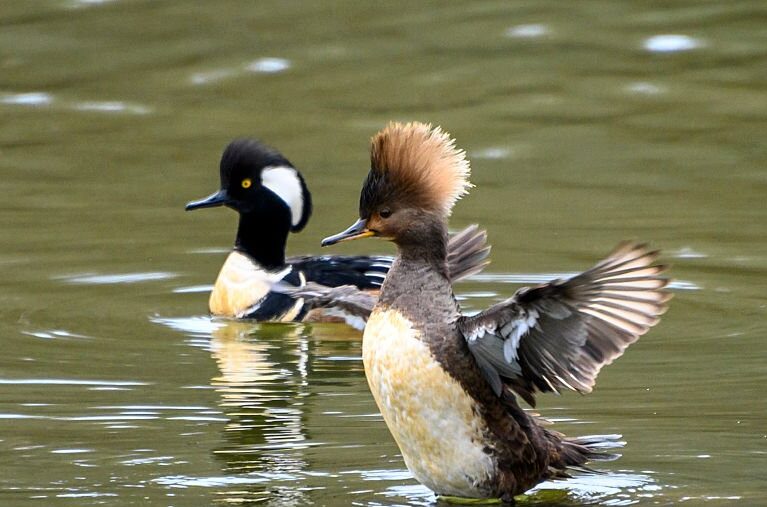
The Hooded Merganser (Lophodytes cacullatus) is one of North America’s most distinctive species of waterfowl. Both sexes possess a large, fan-shaped crest that can be raised or lowered, from which the species takes its name (Urban et al., 1976). Females are predominantly brown with a cinnamon-coloured crest, while males have a contrasting black-and-white head pattern. They can often be confused with Bucephala albeola—the Bufflehead—however, the white patch on a male Hooded Merganser’s crest is fully outlined in black. Their narrow, serrated bills are specialized for capturing slippery aquatic prey underwater, with their diet primarily consisting of fish, crayfish, and aquatic insects (Bellrose, 1976; Environment and Climate Change Canada and Birds Canada, 2024). Instead of the standard “quack” you would expect to hear from a duck, these mergansers can often be heard croaking like a frog! Check out this 30-second video by Backyard Birds & Wildlife to hear their distinct call.
Range
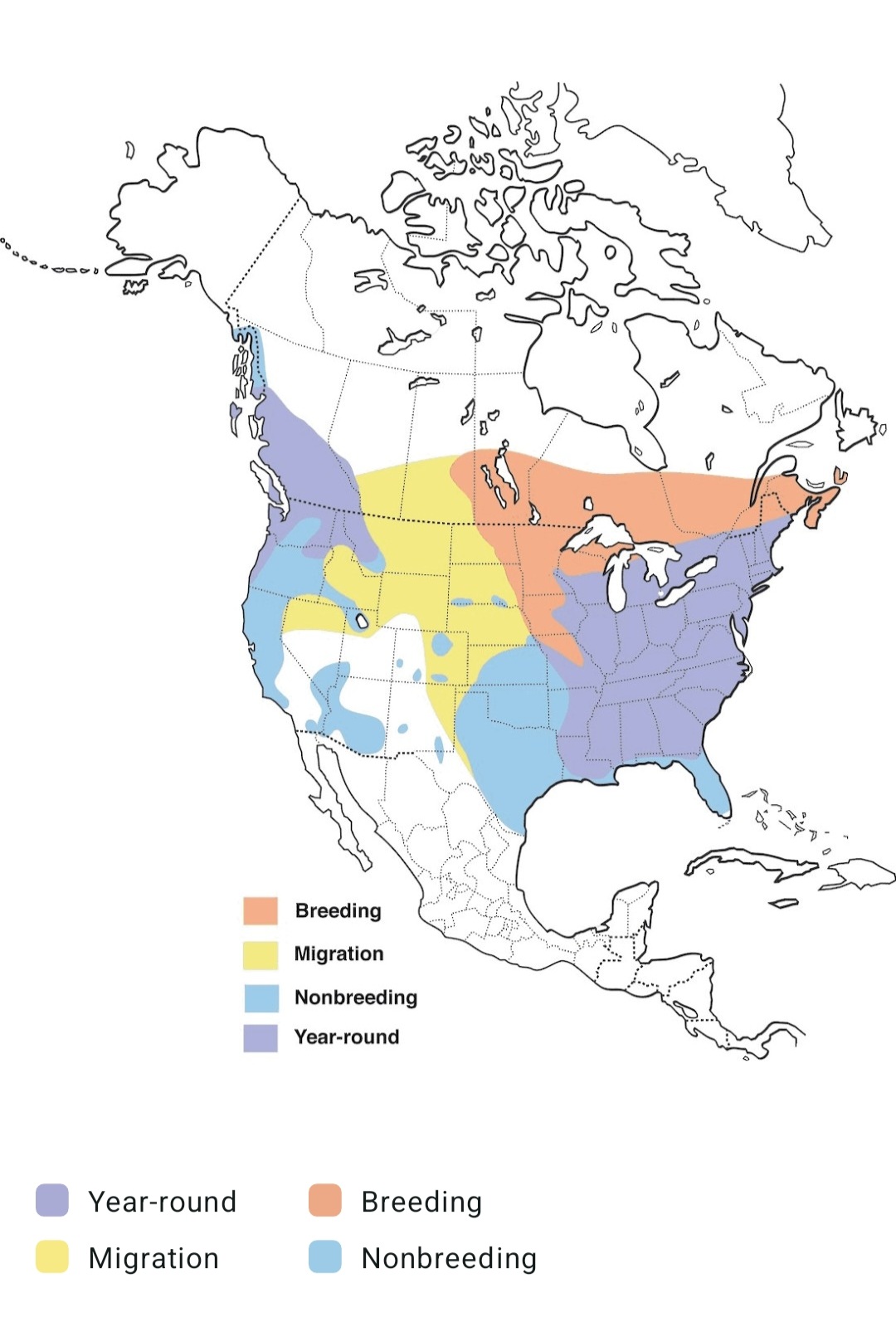
Ranging from southern Canada to the Gulf states, Hooded Mergansers are the only merganser species restricted entirely to North America (Bakner et al., 2024a). Northeastern and northcentral populations migrate south each autumn, whereas females in British Columbia, parts of Washington, Oregon, Idaho, and Montana, along with many of the southeastern United States, are year-round residents. In Canada, they breed in every province, with their highest densities occurring in southern Quebec (Environment and Climate Change Canada and Birds Canada 2024). Approximately 860,000 Hooded Mergansers (coincidentally abbreviated to HOME) breed in Canada, representing roughly 78% of the global population and giving Canada a particularly high responsibility for the species’ conservation.
Forests, Water, and Cavities
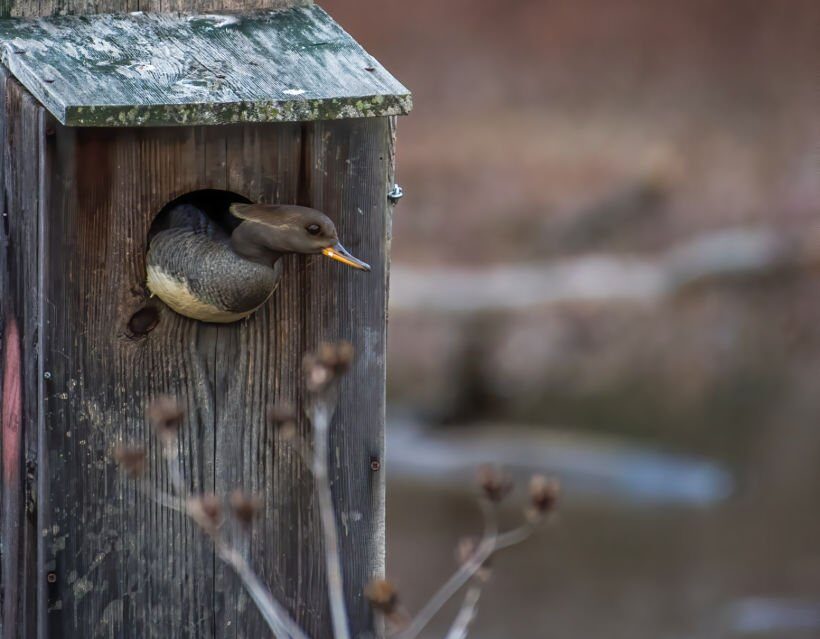
The Hooded Merganser is a small diving duck that is fundamentally connected to both aquatic and forest habitats (Bakner et al., 2025b; Morse et al., 1969). During the breeding season, they typically use wooded streams, lakes, ponds, wetlands and quiet backwaters where suitable nesting cavities occur. They are secondary cavity nesters, meaning that they exploit cavities created by natural processes or other animals rather than excavating their own nest holes. They have also been found using artificial nest boxes—wooden structures installed by wildlife agencies and private landowners to support cavity-nesting ducks—which have become an important part of their breeding ecology in some regions.
Over the years, research on brood habitat has demonstrated the importance of maintaining healthy aquatic ecosystems surrounding nesting areas (Kitchin and Hunt, 1969; Mallory et al., 1993). This connection between forest structure and aquatic habitat means that this merganser can be affected by changes occurring in both environments—they are, in this way, amphibious.
FUN FACT
These diving ducks have ‘shape-shifting’ eyes!
When a Hooded Merganser dives underwater, its eyes have to deal with a completely different optical environment than they do in air (Urban et al. 2020). To stay focused, the merganser can dramatically change the shape of its fleFxible lens by pressing it against the rigid iris of the eye. This gives the lens much more focusing power underwater. Researchers estimate that Hooded Mergansers can accommodate their vision by roughly 40–80 dioptres(unit used to measure optical power)—far more than non-diving birds such as pigeons and chickens. In other words, their eyes are specially adapted to switch from seeing above the water to hunting below it!
Investing in Incubation
For Hooded Mergansers, reproduction involves substantial parental investment. The breeding season lasts approximately 75 days, during which a female lays 10 to 13 eggs and incubates them for roughly 32 days (Bakner et al. 2024a). In northeastern Ontario, Mallory et al. (1993) found that incubating females spent an average of 85.3% of their day on the nest, leaving for only 4.7 recesses per day, on average—admittedly more breaks than most mothers get. Females also lost up to 16% of their body mass during incubation. These observations demonstrate the energetic demands of remaining on the nest while periodically leaving feed herself and her young.
Importantly, however, Hooded Mergansers do not always raise their own young. Their nesting biology is also characterised by interspecific nest parasitism, in which females lay eggs in the nests of another species. Hooded merganser eggs can occur alongside those of Wood Ducks (Aix sponsa), creating mixed-species clutches (Mallory et al., 1993; Mallory et al., 2002). More recent research has shown that these interactions can have different consequences depending on which species is laying the parasitic eggs and which species is hosting them (Bakner et al., 2024a). See Part 2 for more on this subject.
A Canadian Conservation Story
Despite its dependence on specialised forested wetland habitat, the Hooded Merganser is currently classified as Least Concern globally and Secure in Canada (Environment and Climate Change Canada and Birds Canada, 2024). Because they are opportunistic cavity nesting ducks, conservation success has been largely attributed to artificial nest boxes: wooden structures installed by wildlife agencies and private landowners to support cavity-nesting ducks (Bakner et al. 2024b). These concentrate breeding pairs at high densities and make nests conspicuous, including to females seeking nests in which to deposit parasitic and non-parasitic eggs.
As shown in the graph below (see associated link for interactive version), long-term monitoring indicates that the Canadian population has increased by more than 300% since the early 1970s, with very high confidence in the continuation of this trend.
But this strong population trend does not make this species ecologically uninteresting. Instead, the Hooded Merganser provides an excellent example of how a species can depend on a complex combination of mature forest, aquatic habitat, nesting cavities, and prey resources. Its unusual reproductive biology also continues to provide opportunities for ornithologists to investigate the interactions between habitat, behaviour, and reproductive success.

Part 2: A Quiet Tax on the Neighbors
The secret to successful brood parasitism
An Asymmetric Parasitic Relationship
Have you ever wished you could pawn off your kids on another parent? If so, I suggest trying brood parasitism.
Brood parasitism is a reproductive strategy in which a female lays her eggs in the nest of another individual, transferring the costs of incubation and parental care to the host (Bakner et al., 2024a). It occurs in two forms: conspecific brood parasitism, in which eggs are laid in the nest of the same species, and interspecific brood parasitism, in which eggs are laid in the nest of a different species. Waterfowl exhibit brood parasitism more frequently than any other group of birds. The strategy is viable for this group because waterfowl young are precocial; they hatch in an advanced state and feed themselves, so host parents incur little cost in rearing parasitic offspring.
Both wood ducks and Hooded Mergansers are facultative parasites: each species nests normally but will also opportunistically lay eggs in the nests of others—much like a wealthy parent who can afford child care (Bakner et al., 2024a). In the nest box populations of Louisiana and Mississippi, the two species parasitize one another regularly. A 2024 study led by Dylan Bakner monitored over 2,100 nests across both states and found that approximately 24% of Hooded Merganser nests and 13% of wood duck nests contained eggs of the other species.
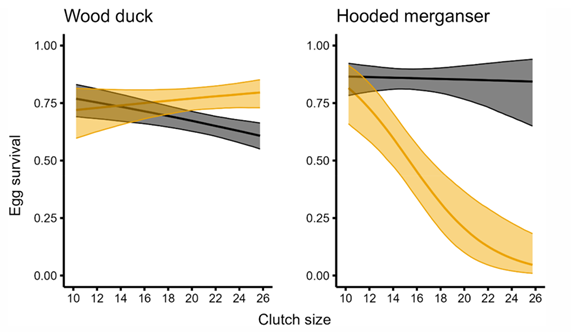
The central finding of the study was the pronounced asymmetry of this exchange, as shown in the comparative graphs below (Bakner et al., 2024a). A Hooded Merganser egg laid in a wood duck nest had a survival probability of 76.2%, nearly equivalent to that of host eggs. By contrast, a wood duck egg laid in a Hooded Merganser nest had a survival probability of only 29.3%. In short, Hooded Mergansers benefit substantially more from the interaction than wood ducks.
Mechanisms of parasitic success
Two traits appear to explain the success of Hooded Merganser eggs.
The first is eggshell strength. Hooded Merganser eggshells are roughly three times stronger than those of wood ducks (Bakner et al., 2024a). In large mixed clutches, eggs are subjected to mechanical stress, and cracked eggs are removed by the incubating host. The durable merganser shell withstands this disturbance, whereas thin-shelled wood duck eggs laid in merganser nests frequently crack, are ejected, and fail to hatch.
The second is timing. Field observations indicate that mergansers typically deposit parasitic eggs before the host begins incubation (Bakner et al., 2024a). Because wood ducks appear to target smaller clutches, which may signal nests still in the laying stage, parasitic females may use host clutch size as a cue for the nesting stage. Eggs laid early develop in synchrony with the host clutch and hatch on schedule.
Clutch size itself also favors the parasite: as parasitized clutches increase in size, Hooded Merganser egg survival remains stable or improves slightly, while wood duck egg survival declines sharply (Bakner et al., 2024a).
Consequences for the host
If Hooded Mergansers benefit from parasitism, do Wood Ducks pay a measurable cost? A companion study published the same year addressed this question by monitoring 1,295 wood duck nests in Louisiana between 2020 and 2023 (Bakner et al., 2024b). The researchers marked 2,465 female ducklings and subsequently recaptured individuals returning as breeding adults, providing a direct estimate of recruitment, the probability that a duckling survives and joins the breeding population.
The results indicated minimal impact (Bakner et al., 2024b). Nests containing Hooded Merganser eggs survived at a somewhat lower rate, likely because some early-season parasitic females produce “dump nests” that are never incubated and ultimately fail. However, because fewer than one in ten wood duck nests contained merganser eggs, the population-level effect was negligible; overall wood duck productivity in Louisiana appears largely unaffected by interspecific brood parasitism.
Recruitment was instead governed by timing on the part of the host (Bakner et al., 2024b). Nearly 75% of recruited females hatched from nests initiated before mid-April, and nest initiation date, rather than brood size, was the only significant predictor of recruitment.
There’s a New Sheriff In Town
The study also documented a new development. The black-bellied whistling-duck (Dendrocygna autumnalis), a southerly distributed species undergoing a northward range expansion, has recently joined the Hooded Merganser as an interspecific parasite of wood duck nests in Louisiana (Bakner et al., 2024b). Whistling-ducks exhibit exceptionally high rates of conspecific brood parasitism; in parts of Texas, every nest is parasitized, and clutches exceeding 50 eggs have been recorded. To date, their effect on wood ducks appears limited, though field personnel have observed aggressive interactions at nest boxes, and managers are monitoring the situation.
Conclusion
Hooded Mergansers are highly effective brood parasites, equipped with structurally robust eggs and well-timed laying behavior (Bakner et al., 2024a). Their primary host, the wood duck, nevertheless shows little measurable cost. Interspecific brood parasitism between these species is best characterized not as a competitive conflict but as a low-level, persistent cost that wood duck populations readily absorb. As this research demonstrates, the success of a parasitic egg is species-, host-, and context-specific.
References
Bakner DL, Ringelman KM, Reynolds LA. 2024. Wood duck nest survival and duckling recruitment is minimally affected by interspecific brood parasitism from hooded mergansers and black-bellied whistling-ducks. Travis SE, editor. PLOS ONE. 19(7): e0305899. doi:10.1371/journal.pone.0305899. [accessed 2026 Sept 22]. https://www.proquest.com/docview/3075014873 .
Bakner DL, Ringelman KM, Reynolds LA, Davis JB, Kaminski RM, Stephens SE. 2024. Wood ducks and hooded mergansers as interspecific brood parasites: An evaluation of parasitic egg survival. Ecology and Evolution. 14(7):1–9. doi:https://doi.org/10.1002/ece3.11721. [accessed 2026 Sept 22]. https://journals.scholarsportal.info/pdf/20457758/v14i0007/nfp_wdahmaaeopes.xml_en.
Bellrose FC. 1976. Ducks, Geese & Swans of North America. 3rd ed. Harrisburg, PA: Stackpole Books.
Birds Canada. 2024. Nature Counts – the state of Canada’s birds. Naturecountsca. [accessed 2026 Sept 22]. https://naturecounts.ca/nc/socb-epoc/species.jsp?sp=hoomer.
Cornell Lab of Ornithology. 2026. Merlin Bird ID – home. Merlin Bird ID – Free, instant bird identification help and guide for thousands of birds. [accessed 2026 Sept 29]. https://www.merlinbirds.org/.
IUCN. 2019. The IUCN red list of threatened species. IUCN Red List of Threatened Species. [accessed 2026 Sept 29]. https://www.iucnredlist.org/assessment/process.
Kitchen DW, Hunt GS. 1969. Brood habitat of the hooded merganser. The Journal of Wildlife Management. 33(3):605–609. doi:10.2307/3799384. [accessed 2026 Sept 22]. https://www.jstor.org/stable/3799384 .
Mallory ML, Lumsden HG, Walton RA. 1993. Nesting habits of hooded mergansers (mergus cucullatus) in northeastern Ontario. Wildfowl 44.:101–107. [accessed 2026 Sept 22]. https://www.bing.com/search?pglt=2467&q=Nesting+habits+of+Hooded+Mergansers+(Mergus+cucullatus)+in+northeastern+Ontario&cvid=3c7cec95b9844a9e80156e75b2c924be&gs_lcrp=EgRlZGdlKgYIABBFGDkyBggAEEUYOTIHCAEQ6wcYQNIBBzk0MmowajeoAgCwAgA&FORM=ANNTA1&PC=LCTS.
Mallory ML, Taverner A, Bower B, Crook D. 2002. Wood duck and hooded merganser breeding success in nest boxes in Ontario. Wildlife Society Bulletin (1973-2006). 30(2):310–316. [accessed 2026 Sept 22]. https://www.jstor.org/stable/3784486 .
Morse TE, Jakabosky JL, McCrow VP. 1969. Some aspects of the breeding biology of the hooded merganser. The Journal of Wildlife Management. 33(3):596–604. doi:10.2307/3799383. [accessed 2026 Sept 22]. https://www.jstor.org/stable/3799383 .
Urban I, Uwurukundo X, Stumpf D, Frey K, Reichenbach A, Francke M, Brüning R, Brunner R. 2020. Amphibious vision – optical design model of the hooded merganser eye. Vision Research. 175:75–84. doi:10.1016/j.visres.2020.05.011. [accessed 2026 Sept 29]. https://www.sciencedirect.com/science/article/pii/S0042698920301139.
This was a really informative post. Was any research conducted into whether the merganser’s eyes are affected by marine vs. freshwater? It is really interesting that they can adjust their lenses. Thank you for providing such a great resource for someone who wants to learn more.
Hi Taylor, thank you for reading my blog! The article that I reviewed on this subject (https://www.sciencedirect.com/science/article/pii/S0042698920301139) did not conduct any comparisons between their lens contraction in salt- versus fresh-water, and I wasn’t able to find any other sources pertaining to this online. My best guess is that it would not make a huge difference, as the important optical issue when mergansers dive isn’t really the salt content of the water; it’s the change in refractive index between air and water. However; I could see this being a great research question for a future study!
Wow, this is a super interesting post. I am a bit of a closet birdwatcher, but I admit I don’t know enough about the different species of ducks to name them when I see them. Thanks for bringing me up to date on one of the most distinctive species!
Glad you enjoyed the read! If you’re interested in contributing to citizen science, consider downloading the eBird app so you can record your own sightings and learn more about identification and details of BC’s birds. https://www.birdscanada.org/ebird-canada
Beautifully informative post! I found it really interesting that they will either practice brood parasitism or spend so much energy on incubating their own young. I am curious whether it is mentioned anywhere whether they will choose parasitism over rearing their own young in times of environmental or physical stress? Or are there any hypothesized causative factors that lead them to “pawn their children off”?