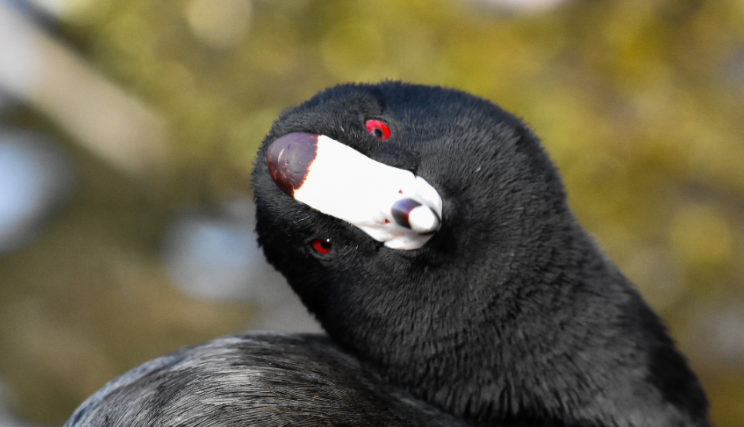
If you see a plump, chicken-like bird with bright red eyes and disproportionally large feet… you might have found an American Coot (Fulica americana).
Order: Gruiformes
Family: Rallidae
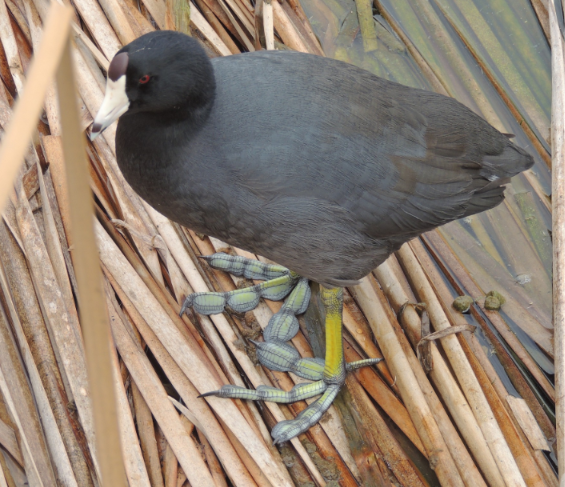
Fulica is a Latin word that means Coot and separates the coots from ‘typical’ rails by the presence of lobed toes and a frontal shield.
This is a wetland bird with a dark head and a light beak, dramatically different from other semi-aquatic birds who typically have dark beaks and brown or gray heads. The American Coot belongs to the family Rallidae, which includes species of Rails, Gallinules, and of course Coots. The Coots are considered the most aquatic of all rallids. (Birds of the World, 2020).
American Coots are hardy and well adapted to many habitat types, they have unusual behavior when compared to their secretive relatives. Flocks are loud and aggressive, often swimming in open water or found in a golf course.
Identification
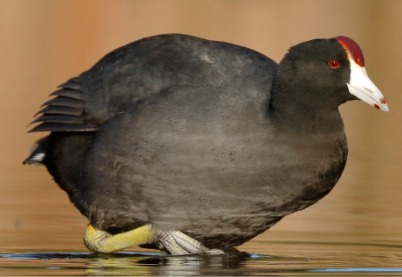
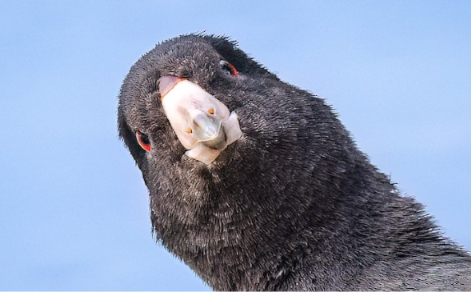
Look for a crow sized bird with broad pointed wings, and a short tail. It will have a charcoal body with a black head and neck and a white bill. Coot’s underside is an ashy-gray and their undertail coverts are white. If caught in flight, look for a white trailing edge to its secondary feathers. Immature Coots have paler grey bodies than mature adults, while very young chicks have bright red heads, appearing out of place in a marsh.
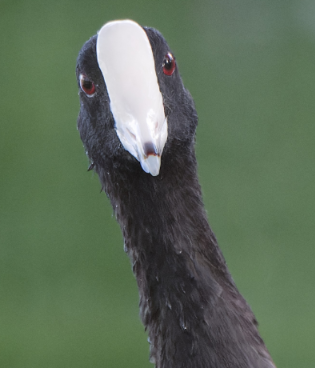
The stand-out bill features a callus at its base (frontal shield). There are two shield colours of the American Coot, white-shielded, and red-shielded. As you would expect, the red-shielded American coot has a white frontal shield with a red callus on the upper part. This is the Coot most common in North America.
The white-shielded American Coot was once considered a separate species, the Caribbean Coot (Fulica caribaea). The shield of the beak is continuous in the Caribbean Coot and a separate callus distinct from the bill in the Amercian Coot. But many arguments and no concrete decisions have been made about the taxa distinctions. In 2016 the Caribbean and American Coot were combined because shield colour was not a reliable species-level distinction. This colour variation is likely testosterone-driven, and the two forms interbreed freely, have no difference in calls or plumage. In some sources they are still considered the same species, others say they are separate sub-species while even still, some consider them separate species entirely.
In a habitat overlap with the Eurasian Coot, look for undertail coverts to differentiate species. The American Coot always has at least some white, and the Eurasian Coot has all black coverts. The Hawaiian Coot is similar in plumage to the American Coot, however its shield extends well beyond the crown of the head and is visible from the back of the bird. The American Coot shield is much more flush with the head and does not stand out when looking at the back of the bird.
Vocalizations
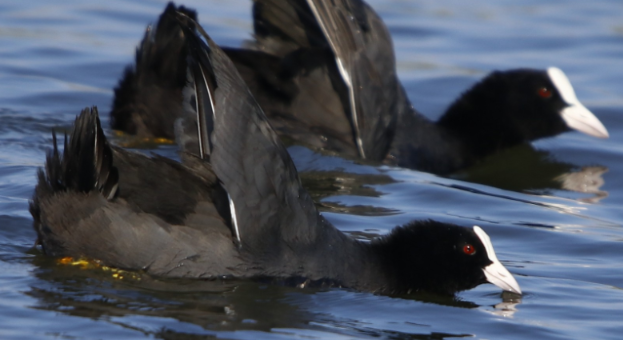
None of the sounds made by American Coots can really be considered a song. However they are not a quiet species. They make 6 different categories of sounds as adults. These can be summarized as friendly notes for mating and recognition, defense notes, and offense notes. Interestingly enough, in each of these calls there is variation in notes between males and females. This is due to sexual dimorphism of their voice box (aka syrinx). Female Coot calls tend to be lower, and more nasally while male calls are higher in pitch and very clear.
For calls, they make a hollow clucking that sounds like “krrp” or “prik”.
Figure 5: American coot call in Washington, USA. Credit Greg Irving (2025)
Distribution & Habitat
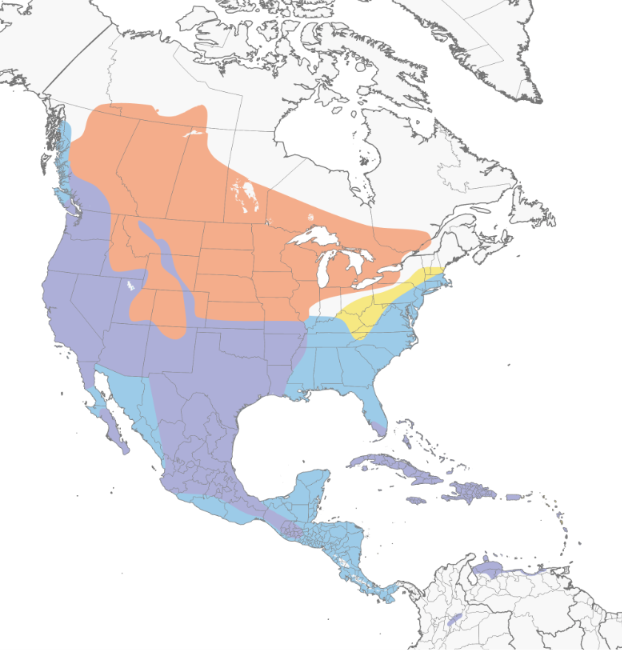
American Coots span all of North America, and have even been found as far south as Columbia and Venezuela. Their migratory habitats are not well understood, but researchers agree that the most northerly populations do in fact migrate in fall and spring. Coots are night migrators, which makes studying their dispersal difficult for those who wish to study them.
Coots live in freshwater wetlands, marshes, and ponds. Being as widely distributed as they are, they also live in highway ditches, waste impoundments, and coastal habitats. Coots require emergent vegetation like bulrushes, reeds, and cattails, so as long as those requirements are met they can live there. They have been found in salt marshes, coastal bays, and even far from last on the sea while migrating.
The map on the left shows American Coot distribution, with purple showing year round presence of birds, orange showing the breeding grounds, yellow being a migratory area, and blue being non-breeding. In the southern areas of Vancouver Island, up to Campbell River, the American Coot can be found year round, though becoming sparser in the colder months.
See here an animation showing American Coot migration data.
Breeding
American Coots move fast. Pair formation is monogamous and begins at the spring breeding area. As soon as they arrive to the breeding grounds in mid-April, a pair will begin to build a nest. These nests are built on floating platforms in dense sedges or reeds. The breeding grounds must have shallow fresh water, with thick marsh vegetation for protection. Within those parameters however, the American Coot is highly adaptable. In years of high rainfall, seasonal wetlands will be used, while permanent wetlands are preferred in years of low water.
In Manitoba and North Dakota, American Coots were found to favour prairie pothole habitats. During breeding Coots were avoidant of brackish waters despite their use of saline habitats for migration and wintering. Very rarely the Coot builds a nest on the edge of a vegetative stand, making the nest highly visible. In these cases a parent will fiercely guard the nest, even more than they typically do.
Eggs and Young
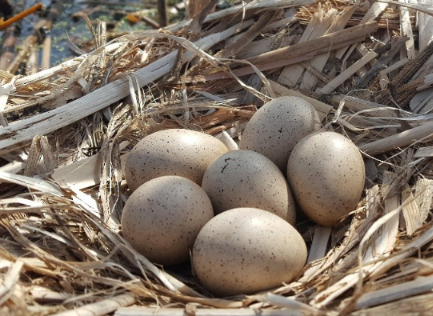
They lay 2-12 grayish eggs with brown spots in a clutch, however only 2-5 of these eggs will live long beyond hatching. Both sexes work together to incubate these eggs for up to 27 days. This hatching process is asynchronous as Coots only lay one egg every 3-4 days, meaning the first egg will hatch 3-4 days before the final egg. Couples may have 2 broods per year depending on resource availability.
The young are considered semi-precocial meaning they are mobile on their own, but need some assistance feeding and are not yet able to fly. Coot chicks are still cared for at night in a nest-like platform built by the male for overnight brooding. However, about three to five days into their ‘fledgling-hood’, the adults grow annoyed with the chicks and signal to them that it is time to learn to feed on their own. This message is delivered with a few bites to the head. After this discipline the chicks attempt to feed on their own and are able to fly by 8 weeks after hatching.
Socialization
A very odd parenting phenomenon was documented in ‘The Life of Birds’ with David Attenborough. They proposed that adult coots punished begging chicks in order to test their resilience. Eventually concentrating punishment on a few chicks, who will eventually give up asking for food and starve to death. For the Coot, this strategy lowers the demands for parental care potentially giving a better chance to the surviving fledglings.
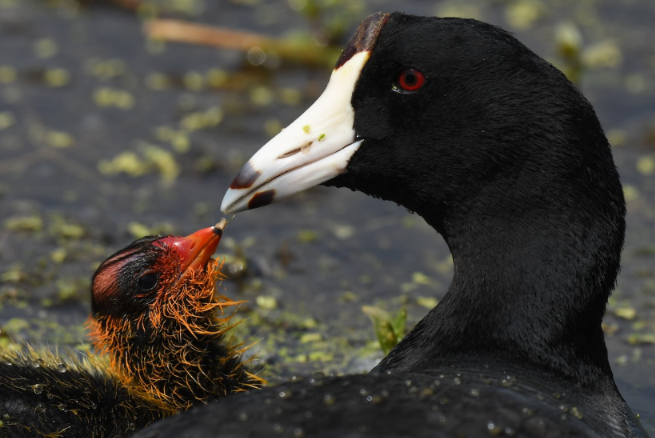
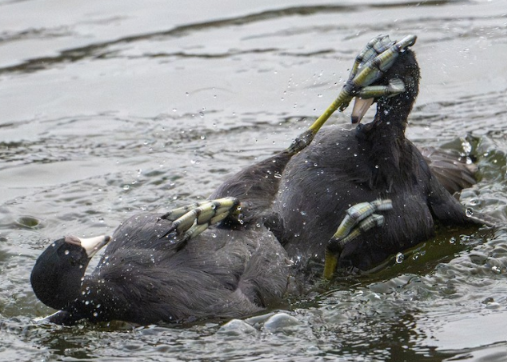
Adults have been observed using pieces of food in their beaks to tempt chicks down into the water for swimming lessons. Both parent Coots will then guide their chicks to food and dive, bringing up amphipods and shrimp from the water. During this sensitive time in a young American Coot’s life, the adults are extra protective. Nearly regardless of size, other birds will be fiercely told off by the parents from the moment they enter a feeding ground. They use their long legs and wide feet to kick intruders, and scream at them creating chaos to show their ownership of the area.
Other ways of defending their territory is by slapping the water loudly with their feet, patrolling its boundaries like a prison guard. This stops intruders from getting too close by giving an audible signal when hidden in heavy cover of vegetation.
Locomotion
American Coots can be seen mixing will all sorts of ducks in their freshwater habitats. In these waters, Coots use segmented toes and rear placed legs to dive and feed underwater. The lobes on their feet help them propel through the water, and each lobe folds back when the Coot lifts its leg, allowing them to walk better than a duck. Their long toes also assist them in walking through marshland that they would otherwise sink in.
When above the waters surface, they swim along with a back-and-forth motion of the head, bobbing along. While walking on land, the same head nodding will be observed.
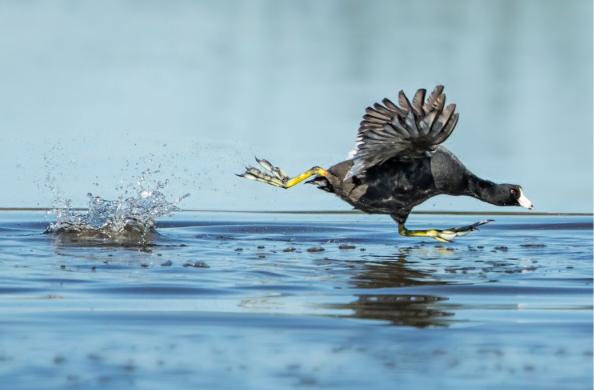
In order to get into the air, a coot will run clumsily over the waters surface before taking flight. They fly with all limbs outstretched, including their legs and large lobate toes. An extremely rare and exciting sight would be to observe a flock of flying American Coots. They tend to prefer flying at night, especially extended distances.
Diet
Coots are opportunistic omnivores, meaning they’ll eat just about anything that it can get in its mouth. Aquatically they prefer to forage in areas with plentiful emergent macrophytes, which are essentially large plants that are embedded in the substrate. They dabble on the waters surface, pecking at floating vegetation and insects or dive for food underwater. While diving, all food caught was brought to the surface to be consumed.
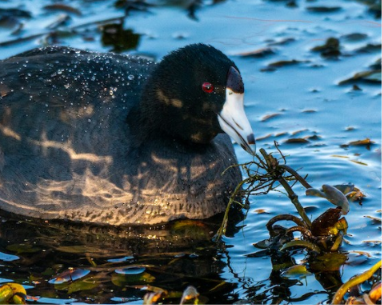
Some plants Coots like to eat include pond-weeds, algae, sedges, and wild grasses. Animal matter is less common in diet, however it becomes an important component during the breeding season to quickly grow young. In particular, insects, mollusks, spiders, and crustaceans. In the Southern United States, American Coots have been found to learn how to exploit nearby seafood farms. This has resulted in a population of Louisiana Coots that feed at crawfish farms, with some becoming bold and moving on to larger animal prey including vertebrate larvae and fish.
American Coots don’t always do all this work themselves. They are considered to be kleptoparasitic, and will steal food from other waterfowl that feed nearby.
So, if you see a Coot on its own… they might have wronged another bird nearby.
Cultural Significance

American Coots are generally associated with craziness, which may be due to their odd appearance or because of the way they swim. Several indigenous traditions assign the role of “earth-diver” to Coots and other diving birds. This is a story where animals try to dive to the bottom of the first body of water to form on Earth. The successful animals bring up mud which becomes the land we stand on today. In Cheyenne culture, the Coot is the last animal to attempt diving to the depths of the sea. Upon bringing up the mud, a turtle is said to volunteer to hold the mud on its back as the creator works to create ground. This story attributes the creation of Earth as we know it to the Coot (and of course the turtle). Aquatic birds are often linked to weather for indigenous people, bringing rain and weather predictions. (Hailey Brophy, 2022).
Conservation Status
Population numbers are in the low 7 millions. This puts American Coots in the IUCN Status of least concern. There are no current surveys specific to American Coots to monitor breeding or wintering areas.
The main concern to American Coots along with other wetland species is habitat loss. Coots however are more resilient than dabbling ducks because they naturally prefer semipermanent marshes. Dabbling ducks tend to prefer seasonal wetlands which are at a greater risk of loss.
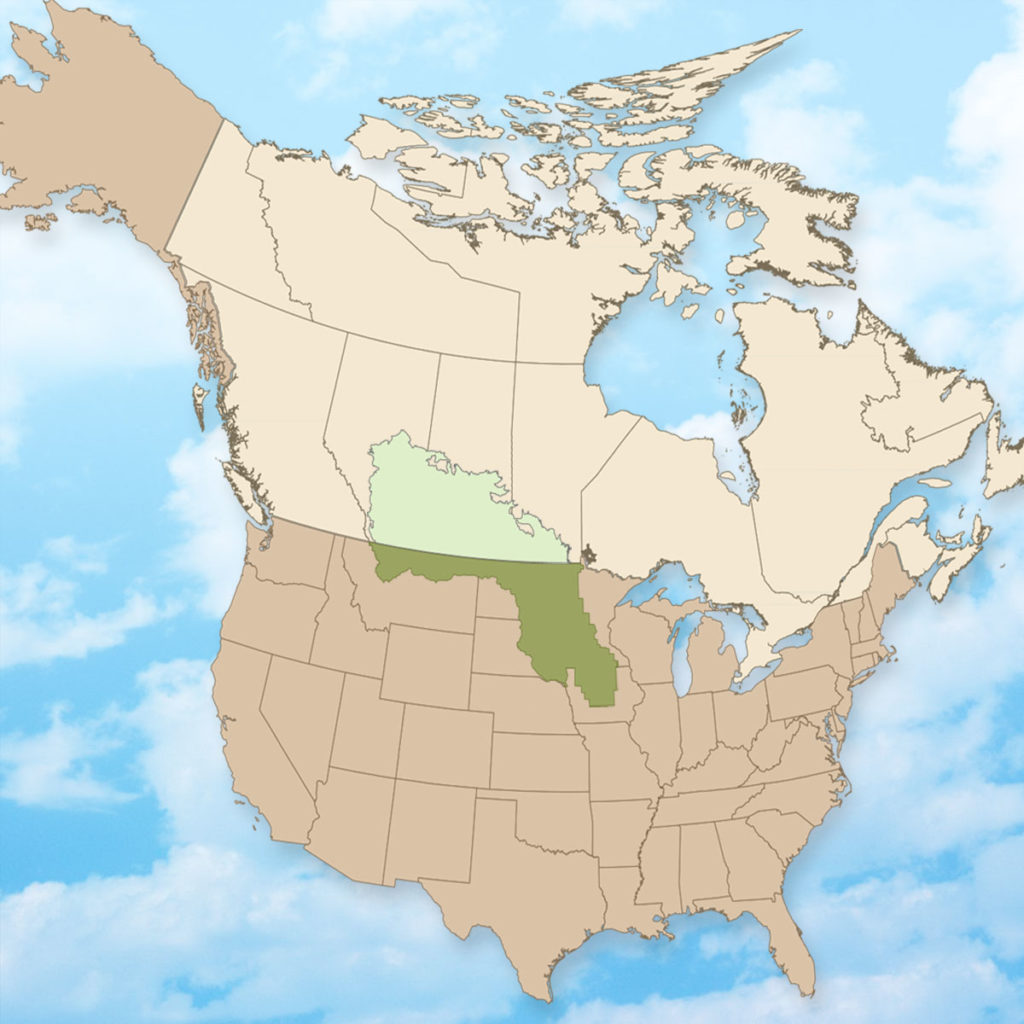
Currently, conservation of wetlands is taking place in the Prairie Pothole Region for semipermanent wetlands. This area consists of millions of glacially formed wetlands and surrounding grasslands. It is known as one of the most important migratory bird habitats and is a “duck factory”.
However maintenance and protection of wetland habitats in the Southern US and Mexico is equally as crucial to ensure overwintering survival.
An Exploration of Strange Coot Chicks
Before diving in to the studies below, its important to be reminded what American Coot fledglings look like.
Do American Coot parents prefer highly ‘decorated’ offspring?
Generally fledglings are covered in a cryptic natal plumage to keep them hidden from predators. American Coots turn this on its head and are covered with orange and red feathers when they hatch. The head feathers are highly modified and lack a down portion completely, this means they serve no thermoregulatory function and must be for signaling of some sort. The top of the head is brightly coloured and completely naked. They are one of the most highly decorated young in the entire animal kingdom. As this colourful plumage is lost by the age of three weeks, meaning sexual selection cannot be used to explain this ornamentation. Peacocks have magnificent plumage too, but it’s for attracting a mate, so why would a chick show such extravagant plumage at only a few days old? Since being brightly coloured and flightless causes high risk of predation, there must be some other advantage to the plumage.
Parents are often observed to have favourite offspring and show this through allocation of food. If American Coot parents feed offspring with the most extreme colouration or patterning, that could result in the evolution of this strange fledgling trait. Coot chicks were shown to not vocalize when begging for food, and instead silently approach the parent presenting their plumage or naked head. “These displays suggest that parents assess chick plumage during feeding.” (Lyon, 1994).
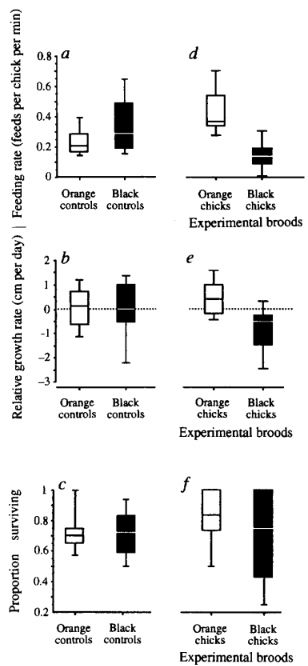
To test their hypothesis researchers manipulated the plumage of chicks in an American Coot population in central BC in 1992. They took 90 breeding pairs of Coots on 3 permanent wetlands and altered chick appearance by trimming the orange tips of their body feathers. In each brood, only half of the chicks were trimmed (now deemed ‘black’ chicks) and the other half were left with plumes intact (‘orange’ chicks). The black chicks only had orange plumage left on their throats which closely resemble ancestral appearances of Rallids. Other than the trimming, all chicks were handled in a similar manner and released to their parents after 30 minutes in captivity.
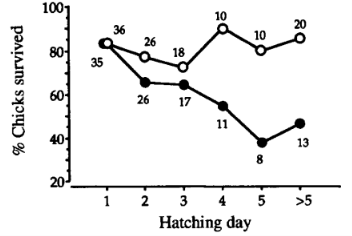
Late-hatched orange chicks had dramatically higher survival rates than late-hatched black chicks, but this difference was very minor in early-hatched chicks. This was expected due to the patterns of parental care in American Coots where the adults allow chaos to take over for the first 10 days where the biggest and earliest-hatched chick will physically overpower the others and wins most meals. Finally, after the initial ‘cull’ around day 10 the parents will allocate nearly 80% of food resources to their favourite (the brightest) later-hatched chick. Therefore ornamentation increases the chances that a chick will be chosen as a favourite once brood division takes place.
American Coots are brood parasites, meaning a mother Coot sneaks eggs into nests of other Coots to pass off the burden of parental care to another. If parents prefer the ‘fancy’ plumage, it would make sense for the parasitic chicks to be the flashiest in order to trick their host into feeding them most. However, in the studies done by Bruce Lyon, Daizaburo Shizuka, and others in 1994 and 2007 proved the opposite. Parasitic chicks are consistently duller, why? Female American Coots lay their best eggs first, when she is not being a parasite, instead focusing on starting her own clutch first. The last few eggs tend to receive less nutrients in development, and therefore tend to be duller in plumage colour while also ending up as the parasitic chicks.
Parents will favour late-hatched colourful chicks because they are both less likely to be parasitic chicks and are also most ‘flashy’ and get parental attention easier in an otherwise dull environment.
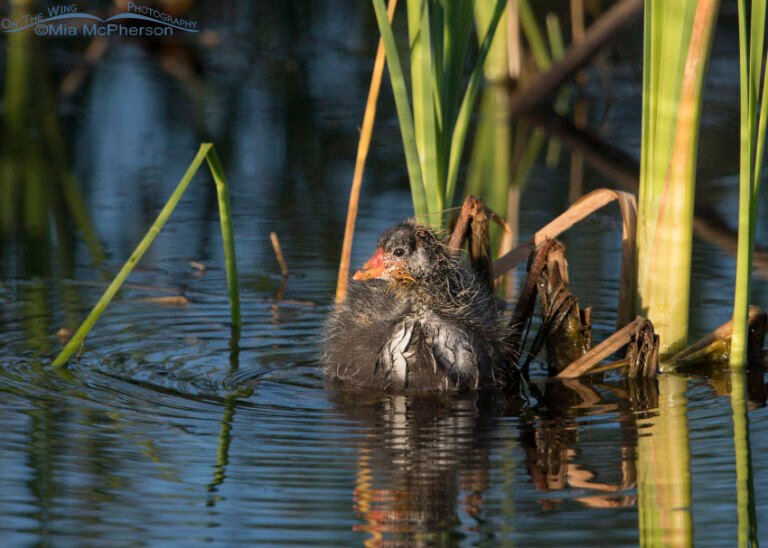
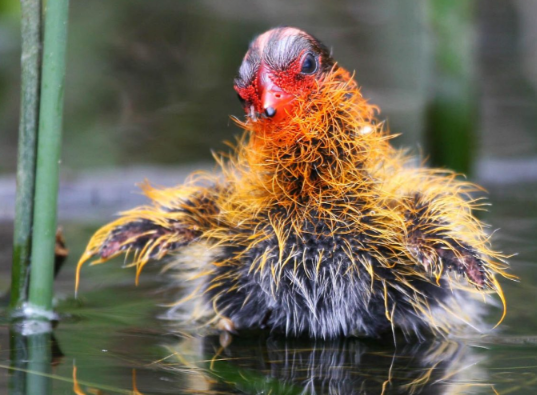
This all comes together to give us a better understanding of the importance of ornamentation in American Coot hatchlings. The idea that plumage was used to fool host parents into favouring chicks that are not their own can be rejected. The decoration and colouration of chicks is used to give parents a signal of birth order in order, to focus resources on the chicks most likely to be theirs, and avoid wasting feeding efforts onto parasitic chicks.
Studies Reviewed
Lyon, B. E., & Shizuka, D. (2020). Extreme offspring ornamentation in American coots is favored by selection within families, not benefits to conspecific brood parasites. Proceedings of the National Academy of Sciences of the United States of America, 117(4), 2056–2064. https://www.jstor.org/stable/26897803.
Lyon, B. (2007). Mechanism of egg recognition in defenses against conspecific brood parasitism: American coots (fulica americana) know their own eggs. Behavioral Ecology and Sociobiology, 61(3), 455-463. https://doi.org/10.1007/s00265-006-0273-2
Lyon, B. E., Eadie, J. M., & Hamilton, L. D. (1994). Parental choice selects for ornamental plumage in american coot chicks. Nature (London), 371(6494), 240-243. https://doi.org/10.1038/371240a0
References
American coot. Audubon. (2026). https://www.audubon.org/field-guide/bird/american-coot
American coot – migration: Bird migration explorer. Migration | Bird Migration Explorer. (2026). https://explorer.audubon.org/explore/species/1527/american-coot/migration?layersPanel=collapse&legend=collapse&zoom=2.69395129972336&x=18882.701349999756&y=2270428.4733499996&range=0.7976%2C0.8176
American coot overview, all about birds, Cornell Lab of Ornithology. All About Birds. (n.d.). https://www.allaboutbirds.org/guide/American_Coot/overview
American Coot. Xeno-Canto. (2005). https://xeno-canto.org/species/Fulica-americana
BBC Studios Natural History Unit. (1998). The Life of Birds. United Kingdom.
Brisbin Jr., I. L. and T. B. Mowbray (2020). American Coot (Fulica americana), version 1.0. In Birds of the World (A. F. Poole and F. B. Gill, Editors). Cornell Lab of Ornithology, Ithaca, NY, USA. https://doi.org/10.2173/bow.y00475.01
Brophy, H. (2022). Coot Symbolism & meaning (+totem, Spirit & Omens). World Birds. https://worldbirds.com/coot-symbolism/
Cornell Lab. (n.d.). American coot (red-shielded) – fulica americana (red-shielded). Macaulay Library. https://search.macaulaylibrary.org/catalog?taxonCode=amecoo&sort=rating_rank_desc
Ducks Unlimited. (n.d.). American Coot: Ducks Unlimited. View State Page. https://www.ducks.org/hunting/waterfowl-id/american-coot
Lepage, D. (2003). Fulica Americana (American coot) – AVIBASE. Avibase – The World Bird Database. https://avibase.bsc-eoc.org/species.jsp?avibaseid=4FB248BAEFEC2868
Lyon, B. E., & Shizuka, D. (2020). Extreme offspring ornamentation in American coots is favored by selection within families, not benefits to conspecific brood parasites. Proceedings of the National Academy of Sciences of the United States of America, 117(4), 2056–2064. https://www.jstor.org/stable/26897803.
Mark, J. J. (2023). Lakota Sioux Creation Story. World History Encyclopedia. https://www.worldhistory.org/article/2279/lakota-sioux-creation-story/
Merriam-Webster. (n.d.). Fulica. In Merriam-Webster.com dictionary. https://www.merriam-webster.com/dictionary/Fulica
Redpath, M. (2025). American coot: The craziest feet in the pond. Traveling Nature Journal. https://travelingnaturejournal.com/american-coot/
It was very interesting to read about how fiercely they protect their young. Are they known to ‘snap’ at intruders with their bills? Like a Canada goose might?
Or do they reserve the biting for their own young.