Introduction
To begin, let’s talk about the basics. What are they? The bufflehead (Bucephala albeola) is a small diving duck that can be found across North America. The diving is in reference to how they capture food. The other type of duck is a dabbling duck, who use their bills to scoop food from the water’s surface. The buffleheads spend a lot of time underwater to hunt, so they may be a little difficult to spot. They can remain underwater for only around 13 seconds at a time but may dive frequently (Cornell Lab, 2026). They really are small quackers, remaining mostly silent. When they do quack, females produce a sound like a croak and males more of a squeak or growl (Sibley, 2016).
Order Anseriformes
Family Anatidae
Genus Bucephala
Who are you?
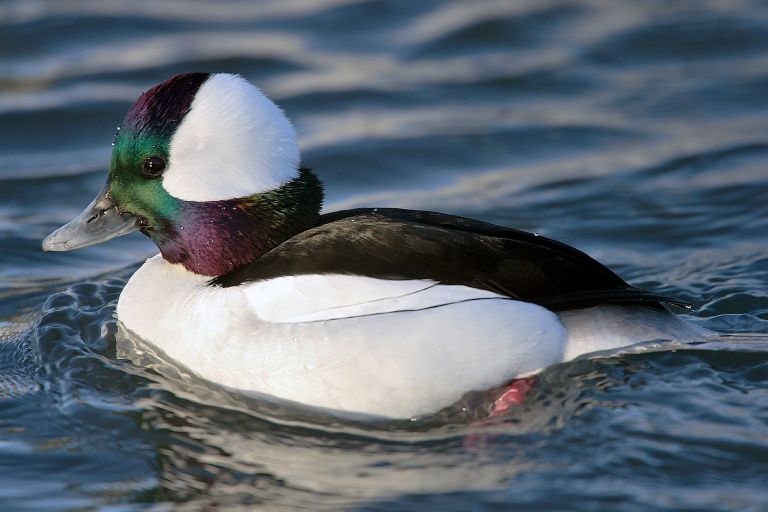
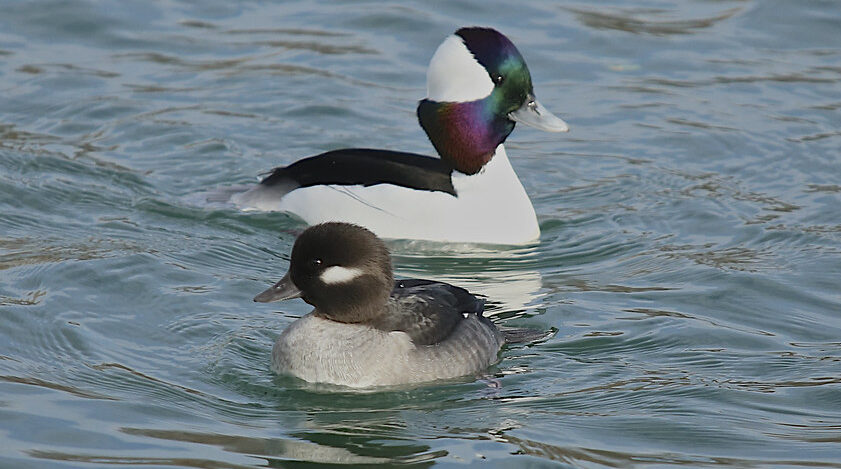
They are grouped with the goldeneyes, Bucephala, who all also have bulbous heads. The scientific name means ‘bullheaded, white’, in reference to the odd shape of their heads and the white patch found on the backs of the adult males’ heads. The rest of an adult male’s head is iridescent, and they have a body mainly white with some black on the wings and back. The females are less distinctive with a gray-brown body and head, with an oval white patch on their cheeks. The juvenile males in their first winter can be mistaken for females, as they do not yet have their full head colour or white on their bodies. The buffleheads are the smallest of the diving ducks and almost the smallest of all the ducks, about 380g (Sibley, 2016).
Tiny but mighty
Being so small allows them to take advantage of small cavities for nesting, which is commonly old Northern Flicker holes in trees. That is, holes the Flickers have made with their beaks, looking for food. Although these are small cavities for duck species, for cavity-nesting birds in general they are on the large side. This is comparing to species like chickadees, who can use even smaller spaces (Edworthy et al, 2018). Their clutches vary from 4-17 eggs and are plain cream coloured or buff. Breeding occurs in forested areas near lakes or ponds in warmer weather, and involves some courtship. Males will fly over, land in the water and bob their heads at females, crests raised. Even though they’re small, they’ll still fight! They can be very territorial during this time, once they have a mate the males may attack others and chase them out if their territory. This is not a red flag for the ladies, buffleheads are monogamous and will mate with the same partner for multiple years in a row (Cornell Lab, 2026). This doesn’t mean they will mate for life, by the sounds of things they may switch things up and choose a new mate some years, but will only have one mate at a time.
What’s for dinner?
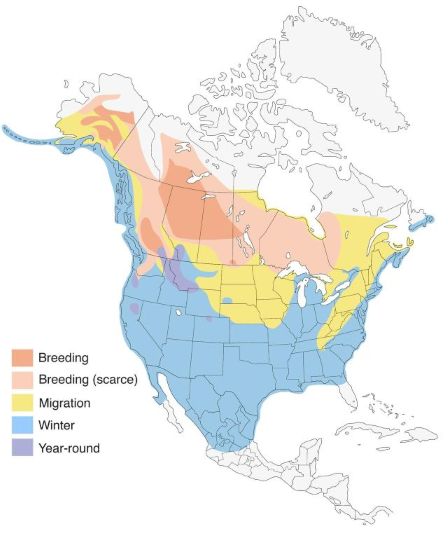
Depends on the time of year. They eat a variety of foods and dive underwater to hunt small invertebrates and will eat mollusks, seeds, aquatic vegetation and fish. In the warmer weather they will be in areas of freshwater with lakes and ponds, eating the invertebrates, and in winter will be on coastlines and on beaches, with the mollusks (Cornell Lab, 2026).
Who’s counting?
Buffleheads are in the category of least concern, so no need to worry about their cute selves going anywhere. They had previously been hunted extensively and populations dwindled, but their numbers are increasing. Now, up to 250,000 are still hunted per year but have a population of around 1.3 million (Cornell Lab, 2026). It’s possible this number could be farther from reality, as it is common for reported birds to be undercounted and misidentified. It can be difficult to identify and accurately count, especially if they’re flying over (Brusa et al, 2024). However, research shows that citizen science can greatly help accuracy in these numbers and provide data for areas not reached by long-term studies such as the WBPHS (Waterfowl Breeding Population and Habitat Survey)(Adde et al, 2021). So get on eBird and make those lists for science!
Research
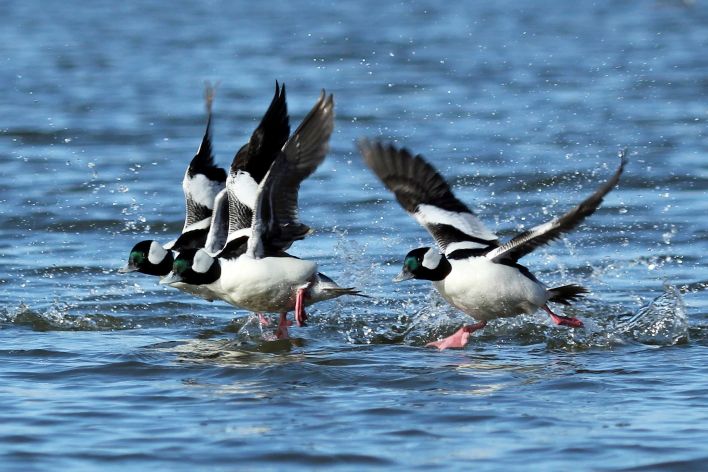
The avian influenza viruses (AIV) are a type of virus that is zoonotic (spreads across species) and can spread rapidly. It’s difficult to track and determine where breakouts originate because it’s generally asymptomatic in wild populations (McBride et al, 2021). Unfortunately buffleheads are among the populations of waterfowl that can be affected by AIV. They are one species that has been monitored for how the viruses are spreading and factors that may influence this. AIV naturally originates in waterfowl, sometimes mutating, and spreads to domestic flocks like chickens. This mutating is what can lead to aggressive strains of the virus, and portions of pandemic-causing viruses have been shown to contain portions of AIV DNA. This would indicate that avian populations are hosts involved in the spread of these viruses to humans and other animals. What influences the spread of viruses like this is not fully known, but a possible theory is overlap between different populations of waterfowl. The greater the overlap, the more the virus seems to spread, since it has access to more juveniles with immune systems not fully developed. Species more closely related may also be more likely to contract the virus from others (Hicks et al, 2022). Sea ducks like the bufflehead also have varied and complex behaviours and use of their environments, especially migration, so this may also contribute to the virus spread. Their migration is also what makes it difficult to study and sample the virus, so although the sea ducks may be important in the spread of AIV, they are understudied and not a lot of information is currently available (McBride et al, 2021).
We likely will continue to have outbreaks of AIV, since it mutates and we can’t exactly tell the wild birds where to avoid flying. This doesn’t mean one should be afraid of waterfowl. Rather, be mindful of interactions and wash your hands if you come in contact with them, just in case. It’s generally wise to keep your footwear clean if you plan on visiting a farm and interacting with the animals there too. The virus can be very fatal and spread easily amongst domestic flocks, so unfortunately culling flocks is the only viable option to avoid losing everything. Viruses are difficult to remove from an environment as well, so prevention and regular cleaning with appropriate chemicals is the only way to go.
References
- Adde, A. et al. Integrated Modeling of Waterfowl Distribution in Western Canada Using Aerial Survey and Citizen Science (eBird) Data. Ecosphere, 12(10). 2021. https://doi-org.ezproxy.viu.ca/10.1002/ecs2.3790
- Brusa, J. et al. Correcting for Measurement Errors in a Long-Term Aerial Survey With Auxiliary Photographic Data. Ecosphere 15(8). 2024. https://doi-org.ezproxy.viu.ca/10.1002/ecs2.4961
- Cornell Lab, All About Birds. Cornell University. 2026. https://www.allaboutbirds.org/guide/Bufflehead/overview
- Edworthy, A. et al. Tree Cavity Occupancy by Nesting Vertebrates Across Cavity Age. The Journal of Wildlife Management, 82(3):639-648. 2018. https://www.jstor.org/stable/26608002
- Hicks, J. et al. Host Diversity and Behavior Determine Patterns of Interspecies Transmission and Geographic Diffusion of Avian Influenza A Subtypes Among North American Wild Reservoir Species. PLOS Pathogens 18(4). 2022. https://doi.org/10.1371/journal.ppat.1009973
- McBride, D. et al. Genomic Evidence for Sequestration of Influenza A Virus Lineages in Sea Duck Host Species. Viruses 13(2):172. 2021. https://doi.org/10.3390/v13020172
- Sibley, D. Sibley Birds West. Alfred A. Knopf. 2016.
- Figure 1, banner image: Mathew Filosa. https://www.audubon.org/field-guide/bird/bufflehead
- Figure 2: Archaeodontosaurus. 2018. https://commons.wikimedia.org/wiki/File:Bucephala-albeola-007.jpg
- Figure 3: Yankech Gary. 2015. https://www.flickr.com/photos/49663413@N08/15560718213
- Figure 4: Cornell Lab. 2026. https://www.allaboutbirds.org/guide/Bufflehead/maps-range
- Figure 5: John West. https://www.audubon.org/field-guide/bird/bufflehead
