If you’ve ever been hiking through the woods, you might have heard what sounds like Tinkerbell trying her hand at demolition work. But don’t worry! It’s (probably) just a Downy busy building a cozy home.
The Downy Woodpecker (Dryobates pubescens) is a familiar sight to most people, and if you haven’t seen them, you’ve probably heard them. These noisy little guys are apart of the Order Piciformes and Family Picidae, which consists of woodpeckers and their relatives (Cornell Lab of Ornithology, 2017).
Identification
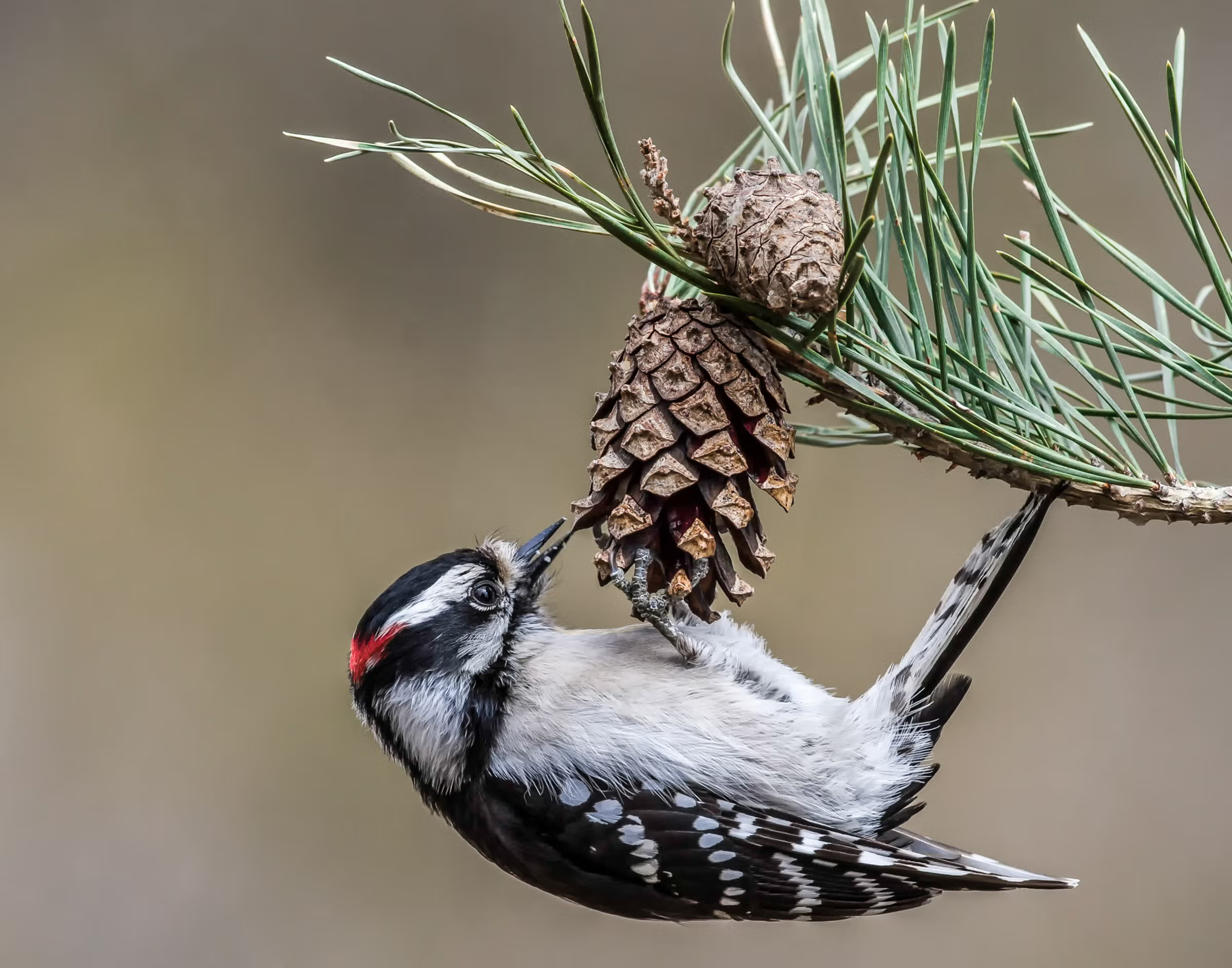
The Downy Woodpecker has a pretty distinct look that’s hard to miss once you know what you’re looking for. They have black and white feathers, creating a checkered pattern on their wings, with bold black-and-white stripes on their head. They also have chisel-shaped bills, sturdy shoulders, and stiff tail feathers that help them cling to tree trunks while searching for food. Measuring just 14–17 centimetres long, they have a smaller body plan than other woodpeckers, with a noticeably shorter bill than many of their relatives (Cornell Lab of Ornithology, 2017).
Young Downies hatch with a reddish patch on their crown, but as they mature, females lose this marking while males retain it, with the red marking migrating to the back of their heads.
A Hairy Situation
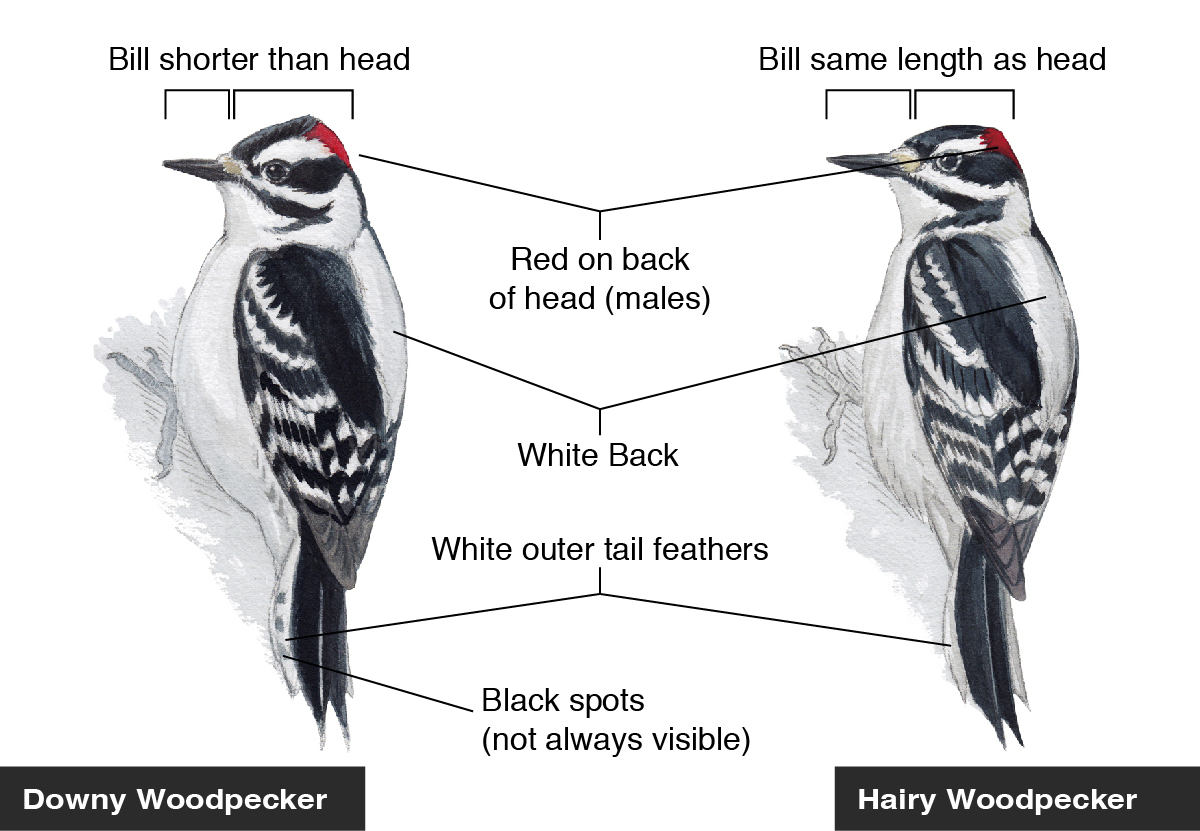
Spotting the difference between Downy and Hairy Woodpeckers can be tricky, as they share similar black-and-white markings making them very easy to mix up. Size can help, but it’s not always easy to judge when you don’t have both birds standing side by side.
The best clue is their bill, with Downies having bills smaller than their heads, and Hairy Woodpeckers having bills that are roughly the same length as their head (Welch, 2023).
Sound
Downy Woodpeckers have three identifiable sounds that they produce, two being calls and one being their drumming.
The whinny call is a fast, high-pitched series of notes that drops at the end. They use this call for attracting and contacting mates.
Their other call is a high-pitched pik-pik-pik, this is used for contact calling, predator alerts, and to ward off rivals.
The last distinct sound is their iconic drumming. This sound is produced when they hammer their beaks against trees. This is used for communication, territory squabbles, and when they excavate cavities to nest in (Hernbroth, 2023).
Where to find downies
Downy Woodpeckers are pretty much everywhere in North America, ranging from Alaska all the way down to Florida. These birds are year-round residents, meaning they live and breed in the same area without migrating (Cornell Lab of Ornithology, 2017).
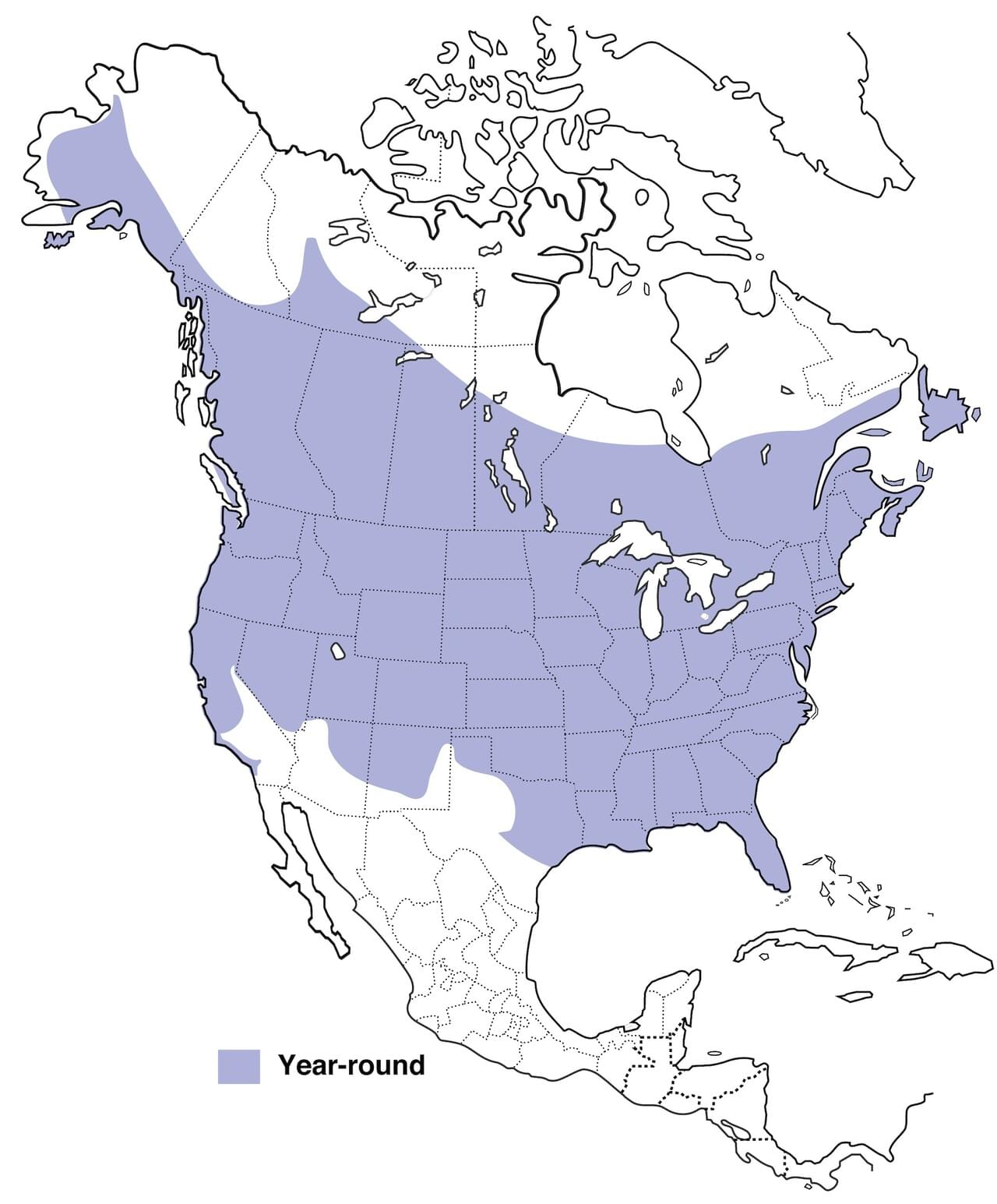
They aren’t particularly fussy about where they settle down (even nesting inside building walls), but they do favour open habitats such as deciduous and mixed woodlands, parks, swamps, and backyards (Cornell Lab of Ornithology, 2017). You can look for them hopping along tree trunks and branches or exploring tall weeds in search of food.
Behaviour
Feeding
Using their short, sharp bills, Downies spend most of their day pecking at tree bark and dead wood to uncover insects and larvae.
Their foraging behaviour also differs between the sexes. Matthysen et al. (1991) found that males generally searched for food on thinner branches than females. When males were absent, females sometimes shifted towards using thinner branches themselves. This suggests that social dominance may influence where these birds forage.
Social Lives
During winter, these birds sometimes join mixed-species flocks, hanging out with other birds such as chickadees, titmice, and nuthatches. Sullivan (1984) found that Downy Woodpeckers foraging alone spent more time scanning their surroundings for danger and less time finding food. But when they join larger groups of three or more birds, they dont have to keep a close eye on potential threats as much and can spend more feeding. The birds also respond quickly when their flock grows or shrinks, and will adjust their alertness accordingly.
Nesting
Rather than building a traditional nest of twigs and leaves, breeding pairs will take turns excavating a cavity in soft, decaying wood.
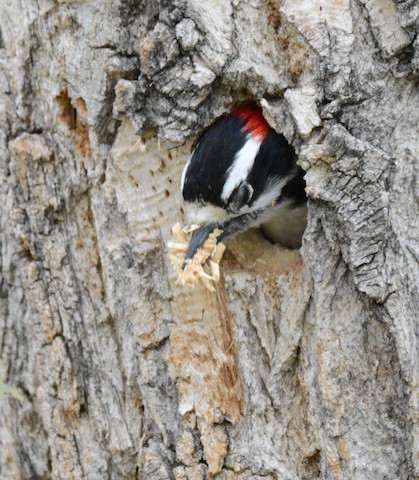
Once they’ve made themselves a home, they’ll typically lay four to six eggs. With both parents contribute to raising their young, males play an important role by incubating eggs at night and help to brood and feed the chicks. Unlike most male birds, they can even develop a brood patch. Once the young leave the nest, they continue relying on their parents for several weeks while learning to find food independently (Winkler, 1995).

A Little Peck Goes a Long Way
Despite its size, the Downy Woodpecker plays a big role in keeping forest ecosystems healthy. Its diet includes insects and larvae found beneath tree bark, helping regulate insect populations that may damage trees.
Their home building skills also comes in handy. Once abandoned, the cavities that Downies make when nesting can provide shelter and nesting opportunities for other animals that cannot easily create their own homes (Bacchi, 2023).
Conservation Status
The Downy Woodpecker has a widespread distribution and a relatively stable population, so it is currently classified as Least Concern on the IUCN Red List (BirdLife International, 2025). Its ability to adapt to different environments, including forests, parks, and suburbs, helps it thrive across most of its range.
Although it has a healthy overall status, protecting suitable habitats remains important for its long-term survival. The loss of trees and wooded areas can take away access to food, shelter, and nesting sites. Maintaining diverse woodland habitats and preserving dead trees can help these little birds continue to flourish (Bacchi, 2023).
Recent Research
All is Fair in Love and War
Downy Woodpeckers get very territorial during the breeding season and will use a combination of drumming, calls, and coordinated behaviour to keep intruders at bay. A study by Schuppe et al. (2016) explored how these pairs respond to potential threats by playing recordings of woodpecker drumming. The longer drum sequences mimic a bigger threat and shorter ones to represent a less threatening visitor.
When the intruder seemed less threatening, the first bird to respond toned down its aggressive signals once its partner arrived, while the second bird increased its aggression. This suggests that the pair may share the responsibility of defending their territory rather than both birds maintaining the same level of effort.
But when the intruder sounded more threatening, both birds kept up their stronger defensive displays. Researchers also found that short calls known as “pik calls” were associated with the partner’s aggressive behaviour under these higher-threat conditions.
So Downies don’t just randomly chase away intruders, but they actually adjust their defensive tactics according to the situation and their partner’s behaviour, avoiding potential risks associated with territorial disputes (Schuppe et al., 2016).
Mini Jackhammers
Have you ever wondered how a woodpecker can hammer away at a tree without getting completely knocked off balance? A study by Antonson et al. (2025) explored how Downy Woodpeckers coordinate their muscles and breathing while pecking. Researchers found that muscles in the birds’ heads, necks, abdomens, hips and tails all play a part. Some muscles help swing the head forward, others stiffen and support the neck, and the tail helps brace the body against the tree.
Downy Woodpeckers will even time their breath and pecks, breathing out as their bills strike the wood. This may help stabilise their bodies and support the force of each hit. And when they get tapping rapidly, the birds take tiny breaths between strikes, breathing roughly nine times per second (more than three times their average resting rate). The study also found that some muscles worked harder during longer tapping sequences, helping the birds keep their movements going.
These findings suggest that Downy Woodpeckers are just small jackhammers wearing fancy checkered coats and red toupees.
References
Downy woodpecker overview, all about birds, Cornell Lab of Ornithology. (2017). Allaboutbirds.Org. https://www.allaboutbirds.org/guide/Downy_Woodpecker/overview
Downy woodpecker identification, all about birds, Cornell Lab of Ornithology. (2017). Allaboutbirds.Org. https://www.allaboutbirds.org/guide/Downy_Woodpecker/id
Welch, K. (2023, January 4). Downy and hairy woodpeckers | bird academy • the Cornell Lab. CornellBirds. https://academy.allaboutbirds.org/downy-and-hairy-woodpeckers/
Hernbroth, A. (2023, December 4). What sounds do a downy woodpecker make? – Birdful. Birdful. https://www.birdful.org/what-sounds-do-a-downy-woodpecker-make/
Matthysen, E., Grubb, T. C., & Cimprich, D. (1991). Social control of sex-specific foraging behaviour in downy woodpeckers, Picoides pubescens. Animal Behaviour, 42(3), 515–517. https://doi.org/10.1016/S0003-3472(05)80057-0
Sullivan, K. A. (1984). The advantages of social foraging in downy woodpeckers. Animal Behaviour, 32(1), 16–22. https://doi.org/10.1016/S0003-3472(84)80319-X
Winkler, H. (1995). Woodpeckers : a guide to the woodpeckers of the world (pp. 31-32). Houghton Mifflin. https://ebookcentral.proquest.com/lib/viu/reader.action?docID=738762&ppg=43&c=UERG
Bacchi, A. (2023, May 12). Is the downy woodpecker endangered – the bird identifier. The Bird Identifier. https://thebirdidentifier.com/is-the-downy-woodpecker-endangered/
BirdLife International. (2025). Dryobates pubescens. The IUCN red list of threatened species 2025: E.T22681155A141048303. International Union for Conservation of Nature and Natural Resources (IUCN). The IUCN Red List of Threatened Species. https://www.iucnredlist.org/species/22681155/141048303
Schuppe, E. R., Sanin, G. D., & Fuxjager, M. J. (2016). The social context of a territorial dispute differentially influences the way individuals in breeding pairs coordinate their aggressive tactics. Behavioral Ecology and Sociobiology, 70(5), 673–682. http://www.jstor.org.ezproxy.viu.ca/stable/44857010
Antonson, N. D., Ogunbiyi, S., Champigneulle, M., Roberts, T. J., Goller, F., & Fuxjager, M. J. (2026). Correction: Neuromuscular coordination of movement and breathing forges a hammer-like mechanism for woodpecker drilling. Journal of Experimental Biology, 229(2), Article jeb252195. Antonson, N. D., Ogunbiyi, S., Champigneulle, M., Roberts, T. J., Goller, F., & Fuxjager, M. J. (2026). Correction: Neuromuscular coordination of movement and breathing forges a hammer-like mechanism for woodpecker drilling. Journal of Experimental Biology, 229(2), Article jeb252195. https://doi.org/10.1242/jeb.252195