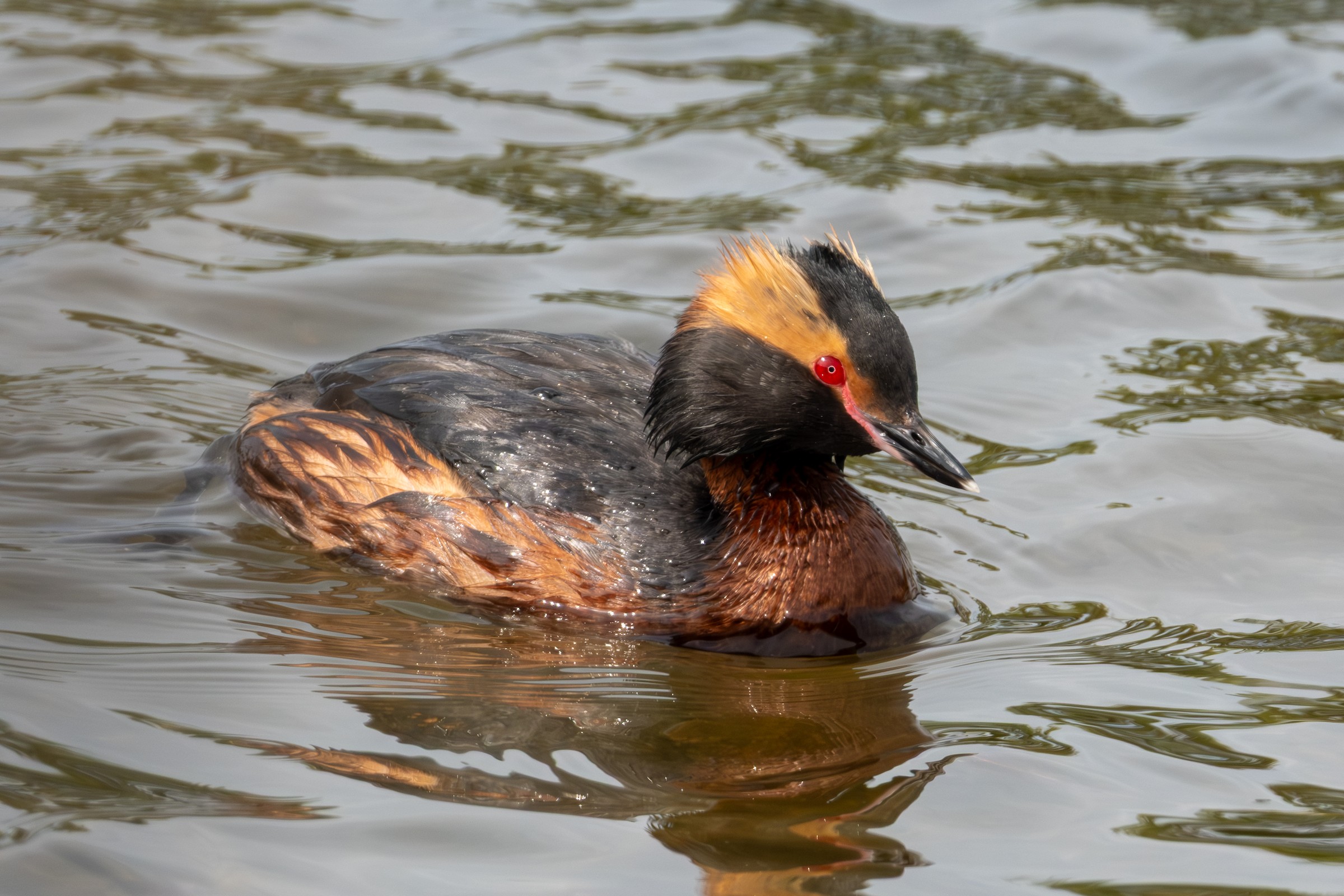
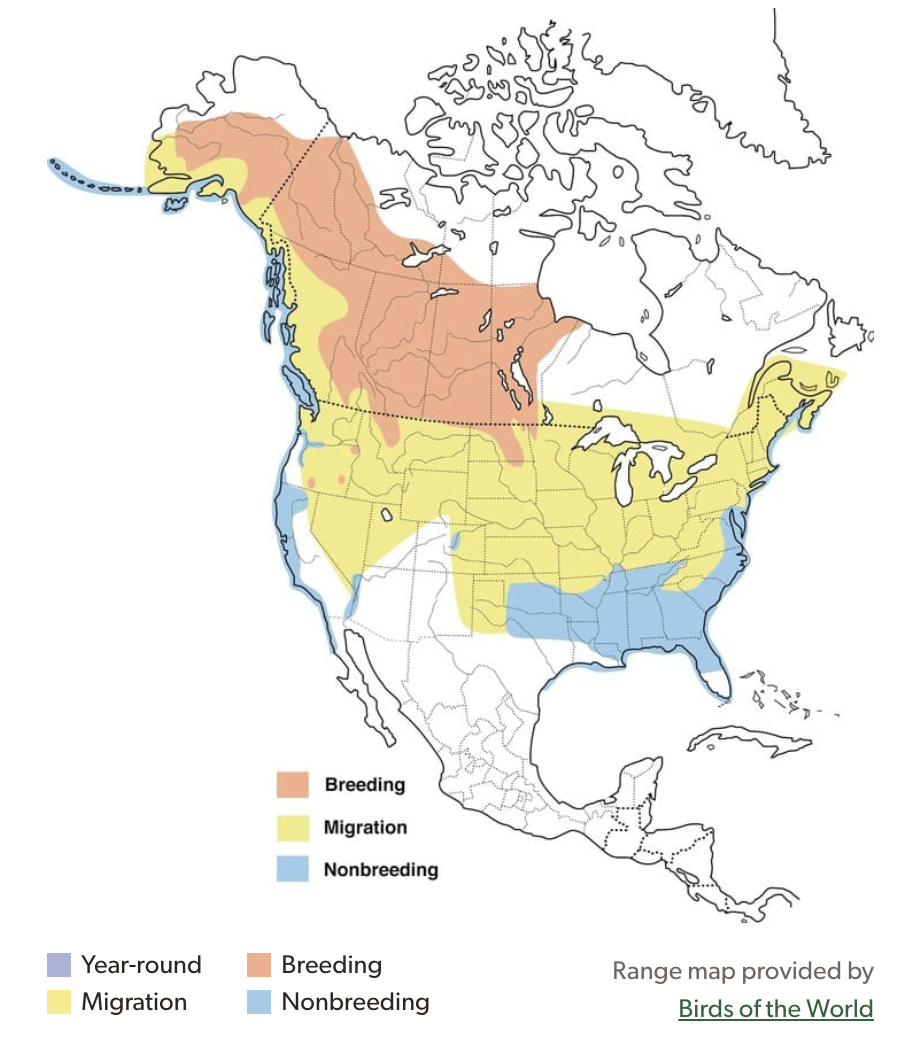
The Horned Grebe (Podiceps auritus) is a member of the ancient waterbird order Podicipediformes and the family Podicipedidae (Avibase, 2026). Known in Europe as the Slavonian Grebe, this compact waterbird has two globally recognized subspecies. Podiceps auritus auritus breeds across the Palearctic, from Scandinavia through Siberia to western China, while Podiceps auritus cornutus breeds in North America, from Alaska and western and central Canada to the northern section of the United States (Avibase, 2026).
Figure 1: Range Map of Horned Grebe – from Cornell Lab of Ornithology
Unlike ducks and other waterfowl that spend much of their time on the surface, grebes have remarkable anatomical features adapted specifically for diving. Their legs sit far back on their bodies, and their feet have flexible, broad, lobed toes rather than webbing (Jehl, 2017). This design gives them strong, lift-based propulsion underwater, helping them chase agile aquatic prey with impressive speed and manoeuvrability. However, this makes movement on land quite awkward, so Horned Grebes spend nearly all their time in the water, leaving it only for brief movements on their floating nests (Jehl, 2017).
The Horned Grebe migrates seasonally between freshwater wetlands inland and marine coastal habitats (Avibase, 2026; Stout & Cooke, 2003). During the breeding season, they settle in shallow, permanent or semi-permanent freshwater wetlands, prairie potholes, subarctic lakes, and man-made roadside borrow pits (Kuczynski et al., 2012; Osnas, 2003). Field studies across western Canada show that Horned Grebes strongly favour small bodies of water, typically less than 2 hectares in surface area, bordered by dense emergent vegetation such as cattails, sedges, and bulrushes(Kuczynski et al., 2012).
Nests are typically built within 10 feet of the shoreline, often nestled among emergent vegetation such as reeds, sedges, and rushes. They’re made of aquatic plants piled high enough for the top to remain above the waterline. Depending on the wetland’s layout, nests may float while anchored to emergent plants, sit directly on rocks or mud, or be secured to the pond bottom (Cornell Lab of Ornithology, n.d.). Both birds decide on the nest location together. Horned Grebes often form monogamous pairs, usually during spring migration or even in winter. Their courtship includes a series of fun displays, such as swimming together, shaking their heads, and the weed presentation, which is my favourite.
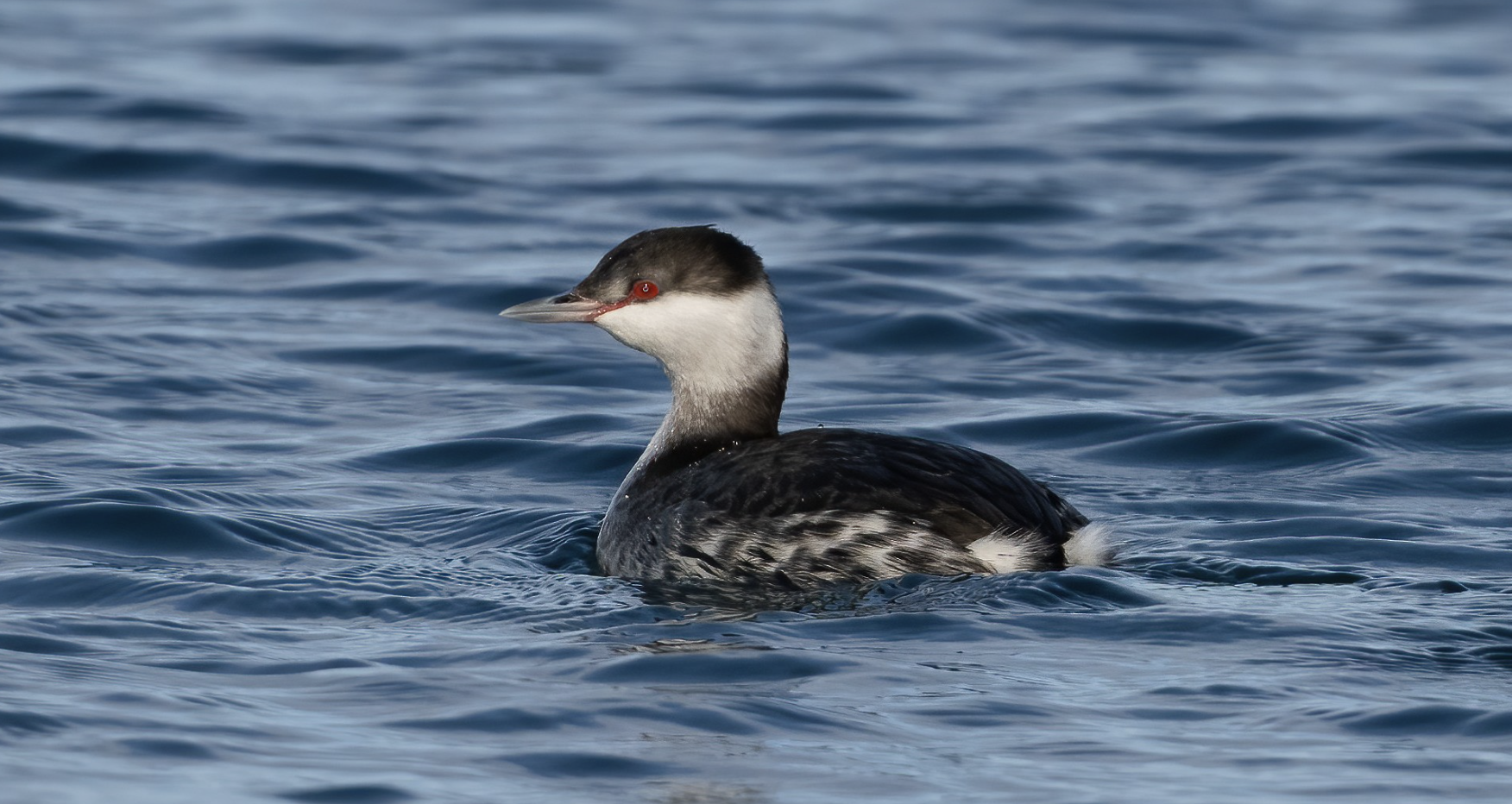
During the spring and summer breeding season, adult Horned Grebes display a jet-black head adorned with bright, golden-yellow feather plumes (the iconic “horns”), which extend backward from behind ruby-red eyes (Avibase, 2026). Their neck, upper breast, and flanks feature a rich, reddish-chestnut wash that sharply contrasts with a dark gray-black back. By late summer, adults undergo a complete prebasic molt that sheds those colourful feathers. Horned Grebes undertake a specialized molt migration rather than flying directly to wintering grounds (Stout & Cooke, 2003). Adult grebes depart breeding ponds between late May and August to aggregate on larger inland staging lakes. On these large waterbodies, they undergo a simultaneous wing feather (remiges) molt, rendering them completely flightless for 20 to 35 days while regenerating their flight feathers on food-rich waters (Stout & Cooke, 2003). Once the molt is complete, grebes resume their migrations to reach coastal wintering grounds along the Pacific Coast, the Atlantic Coast, the Gulf of Mexico, and the North Sea (Binford & Youngman, 2010; Stout & Cooke, 2003). In non-breeding winter plumage, the species adopts a crisp, high-contrast black-and-white look characterized by a dark cap extending horizontally down to eye level, stark white cheeks and throat, and a straight, dark bill tipped with a subtle pale point (Avibase, 2026).
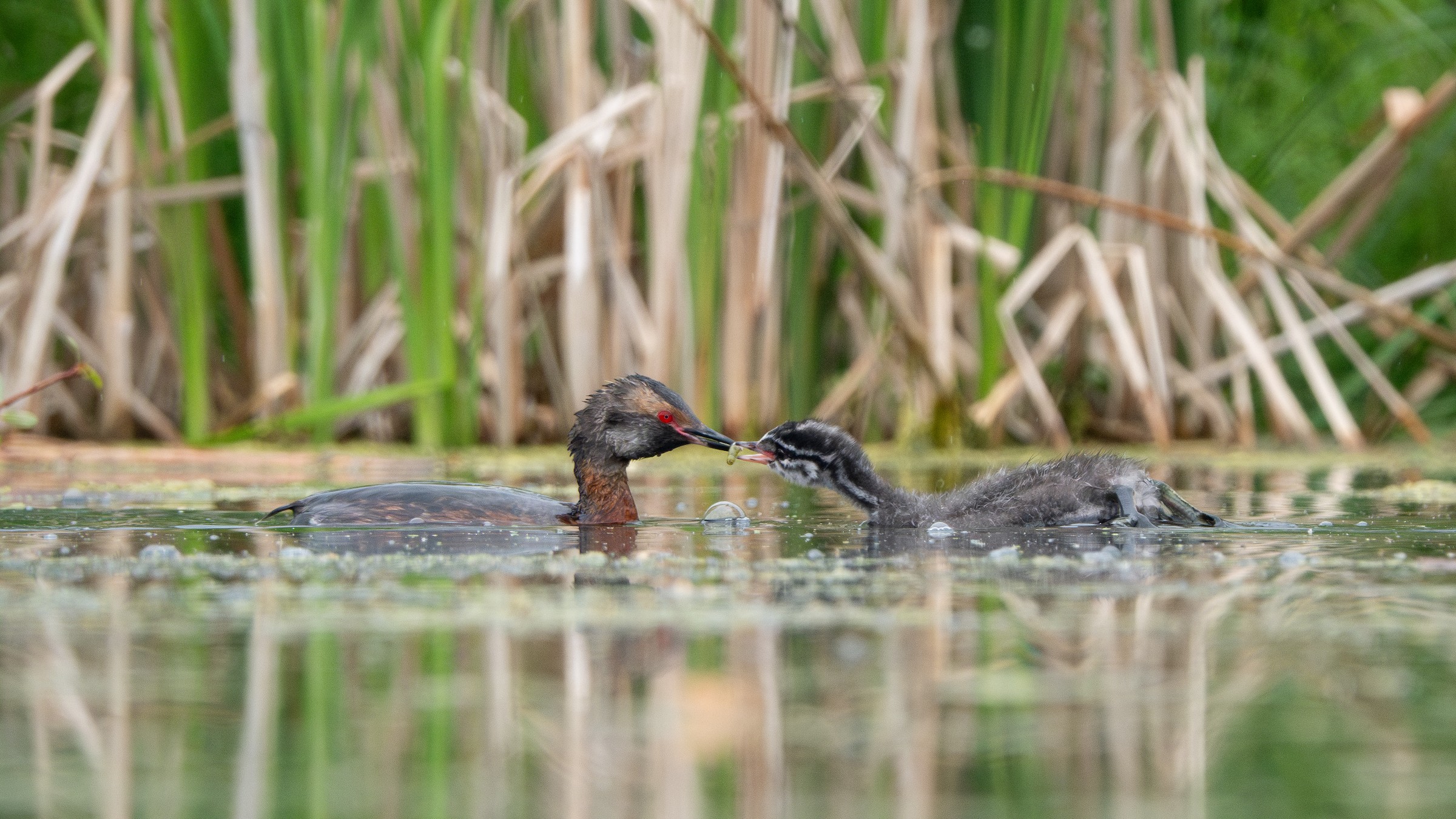
During the breeding season, Horned Grebes are quite territorial, with each pair typically defending a small pond or a sheltered bay in an isolated wetland (Karlsson, 2015; Osnas, 2003). Their diet also changes with the seasons. In winter, they eat small marine fish and crustaceans. During breeding season, they take a more varied approach, feeding on aquatic invertebrates such as dragonfly and damselfly nymphs, beetle larvae, water boatmen, amphipods, and leeches, as well as small fish like the brook stickleback (Kuczynski & Paszkowski, 2010; Lewis et al., 2015).
One of the most remarkable evolutionary traits of the Horned Grebe, understood in the last 20 years, is the 500-year conundrum of feather-eating digestion.
All species in the order Podicipediformes intentionally pluck and eat their own feathers. The feathers build up into a dense mass in their digestive tract, which they periodically regurgitate as compacted pellets (Jehl 2017). The Aztecs first documented the practice in the 16th century, and early naturalists later noted it, including Buffon, Audubon, and Nuttall. For five centuries, the biological purpose of feather-eating remained debated until Dr. Joseph R. Jehl Jr. brought together decades of anatomical dissections and bioenergetic data in The Wilson Journal of Ornithology (Jehl 2017).
Grebes eat feathers because they form a tangled clump in the stomach that helps them process food, including insects with hard shells. Unlike birds that swallow small stones to grind their food, grebes rely on feathers alongside strong stomach acid. Parents even feed feathers to their chicks before their first meal to help prepare their stomachs for digestion (Jehl, 2017).
Their stomach has three parts:
- Proventriculus: Produces stomach acid and digestive enzymes.
- Gizzard: Holds and mixes food while the acid breaks it down.
- Pyloric pouch: Helps control when the broken-down food moves into the small intestine.
Jehl (2017) argued against two older explanations for why grebes swallow feathers:
- Protecting the stomach from sharp bones: Grebes that do not eat fish also swallow many feathers, and stomach acid quickly dissolves sharp bones.
- Removing parasites: Grebes can still carry more than 30,000 intestinal worms. Bringing up pellets removes only small pieces of stomach contents and doesn’t clear out the parasites.
Grebes and flamingos are close evolutionary relatives, and Jehl (2017) suggested that their different habitats may help explain their distinct feeding methods. Flamingos feed in shallow water, where they can easily swallow grit from the bottom. Grebes, on the other hand, evolved to feed in open water, where grit was harder to reach, and may have begun swallowing floating feathers instead.
Figure 2: Change in Summer Range of Horned Grebe if Temperature +1.5°C
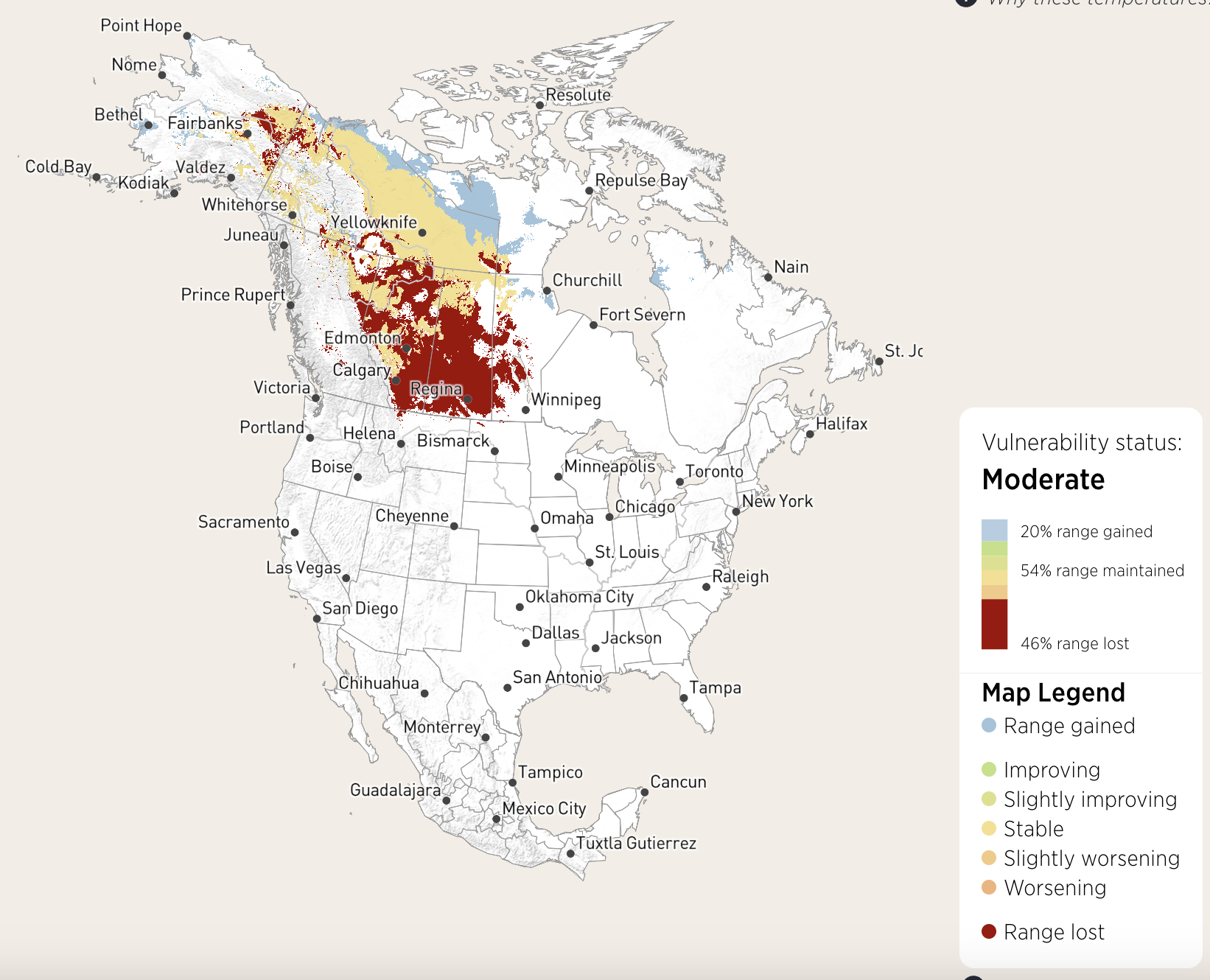
Global conservation assessments by the International Union for Conservation of Nature (IUCN) classify the Horned Grebe as Vulnerable. In Canada, the Committee on the Status of Endangered Wildlife in Canada (COSEWIC) lists the Western Canadian population as a species of Special Concern and the isolated Magdalen Islands population in Quebec as Endangered (Hammell, 2017; Kuczynski et al., 2012). Long-term survey data also show significant population declines over several decades across North American prairie parklands (Hammell, 2017).
Horned Grebes face several key environmental pressures:
- Habitat Loss & Degradation: Wetland drainage and agricultural infilling have significantly reduced natural breeding habitats in the prairie pothole region (Hammell, 2017; Osnas, 2003).
- Interspecific Competition: Multiple decades of field studies in Manitoba show that expanding populations of larger Red-necked Grebes and assertive Pied-billed Grebes can make it harder for Horned Grebes to access their preferred permanent breeding wetlands (Hammell, 2017; Osnas, 2003).
- Territorial Density Constraints: Multi-site studies in Sweden suggest that higher breeding-pair density can reduce reproductive success. Ponds with a single breeding pair have shown significantly higher chick survival (Karlsson, 2015).
- Nest Predation & Environmental Disturbance: Several factors can make it harder for eggs and chicks to survive, including predation by birds such as Carrion Crows and aquatic predators such as Northern Pike, changing wetland water levels, cold summer spells, and disturbance from anglers along the shoreline (Ewing et al., 2013; Summers et al., 2009).
Despite these pressures, habitat restoration research suggests that constructed wetlands, including highway borrow pits, can offer effective alternative breeding sites (Kuczynski et al., 2012). With adequate water depth, open-water areas, and surrounding emergent vegetation, these ponds can support high chick productivity and provide a valuable tool for waterbird conservation (Kuczynski et al., 2012).
References
Avibase (2026). Podiceps auritus (Horned Grebe) – Avibase taxonomic checklist and distribution database. https://www.biodiversitylibrary.org/item/10277#page/6/mode/1up
Binford, L. C., & Youngman, J. A. (2010). Flight speeds of migrating Red-necked and Horned Grebes. The Wilson Journal of Ornithology, 122(2), 374–378. DOI: 10.1676/08-062.1 https://www.jstor.org/stable/40600431?seq=1
Cornell Lab of Ornithology (n.d.). Horned grebe (Podiceps auritus). The Birds of North America. https://birdsoftheworld.org/bow/historic/bna/horgre/1.0/introduction
COSEWIC (2009). COSEWIC assessment and status report on the Horned Grebe (Podiceps auritus), Western population and Magdalen Islands population, in Canada. Committee on the Status of Endangered Wildlife in Canada, Ottawa. https://www.canada.ca/en/environment-climate-change/services/species-risk-public-registry.html
Ewing, S. R., Benn, S., Cowie, N., Wilson, L., & Wilson, J. D. (2013). Effects of weather variation on a declining population of Slavonian Grebes (Podiceps auritus). Journal of Ornithology, 154(4), 995–1006. https://link.springer.com/article/10.1007/s10336-013-0967-y
Hammell, G. (2017). Changes to the population status of Horned Grebes (Podiceps auritus) and Red-necked Grebes (Podiceps grisegena) in southwestern Manitoba, Canada. The Canadian Field-Naturalist, 131(4), 317–324. https://www.canadianfieldnaturalist.ca/index.php/cfn/article/view/2069
Jehl, J. R., Jr. (2017). Feather-eating in grebes: A 500-year conundrum. The Wilson Journal of Ornithology, 129(3), 446–458. https://www.jstor.org/stable/26456059?seq=1
Kuczynski, E. C., & Paszkowski, C. A. (2010). Food-web relations of the Horned Grebe (Podiceps auritus) on constructed ponds in the Peace Parkland, Canada. Wetlands, 30(5), 853–863. https://link.springer.com/article/10.1007/s13157-010-0097-8
Kuczynski, E. C., Paszkowski, C. A., & Gingras, B. A. (2012). Horned Grebe habitat use of constructed wetlands in Alberta, Canada. The Journal of Wildlife Management, 76(8), 1694–1702. https://wildlife.onlinelibrary.wiley.com/doi/10.1002/jwmg.421
Lewis, T. L., Lindberg, M. S., Schmutz, J. A., Bertram, M. R., & Dubour, A. J. (2015). Species richness and distributions of boreal waterbird broods in relation to nesting and brood-rearing habitats. The Journal of Wildlife Management, 79(2), 296–310. https://wildlife.onlinelibrary.wiley.com/doi/10.1002/jwmg.837
Osnas, E. E. (2003). The role of competition and local habitat conditions for determining occupancy patterns in grebes. Waterbirds, 26(2), 209–216. https://www.jstor.org/stable/1522554?seq=1
Stout, B. E., & Cooke, F. (2003). Timing and location of wing molt in Horned, Red-necked and Western Grebes in North America. Waterbirds, 26(1), 88–93. https://www.jstor.org/stable/1522471?seq=1
Summers, R. W., Mavor, R. A., & Hancock, M. H. (2009). Correlates of breeding success of Horned Grebes in Scotland. Waterbirds, 32(2), 265–275. https://www.jstor.org/stable/40660815?seq=1
Media Credit
Horned Grebe Photos from: https://search.macaulaylibrary.org/catalog?taxonCode=horgre & https://www.audubon.org/field-guide/bird/horned-grebe
Figure 1: https://www.allaboutbirds.org/guide/Horned_Grebe/overview
YouTube Video 1: https://www.youtube.com/watch?v=EvGxYWR9bTU
YouTube Video 2: https://www.youtube.com/watch?v=zfXv_AWWu6w
Figure 2: https://www.audubon.org/field-guide/bird/horned-grebe