The Prelude: Reflections and Illuminations

By Morgan Campbell

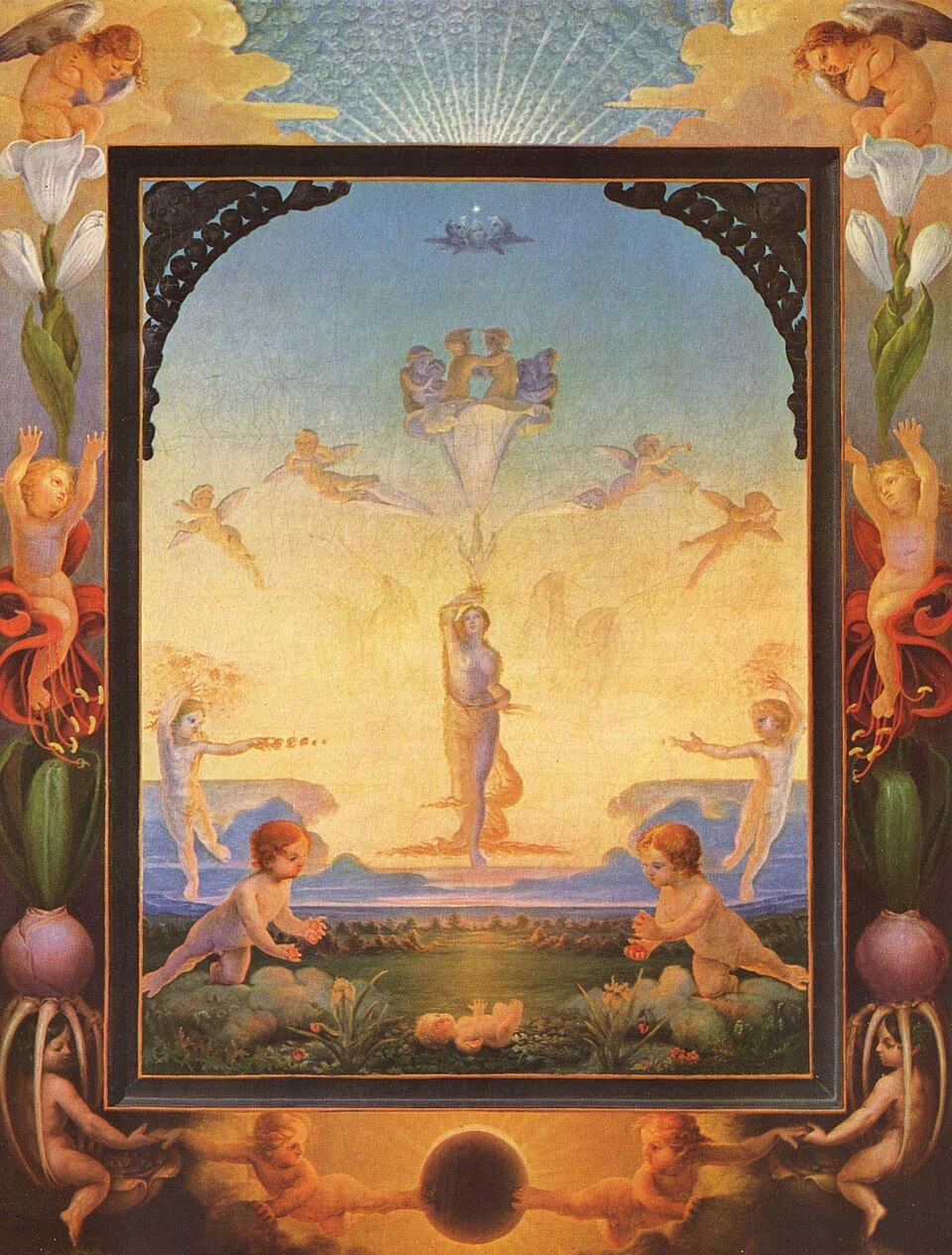
Philipp Otto Runge, The Morning, 1808

Literary critic M.H. Abrams suggests in his 1953 work The Mirror and the Lamp that the poets of Romanticism are understood not as “mirrors”, which are reflective of the world, but rather as “lamps”, which serve to illuminate the world. This essay seeks to define what, exactly, is meant by the use of these motifs (‘lamp’ and ‘mirror’) in their connection to Romanticism, and more specifically, how they may apply to Romantic poet William Wordsworth and his collection, The Prelude. Ultimately, this essay concludes that Wordsworth is not easily categorized as either distinctly mirror or lamp-like but may rather be understood as a combination of both. This analysis finds evidence of a deeper complexity in The Prelude, which deviates from the traditionally Romantic pursuit of pure self-inquiry and passion-centred expression. In his poem, Wordsworth conceives of a creative process that is centred around the imagination, a power which possesses a capacity to integrate both passion and reason. The speaker defines the imaginative power, further, as a form of collaboration with a creative source, allowing for an illuminative reflection of both the speaker’s internal world and external environment. Ultimately, Wordsworth’s poetic process is, uniquely, a type of reflection that is both mirror-like in its accurate portrayal of the world, and lamp-like insofar as it arises from self-inquiry and inward contemplation.  

Before applying these symbolic images (the lamp and the mirror) to Wordsworth, it is important to establish how they might be defined and applied in the context of Romantic poetry. In his lecture on Jean-Jacques Rousseau—a figure influential to both the Enlightenment and Romantic period—Dr. Mark Blackell described the Romantic ideal of the artist and the new vision of the modern self. For the Romantics, it was understood that within the individual lay a natural depth which, if plumbed, allowed for the self to “commune with some natural source as the wellspring of creativity” (Blackell, 00:08:58-00:09:14). The Romantics placed an emphasis on the individual, the inward state, and a particular value placed on the experience of emotion and passion. This movement came as a response to the Enlightenment, which valued reason over the emotions and placed epistemological value on rationalism—an affirmation that knowledge could be procured purely via contemplation of the mind and intellect. By this line of distinction, it makes sense for Abrams to refer generally to the Romantic poets as ‘lamps’—that within their individual being could be found an internal source of light, through which the creative act of poeticizing would be seen as a type of illumination. By contrast, the thinkers and writers of the Enlightenment, for the sake of this analysis, could be categorized as mirrors—reflecting the world as it is, through concise analysis and rigorous reasoning.

In many aspects, The Prelude illustrates an image of the Romantic artist: a journey of inward investigation as a means of gleaning wisdom and knowledge about the world. The speaker begins Book Two by affirming his intent of self-inquiry, stating that though much has been unvisited, he has nonetheless “endeavoured to retrace / My life through its first years” (II, 2-3). Later, in Book Eleven, in an effort to regain hope and clarity after a period of being periled by reason, the speaker reaffirms the mission of self-inquiry, “find your way / To the recesses of the soul!” (11-12) and proceeds to draw from his memories as a method of healing and self-renewal. This process of self-inquiry to self-illuminate appears lamp-like, as Abrams might suggest. Still, the speaker in The Prelude describes his personal experience of illumination with more complexity:

A plastic power

Abode with me, a forming hand, at times 

Rebellious, acting in a devious mood,

A local spirit of its own

…………………………

An auxiliar light

Came from my mind which on the setting sun 

Bestowed new splendor, (II, 381-384, 386-388)

Here, the speaker refers to a source of power which is both a “spirit of its own” and yet came from his mind—it comes to aid him, and yet it is also of him. The power is self-determined, and yet found within the depths of the individual. This phenomenon is echoed in Book Eleven:

I had felt

Too forcibly, too early in my life, Visitings of imaginative power

For this to last: I shook the habit off  (XI, 251-254)

Here, the speaker describes his encounters with imaginative power as visitings which produce a lasting and profound impact. It is a power which is foreign to him, and yet, cannot be forgotten or removed from his being. For Wordsworth, this luminous, creative power that is the imagination is the ultimate source of poetic power. This creative process, insofar as it is a kind of communion resulting in illumination, does seem to support Abrams’ thesis that categorizes the Romantic poets as ‘lamps’. However, for Wordsworth, this imaginative process is undeniably also a type of reflection of the external world and reality itself. 

The Prelude centres around the speaker’s intense, lived experiences with the power of nature and his memories of the external world. In Book Two, Wordsworth offers a personal account of nature which places an emphasis on the sense-based, experiential elements of his encounters;

I felt the sentiment of Being spread

O’er all that moves, all that seemeth still, 

O’er all, that, lost beyond the reach of thought 

And human knowledge, to the human eye

Invisible, yet liveth in the heart, (II, 420-424)

In this passage, the speaker refers to the power of nature as something that can be felt, and that resides in the heart—it cannot be accessed with the physical eye or pure reasoning. This sense-based experience seems to align with the ideal of the Romantic artist. However, Wordsworth notes that this experience of nature is not a fictional, fanciful relationship but is an active communion, rooted in reality. The speaker claims of his relationship to nature: “I conversed / With things that really are” (II, 412-413). These poetic reflections are, as Wordsworth claims, true reflections of nature as it is. It is worth asking, then, why Abrams does not recognize these reflections of reality as being mirror-like. What might distinguish Wordsworth’s reflections of reality from, say, the mirror-like reflections of the Enlightenment thinkers that preceded him? 

In Book Eleven, the speaker makes a critique of the use of reason to project judgment onto reality:

Unworthily, disliking here, and there 

Liking, by rules of mimic art transferred

To things above all art. (XI, 153-155)

This passage outlines two of the speaker’s criticisms; the first is a criticism of the faculty of reason, which judges things as either likable or dislikable, secondly, the speaker is making an overarching critique of the rules of “mimic art”. This type of art is explained in Dr. Warren Heiti’s lecture as related to the “cult of the picturesque”: a cultural phenomenon wherein gallery goers were inspired by landscape artworks and proceeded to go into nature and attempt to recreate their experience by the use of mirrors (Heiti, 00:54:10-00:57:40). Wordsworth is critical of this “strong infection” (XI, 156) of the culture insofar as it failed to truly express the “spirit of the place” (XI, 163). It is plausible that Abrams, in his distinguishing of the lamp from the mirror, may have understood the concept “mimic art”, and forms of art that function similarly, to be categorized as a kind of mirroring, and that Wordsworth, being himself critical of this mimicry, must not be a mirror. Given all this, Abram’s theory potentially still stands: Wordsworth’s poetic process is self-inquiring, luminous, and lamp-like, and his own poetry critiques the flat reflections of nature rooted in pure reason and judgment. However, it is still worth investigating whether Abram’s distinctions are truly adequate in assessing the complexity of Wordsworth’s creative process. 

It is vital to note that despite his criticisms of reason, Wordsworth’s poetry is distinct from the tradition of Romantic poets insofar as he does not fully invert the reason-passion dyad for passion to ultimately preside over reason (Heiti, 00:04:20-00:05:30). He does not altogether seek the disposal of reason. In fact, his creative process relies on a synthesis of both reason and passion—but it relies on reason of a certain type. In Book Eleven, the speaker distinguishes two types of reason:

There comes a time when Reason, not the grand 

And simple Reason, but that humbler power 

Which carries on its no inglorious work

By logic and minute analysis (XI, 123-126)

In this passage, one type of reason is the humbler power, which analyzes through logic, and a second type of reason, referred to as “grand and simple”, is cited a few lines later as “the friend / Of truth” (XI, 135-136). The grand and simple reason does not make “distinctions” and “puny separations” (II, 222, 223) but, conversely, appears to unify, bring clarity, and exalt truth:

Of intellectual power, from stage to stage 

Advancing hand in hand with love and joy,

And of imagination teaching truth (XI, 45-47).

For Wordsworth, this fusion of the intellectual power of the mind with the passions of love and joy is the imagination at work—the process which allows for the speaker to both experience the sensations of nature and reflect cogently upon them. The imagination is, as the speaker states plainly, a teacher of truth. This creative process is articulated earlier in Book Two:

From Nature, and her overflowing soul

I had received so much that all my thoughts 

Were steeped in feeling. (II, 416-418)

The image of thought being steeped in feeling suggests, for the speaker, a necessity of both faculties working together. One is suffused in the other, and this is the direct effect of truly experiencing nature—in fact, the source of creative power is, here, nature herself. 
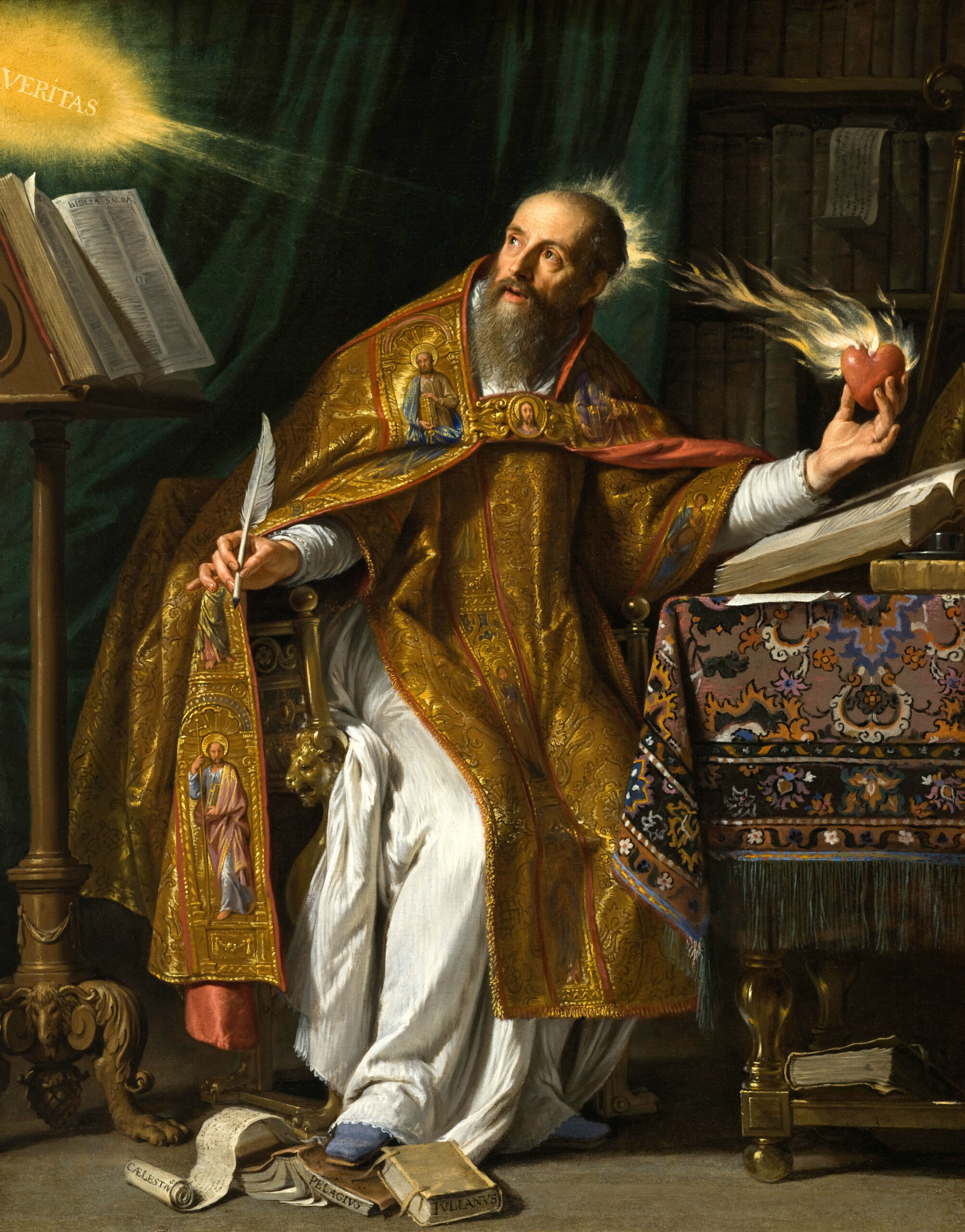
Saint Augustine

Still, it remains to be answered if this element of ‘steeping’, or the fusion of passion and reason, found in poetry, brings a challenge to Abram’s thesis. Perhaps, if we understand the work of mirroring to be a simple, plain reflection of the external world, then Wordsworth is not a mirror. However, one might argue that Wordsworth’s poetry does reflect the world in a way that truly captures the “spirit of the place” (XI, 163). He does this through integrating his experience of the world, allowing his thoughts and sensations to ‘steep’ over time, and ultimately by transmuting this experience into a piece of art. Furthermore, Wordsworth’s reflections have long found resonance with readers, suggesting that his poetry functions as a mirror of shared experience. In reflecting on The Prelude, I find it, personally, challenging to analyze the poetry—to dissect it with “logic and mute analysis” (XI, 126). Yet, there is a sense of resonance found in the work, an inscrutable sense of one’s own lived experience and memories of nature being activated and reflected in the work. The poetry serves, then, as both a mirror toour own experiences of the world and the powers of nature, as well as a source of illumination found within the poignancy of personal memories. 

Ultimately, it appears plausible that Wordsworth may symbolize a lamp, as Abrams suggests, insofar as a lamp is not a singular, solitary source of light in and of itself, but rather illuminates via its connection to a wider circuit of energy (for Wordsworth, this source being the power of imagination and of nature herself). Yet, as is argued, mirror-like qualities are also evident in The Prelude insofar as the speaker reflects on the world around him by presently experiencing nature as it is and communicating these sensations. What results in The Prelude is an artistic expression that is neither a distorted reflection, nor a flat mimicry, nor a pure, unexamined sensation. Rather The Prelude is an expression of a creative communion with the power of imagination and the profound forces of nature, wherein illumination and reflection are invariably intwined. 

Works Cited

Blackell, Mark. “Mark on Rousseau LBST 370 2026”, Video Lecture, 6 January 2026. Vancouver Island University. 

Heiti, Warren. “Warren’s Wordsworth Lecture Part 1”, Video Lecture, February 2026. Vancouver Island University.

Wordsworth, William, The Prelude, edited by Stephen Gill, Oxford University Press, 2010.
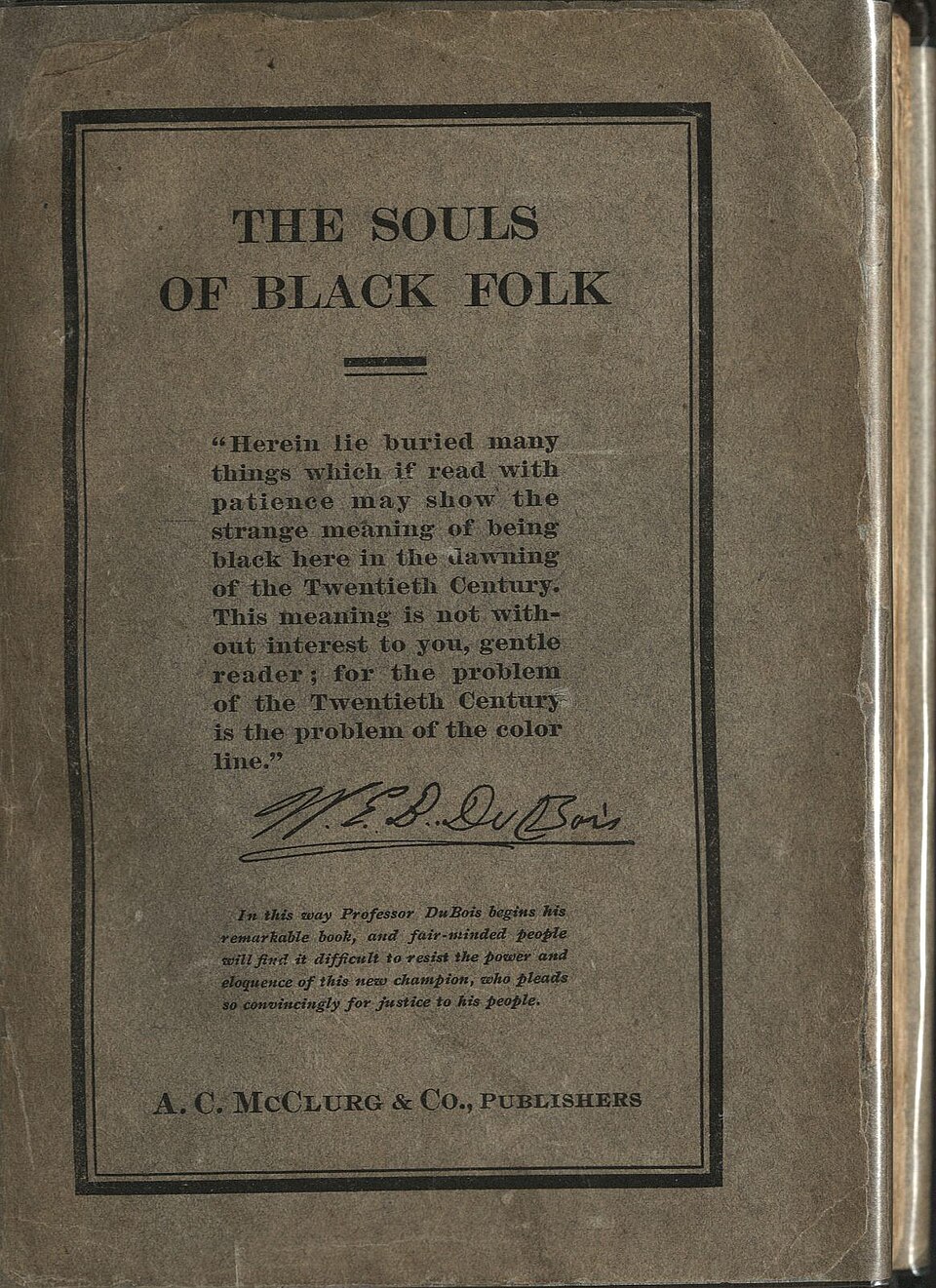
Veiled Sight and Seeing: The Self and the Other in W.E.B. DuBois’ The Souls of Black Folk

By Clio Roe-Leduc

The dust jacket cover of The Souls of Black Folk by W. E. B. Du Bois

The “veil” or “double consciousness” as described in DuBois’ seminal work The Souls of Black Folk is an expression of a rich and highly layered experience. What does it mean to be capable–to be forced into developing the capability—of double consciousness? In what ways does it affect people, and how was this effect enforced in the first place? This ‘double consciousness’ is at once a response to an imbalanced power relation which enables one to see the truth of that power relation, the result of a projection both real and unreal, a consequence of the “veil” of ignorance, and a barrier in the way of fully realizing true self-consciousness. Written in the American era of post-reconstructionist Jim Crow legislation and the context of the author’s experiences as a black man in a highly racially stratified society, DuBois’ conceptual framework is highly revealing of the spiritual and psychological violence of a systemically racist culture. In experiencing the consequences of the “veil,” from which emerges the phenomenon DuBois refers to as “double consciousness,” vision becomes visible in itself as implicated in the structures of oppression – and yet all this leads to the revelation of the “second sight,” which may allow the sight of the future which exists even beyond the veil. 

To articulate this specific internal experience, Dubois begins with the incident which, for the first time in his life, forces him rudely into confrontation and awareness of his distinction and difference from other children. In a moment “when the shadow swept across [him]” (7) and during an exchange among all the children who were freely mingling with one another, a girl—a newcomer—“refused [his] card—refused it peremptorily, with a glance” (8). The engagement, and possibilities that may emerge from that engagement, are rejected out of hand. Even among children, social engagement begins to require and imply a basic equality among peers–an equality which comes into conflict with a hierarchical social structure based on race. As this structure is a construction, it must therefore be policed, reinforced and enacted by the words of individual agents – through interactions even as small as this one. Therefore, the interaction, minor though it is, must be negative in both senses of the word. 

The peremptory refusal by an unknown newcomer is in one sense a negative experience for DuBois, because social rejection, whatever the reason, is naturally hurtful, especially for children. In another sense, it is negative in that the usual interaction does not exist. The experience is curtailed so severely that the harm is affected through an absence—the gap left behind when a small interaction (the exchange of cards) could have taken place, but when one player chooses simply not to engage. The otherwise unremarkable interplay of social life is disrupted by that refusal. Dialogue, like engagement, requires an interlocutor. As with respect to animist philosophies, certain modes of interaction are separated in classification by the simple requirement that all involved in the interaction have relational capacities. In other words, participants are capable not only of being related to, but also of responding by relating to in turn. A conversation needs both parties to be capable of acting as viable interlocutors, or it is, by definition, a monologue. Here, due to a misperception on the part of another child, DuBois is treated as a  person who is not allowed to act in the way that persons may–to enter into a dialogue as an equal, as a person who can respond, and who merits a response in return. 

The incident may have been short—but the impact on DuBois was profound. He experienced it as a revelation in understanding, meaningful not by itself in isolation, but through the connection with the psychosocial superstructures that became visible through the enactment of a racist hierarchy of white supremacist ideals. This gesture does not emerge from pure chance but is borne up out of a quagmire of entrenched social and spiritual disregard for the full personhood of black people, in accordance with that racist hierarchy. DuBois does not suggest that the act itself, or the girl, is in isolation responsible for the profound impact this moment had on him as a child. It is common enough that children may be cruel or careless to each other, amounting to no significant impact. The impact comes from the weight of what is made known to him at that moment. This is his first experience of seeing, through what he calls the “veil,” the presence of that racist hierarchy, and the difference which he now is aware of as separating him from the other children. 

It is significant that the denial of engagement is what precipitates this first awareness of this shadow. The girl has no true experience of him; therefore, the decision she makes is based on a judgement that considers only what she initially sees: the color of his skin, which she understands through a coding she has inherited from a biased social superstructure. That denial speaks to a judgment being made prior to any experience—the judgement must be made merely on the identification and racialization of DuBois as a black boy. In so doing, that judgement cordons off a bridge to the rest of the world, leaving him and those like him severely limited. However intelligent, capable, and emotive one might be, there will be no opportunities to show it to those who turn away their gaze, who do not wish to see. DuBois perceives, rightly, that this seemingly inconsequential stumbling block has far-reaching consequences. The path to the rest of the world, with all the “dazzling opportunities” (8) which he “longed for,” (8) is cut off at the first juncture—that of a willingness to engage as an equal with a racialized black boy. If one is blockaded at this initial moment, how is one supposed to progress at all?  

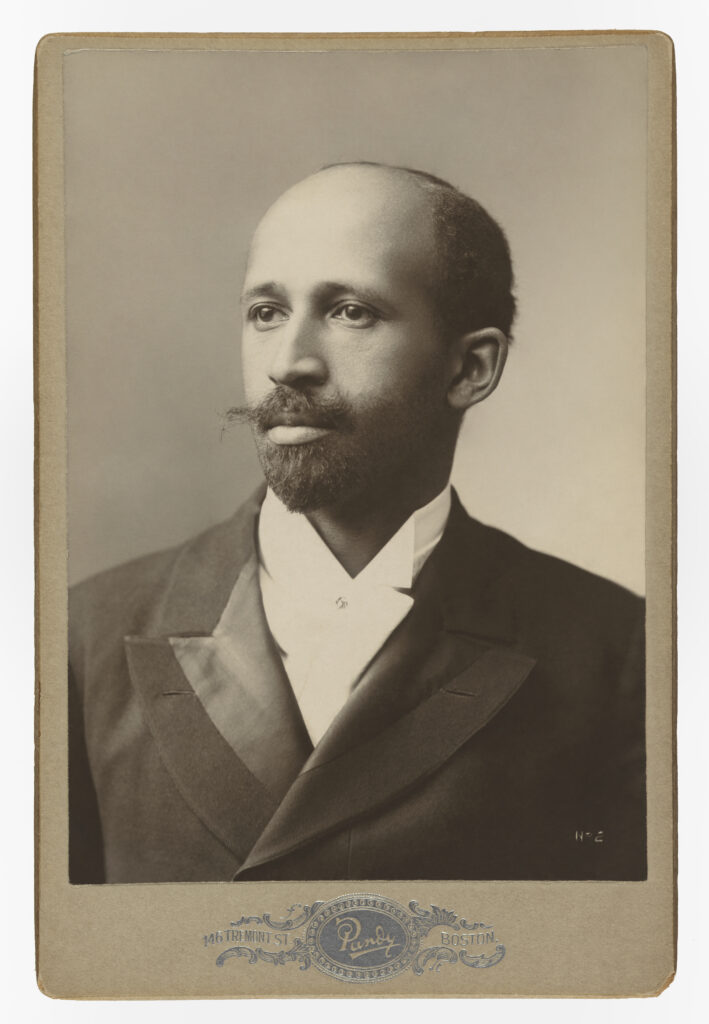
W.E.B. Du Bois by James E. Purdy, 1907

In DuBois’ words, the awareness “dawned upon [him] with a certain suddenness that [he] was different from the others; or like, mayhap, in heart and life and longing, but shut out from their world by a vast veil.” (8) It was not mere awareness that this imposed: by virtue of this awareness, he was made newly conscious—and newly self-conscious. However, this self-consciousness; this sense of how one exists in the world in relation to others, arrives through the eyes of a hostile “other.” The first “sight” one has of oneself is therefore inextricably linked to the veiled, misjudged, and hostile view of those ‘others’ through whom DuBois is made aware of himself. In an important sense the difference he locates is something that is external to himself. He is not different internally; “in heart and life and longing;” (8) to his peers, and yet a difference exists. It exists as it is attached to him, from outside, by a process of superimposition. The difference is not an internal flaw, but an external one—as emphasized by the brief glance upon which the girl based her judgment. There was no opportunity—no time—to judge based on anything but external features. The difference begins through a mistake in vision, which in turn creates a material outcome. The veil of ignorance distorts vision: instead of seeing what is there, one sees only what one expects to see. What the girl sees, when she looks (before she turns away) is the veil–she is not, in fact, seeing him at all. 

That veil of ignorance, however insubstantial, nonetheless has real repercussions. The perception of the difference is based on shaky foundations, and thus results in a flawed evaluation. However, the result of action taken because of that mistaken evaluation creates a very real division in the world—the misperception itself creates the difference. The misreading of reality recursively creates the reality it perceives, through enactments that are predicated on a faulty assumption. By acting as though an imagined difference is real, a difference is created. The discrimination itself is real. The lack of options is real. It has consequences in the world, by creating and maintaining the constraints on people living under this system. 

This is the root of the “double consciousness”: the misperception by privileged others has a force and a power to it, such that it overrides even one’s own self-consciousness. That an outside perspective can interfere and intrude on one’s sense of self is a facet of the violence inherent in systems of oppression which can be difficult to see clearly, or to articulate. The misperception, this veil which obscures the most fundamental aspects of one’s humanity, is then incorporated into the way that DuBois, and other black children like him, conceive of themselves. There emerges “this sense of always looking at one’s self through the eyes of others, of measuring one’s soul by the tape of a world that looks on in amused contempt and pity” (8). Sight and seeing are mechanistically central to understanding this experience—people are reliant on sight as a way of parsing the world before them, but mental constructs (such as prejudice) are incorporated inextricably into that process. Metaphorically, then, the sight of internal objects of perception are equally subject to interference by these associations, as in the “sight” and understanding of oneself. 

The lens through which one sees oneself, then, is that of the gaze of an external hostile party. However, that is not the only model and way of seeing. In fact, the “doubling” is a result of the fact that this veil, or lens, is not total. There emerges, inevitably, some awareness of oneself as “like […] in heart and life and longing,” (8) a degree of true perception of one’s own inner worth and capacity, however contested. To the extent that “the Negro is a sort of seventh son, born with a veil, and gifted with second-sight in this American world⁠,” (8) the second sight can be understood as a counterbalanced or compensatory kind of vision, emerging from the liminal and “doubled” position black Americans inhabit. Although double consciousness inhibits “true self-consciousness,” (8) it nonetheless enables a certain kind of awareness to emerge. Having intimate experience of the contradictions and absurdities of a racist paradigm renders it visible—much as the veil itself becomes visible to DuBois even as it comes to obscure him from himself. The degree to which these two contradictory views of oneself come into conflict produces the struggles of double consciousness. DuBois, with others like him, are forced to withstand the tensions of being at once “an American, a Negro; [with] two souls, two thoughts, two unreconciled strivings” (8).

From these two unreconciled strivings, a tension emerges which seems characteristically generative – one cannot help, with twinned souls and thoughts in one body, to be in a state of constant internal dialogue. Dialogue is a process through which interplay and intercourse produce change – in oneself or in the world. The second sight grants one a special lens through which to see the world revealed, with its illusions and pretenses made starkly apparent. This drives a perpetual motion outward, seeking to reconcile this internal and external dissonance. For DuBois, it is in search of education, in the “the longing to know,” (11) to see, with vision unclouded by any veil, that the possibility and hope of a resolution arises. “In those sombre forests of his striving his own soul rose before him, and he saw himself⁠—darkly as through a veil; and yet he saw in himself some faint revelation of his power, of his mission. He began to have a dim feeling that, to attain his place in the world, he must be himself, and not another” (11). This search itself is no small feat – and yet the circumstances which have made such an internal dissonance in the first instance have also produced a clarity of vision, a capacity for doubled understandings, which imply that one is beholden to that effortful change. If one is ever to reach a state of full self-actualization, attaining true self-consciousness requires a sea-change – not just in oneself, but also in the world. To hold the visions of a dual sight of one’s own worth and of the veil of ignorance may require no less. 

Works Consulted

DuBois, W. E. B. The Souls of Black Folk. Project Gutenberg, 1903/2021, https://www.gutenberg.org/ebooks/408?msg=welcome_stranger.

This Art Needs a Viewer: a Reflection on Ghandl, Bringhurst, and Velázquez. 

By Maggie Velíšková

Artist’s Statement 

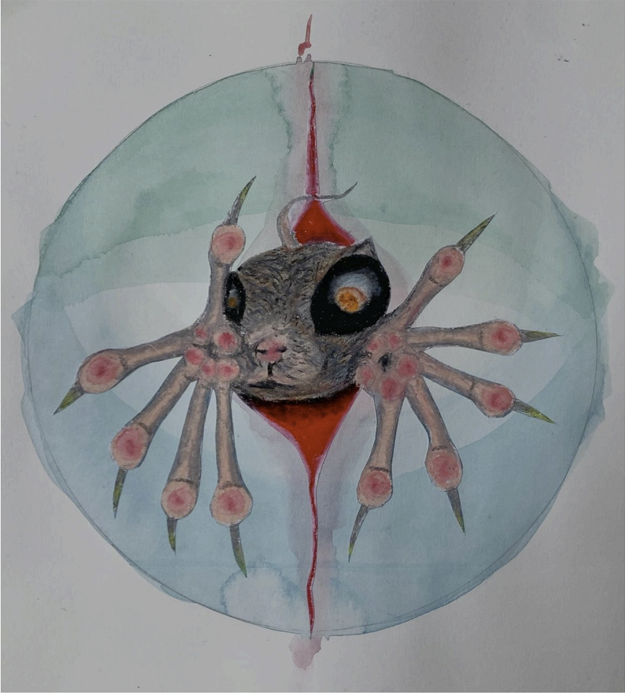
In this artwork, someone in the form of a mouse climbs up a thin red line from the earth world into the sky world. This is the main character from Haida mythteller Ghandl’s story “In His Father’s Village, Someone Was Just About to Go Out Hunting Birds” (translated to English and published in Robert Bringhurst’s book A Story as Sharp as a Knife: The Classical Haida Mythtellers and Their World)—he is a hunter, a “child of good family” (line 1), who falls in love with and marries a goose

woman. At this point in the story, the hunter’s goose wife has gone back to her world, and the hunter has been given a selection of tools and items that will aid him along his journey to find her. The hunter has slipped into the hunting skin that Mouse Woman has given him. Readers of Ghandl’s myth will recall the following quoted passage in which this item (the mouse skin), in combination with the salmon roe, will enable the hunter to scale the red pole up from his world into the home world of his wife. He saw no way of going up. 

Then he entered the mouse skin. 

Pushing the salmon roe ahead of him, he climbed. 

He went up after it. 

(line 204-207) 

The artwork is circular, and the mouse’s sharp claws curve with the frame, the proportions distorted in the circle. The mouse head and paws occupy the foreground of the image, and the thin red line is thick where it is closest to the focal point but is foreshortened dramatically in the upwards and downwards directions. A fish-eye lens effect is intended and will turn out to be instrumental to the connection that this artwork is trying to communicate. This 180 degree field of view gives the viewer a feeling of immersion in this magnification of a scene from between the worlds in Ghandl’s story. Ghandl’s story is riddled with cultural references and Haida mythtelling motifs that an audience embedded within that culture will be familiar with—in this way, the story flourishes when engaged with by a reader familiar with this myth world. Likewise, there is an aspect of the artwork that blooms under the eye of one familiar with the source content. 

The essential aspect to being in relationship with this artwork is the perspective from which the scene is viewed. The scene viewed is the aforementioned one of the hunter climbing into the sky world, but it takes having interacted with the myth to notice that the artwork is made from the perspective of the salmon roe. The orange egg is reflected in the big dark eye of the mouse head—as the viewer sees the mouse, they see reflected what the mouse is seeing. There are two main cues that encourage the viewer to identify with the salmon roe. The first is that though the roe is reflected in the mouse eye, it itself is not

pictured. The second cue is the fish-eye effect that the proportions of the artwork have. Beginning to identify with the salmon roe illuminates a whole new way for the viewer to interact with the artwork—an active, participatory engagement, rather than the removed gaze of the viewer who does not see themselves as part of the narrative process unfolding in the artwork. The salmon roe occupies a curious role in Ghandl’s story. As mentioned above, in order for the hunter to climb up into the sky world, he must slip into the mouse skin and push the salmon roe up in front of him. 

Robert Bringhurst has not only translated into English Ghandl’s story but has also provided the reader with some helpful context, analysis, and commentary in the chapter in which the myth is published (“Goose Food”) as well as the following chapter, “Spoken Music”. As Bringhurst notes, each of the helpful items that the hunter collects are to be used in pairs as the need arises—for example, he must deploy the comb in combination with the oil to help the lice-infested person he encounters in his world (stanza 4.2). 

Bringhurst illuminates some important conventions of Haida mythtelling that readers of Ghandl’s story should recognize, one of these conventions being the symmetry of the plot. Bringhurst draws attention to several moments in Ghandl’s telling of the myth that define a symmetrical plot structure, one of these instances being the red “pole that links earth and sky” (p. 51)—the pole that also functions in the story as a divider between symmetrical sets of encounters and situations that the hunter faces. Looking at the artwork, there is symmetry above and below the hunter, just as in the story in that moment of the story he is midway through his encounters. 

This artwork is a response to both Ghandl’s story and Robert Bringhurst’s commentary on the story. The images are from Ghandl’s telling of “In His Father’s Village, Someone Was Just About to Go Out Hunting Birds”—mouse woman’s hunting skin, the salmon roe, the “big round eyes” (line 159) of mouse woman, the “slender and red” (line 201) thing that connects the two worlds. The way the images and themes are represented in this artwork draws from Bringhurst’s commentary—specifically his discussion of Diego de Silva y Velázquez’s 1618 painting “Kitchen Maid with the Supper at Emmaus”. Bringhurst says that “a myth is a story, and it is a story that insistently recurs: a piece of timelessness

caught like an eddy in narrative time. Once the story is known, a single image or even a single word can evoke it” (p. 48). The artwork is an attempt to, using an image from Ghandl’s story, evoke the whole story, in a way similar to Velázquez’s representation of the moment from the gospel of St. Luke. Bringhurst involves the viewer of the painting in his analysis of how the story is revealed in the painting’s elements. He says that which dawns on the viewer as they take in Velázquez’s painting is what dawns on the woman in the foreground of the painting. The “Goose Food”-inspired artwork is intended to similarily transform the viewer into a participator, using the reflection in the eyes of the Mouse Woman’s hunting skin. Ideally, this artwork will trigger an aha! moment in the viewer—provided the viewer is familiar with Ghandl’s story. 

Materially, the contrast between the main subjects—the mouse and red thing, coloured with oil pastels—and the watercolour background gradient creates a striking difference in textures. Watercolour paints and oil pastels do not mix harmoniously, and do not make for an impression that everything pictured is happening in the same world. Oil and water shy away from each other. Just as each the hunter and his goose wife are out of place in the other’s home world, so does oil fail to integrate into water and vice versa. The hunter cannot subsist on goose food; the goose wife cannot eat what the hunter eats. An artist has a difficult time trying to pick up oil pastel on wet paintbrush, and trying to make a wash of colour on a page by rubbing dry watercolour paint over it is similarly ineffective. 

The use of different media in the artwork reflects the theme of relationship between different worlds in Ghandl’s myth. The hunter falls in love with his prey, and there are insurmountable differences between the couple and their respective lifestyles, though they make efforts to survive in each other’s worlds. Though the hunter is married to the goose woman at the point in the story that this artwork depicts, he is still pursuing her like a hunter pursues prey. He wears Mouse Woman’s hunting skin—with long, sharp claws. He reaches towards the viewer, almost seeming to be pouncing. 

The viewer and the relating that happens between the viewer and the artwork is an important part of the artwork. In Ghandl’s myth, the salmon roe (used in combination with the mouse skin) is necessary—and the viewer is the salmon roe. The artwork contains a representation of the mouse skin

being used, and the viewer is meant to be the salmon roe. In this way, this piece of art needs the viewer—the story needs a listener. Not only does the artwork need a viewer, it flourishes under the gaze of someone who is familiar with Ghandl’s story. And as illuminated by Bringhurst’s notes on the Hadia mythtelling tradition that Ghandl is part of—the symmetry, the significance of certain numbers, the “undissipated energies” (52) that must be resolved, the music of it all; Ghandl’s story blooms when read or listened to by someone who is familiar with the greater themes and structures of Haida mythtelling. 

As illuminated by Bringhurst’s notes on the Haida mythtelling tradition that Ghandl is part of, in which he discusses elements such as symmetry, the significance of certain numbers, the “undissipated energies” (p. 52) that must be resolved, and the musicality of the telling, Ghandl’s story blooms when read or listened to by someone who is familiar with the greater themes and structures of Haida myth telling. Similarly, the relationship between the viewer and the artwork is an important part of the artwork as object—in fact it constitutes its main meaning. In Ghandl’s myth the salmon roe is a necessary, balancing, element, and positioning the salmon roe as reflection in the artwork confirms the symmetrical necessity of a viewer. In this artwork the viewer is reminded how the paired items of roe and mouse skin work inside the myth—it is also apparent how these items are used to specifically employ the viewer’s ability to not only hear the story but to imagine an immersion in the mythic world(s) of that story. As a material object, the artwork can be understood by any viewer, but only truly flourishes under the gaze of someone who is familiar with Ghandl’s story. 

Works Consulted 

Bringhurst, Robert. “Goose Food” and “Spoken Music”. from A Story as Sharp as a Knife: The Classical Haida Mythtellers and Their World. Second Edition, Douglas & McIntyre, 2011, pp 29-63.

Liberalism’s Threat to Liberal Education: A Critical Analysis of Patrick J. Deneen’s Regime Change

By Henry Sipos

Patrick J. Deneen’s (2023) Regime Change: Towards a Postliberal Future is a criticism of modern-day liberal ideals of individualism and self-creation. Deneen argues that classical liberalism (conservatism), progressive liberalism, and Marxism are all progressive liberal ideologies that intentionally and institutionally set up a class of elites to be the vanguard of change. These ideologies all share the common goal of transforming human and social organizations to promote the individual freedom to pursue one’s own ends as they desire, free from the constraints of tradition. As Deneen correctly highlights, in pursuit of these ends, they uproot the ancient tradition of the common good that emphasizes stability, continuity, and predictability in favour of transformation. In this way, progress seeks to abandon ancient civic education’s natural conceptions of good and evil, leading to a polarized society without a moral compass to guide individuals’ lives. While Deneen highlights real problems in liberalism, his critique overlooks the potential value in progressive liberalism and misrepresents the new elites’ intentions. 

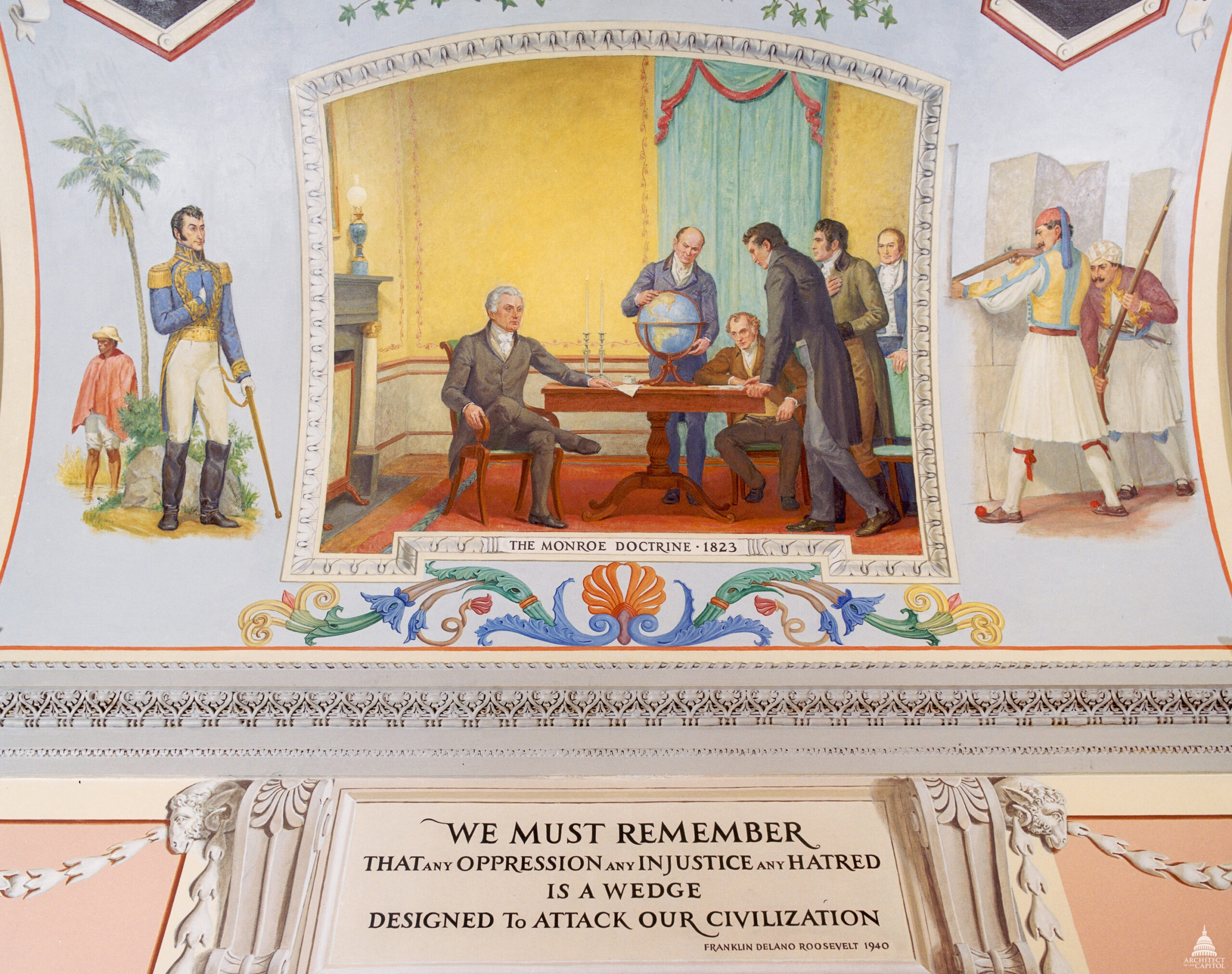
U.S. Capitol – oil painting by Allyn Cox – The Monroe Doctrine (1823), plus a quote from President Franklin D. Roosevelt (1940).

 Deneen argues that liberalism, due to its emphasis on individuals and their contractual relationship with other individuals, instead of creating greater equality and freedom for all, as promised, gives birth to a new form of despotism; the creation of a new class of elites, Deneen calls the managerial class. These elites encompass the educated class that exercises its power through non-governmental institutions. They operate in bureaucratic and managerial positions within quasi-governmental corporations such as universities, managerial institutions, the media, and the arts. As Deneen critiques, this new class views itself as the vanguard of progress and the conservative majority as the obstacle to achieving moral transformation. He argues that the managerial class participates in an act of self-deception, seeing themselves as the oppressed while upholding oppression through their authority over the powerless conservative majority. Iris Marion Young’s (1990) Five Faces of Oppression provides a framework to understand Deneen’s claim that the executive class misuses their privileged role, perpetuating powerlessness. Powerlessness is a form of oppression defined as, “a division structured by the social division of labour between professionals and non-professionals. Professionals are privileged in relation to non-professionals, by virtue of their positions in the division of labour and the status it carries. Non-professionals suffer a form of oppression in addition to exploitation” (Young 56). In other words, the managerial elites exercise power over the real oppressed, which Deneen defines as the “enculturated lower and working class” (Deneen 35), who have no power to wield authority themselves. Thus, the conservative majority, by virtue of their position, are situated to follow orders of the professional class. 

As Deneen sees, the executives are attempting to eliminate structural forms of oppression, which are upheld by the conservative majority, through enforcing ideological policies that influence people from the top down. According to Deneen, progressives mistakenly believe that they are fighting for freedom for all: however, by imposing their moral agenda, instead of freeing individuals, they encroach on the interactions and behaviours of the lower—and working-class people, thereby denying their traditional moral values. Deneen argues that in this process, progressives reject ancient conceptions of natural good and evil in favour of subjective morality. The liberal arts have a thick conception of universal human goods; they endorse a historically informed vision of human flourishing and specific universal intrinsic values forming the foundation of a life well-lived, rather than just a thin set of individual rights. As such, liberal arts are a threat to the progressive ideal of living as one pleases. This criticism seems to stand strong; by abandoning tradition as an obstacle to progress, progressives discard ancient wisdom, leaving humanity without a shared moral framework to guide behaviour. Deneen argues that progressives adopt John Stuart Mill’s (1859) harm principle described in On Liberty, as the standard for judging good and bad. Mill writes, “That the only purpose for which power can be rightfully exercised over any member of a civilized community, against his will, is to prevent harm to others. His own good, either physical or moral, is not a sufficient warrant” (Mill 25) This statement supports that an individual may do as they please as long as their actions do not harm others. This principle reduced morality to subjective judgment of harm, undermining the shared conception of the common good. Thus, while the managerial class may experience structural oppression, their exercise of power over the lower classes simultaneously positions them as oppressors. 

Although the executive class may use forceful avenues to achieve their objectives, they are not necessarily acting in bad faith. Deneen uncharitably positions the managerial elites as a tyrannical force that seeks to oppress through indoctrinating a certain agenda under the guise of progressive liberalism. He fails to grapple with the fact that some policies are in place to protect racial and sexual identities from real harm, not just hurt feelings. Deneen’s critique may be missing the value of progressive liberalism as defined by T. H. Green’s (1888) analysis of welfare liberalism in Liberal Legislation and Freedom of Contract where he writes:

When we speak of freedom as something to be highly prized, we mean a positive power or capacity of doing or enjoying something worth doing or enjoying, and that, too, something that we do or enjoy in common with others. We mean by it a power which each man exercises through the help or security given him by his fellowmen, and which he in turn helps to secure for them. (86)

In this passage, Green describes the aim of progressive liberalism as to secure positive liberty, which is the capacity to achieve one’s ends through cooperation and mutual security in society. Deneen fails to see potential value in the efforts of the executive elites to protect marginalized groups and foster a supportive collective society. While the methods of the professional elites may be invasive, there is valuable discourse to be had on where the rights of the oppressed end and begin. 

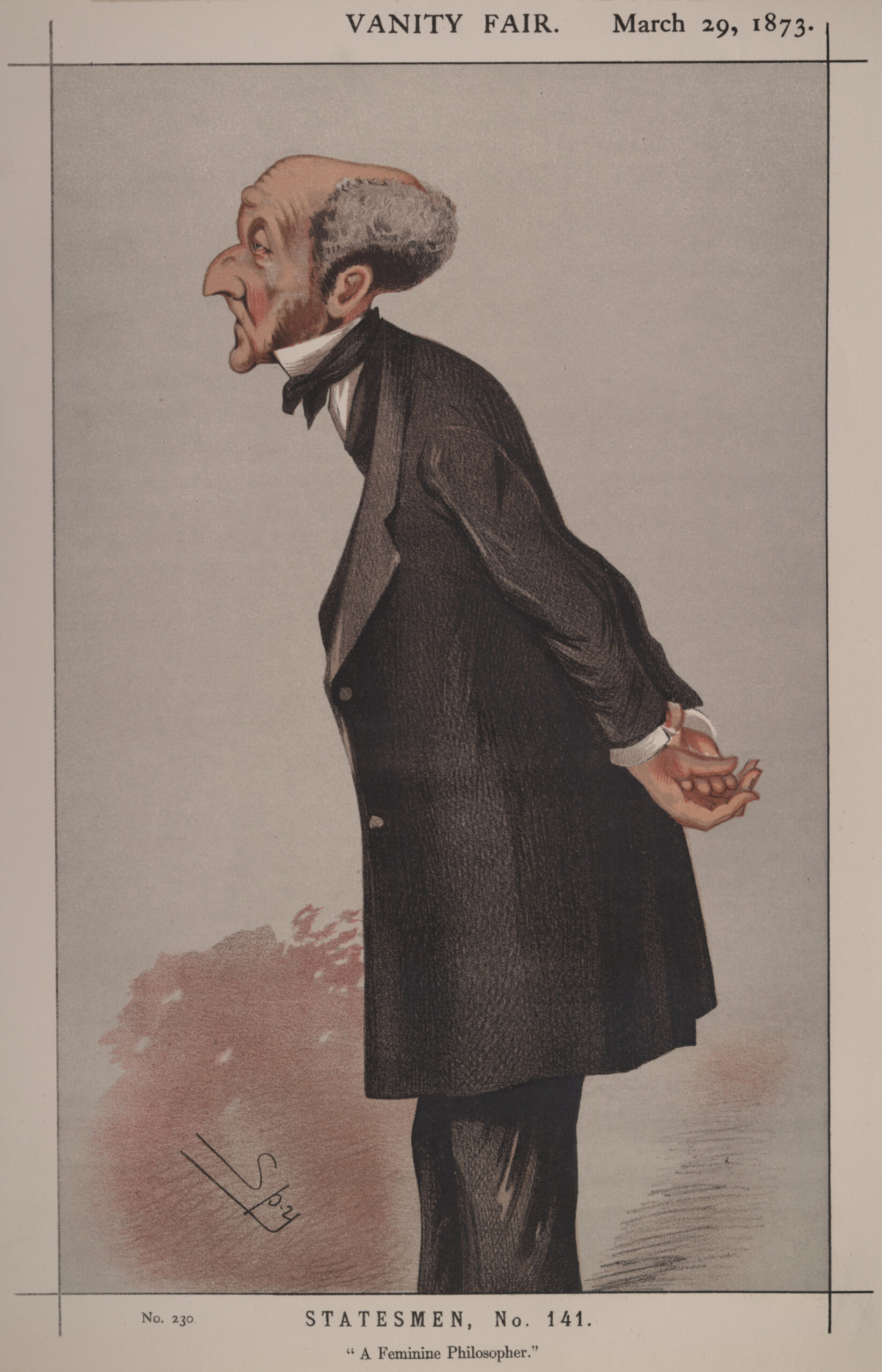
“A Feminine Philosopher”. Caricature of J.S Mill by Spy published in Vanity Fair in 1873.

Deneen proposes Aristopopulism as the solution for the problems in liberalism, calling for a return to ancient values that emphasize the common good, stability, and civic virtue. As Deneen articulates, “what is needed is a mixing of the high and the low, the few and the many, in which the few consciously take the role of aristoi—a class of people who through supporting and elevating the common good that undergirds human flourishing, are worthy of emulation and, in turn, elevates the lives, aspirations, and vision of ordinary people” (153). Deneen envisions a self-conscious elite that uplifts the enculturated majority and promotes human flourishing.  He claims populism as the foundation of Aristopopulism, as it emphasizes the appeal to the “common people.” However, populism is a loose concept that can be attached to various ideologies, including classical liberalism, progressive liberalism, and Marxism, which Deneen critiques. Nevertheless, this vision advocates for the return of a commonly shared moral framework rooted in ancient wisdom and habituation in virtue. By establishing a universal moral foundation inherited from the Western tradition, humans, regardless of their identity, can work towards a common good that emphasizes virtues like justice, honesty, courage, and generosity. 

While Deneen offers some valid critiques of liberalism, he is uncharitable to the positive motivations behind liberal ideologies. Deneen explains that classical liberalism, progressive liberalism, and Marxism all set up an elite as their vanguard to morally transform society. The intentions of these ideologies are not inherently in bad faith, however, in their efforts to protect racial and sexual identities, they reject the ancient conception of the good and embrace moral relativism based on Mill’s harm principle. Thus, they leave humanity without a shared moral compass to guide society. Deneen’s solution to this dilemma is a call for Aristopopulism, which sets up a self-conscious elite responsible for the majority’s flourishing. This vision establishes a universal moral framework rooted in the ancient wisdom of virtues like justice, honesty, and courage to achieve a common good. While Deneen presents valid criticism of liberalism’s discernment with virtue and soul craft, he also undermines the need for policies to protect racial and sexual minorities from real harm, not just hurt feelings. 

Work Consulted

Mill, J.S. On Liberty. Ryerson University Toronto, 1859.

Deneen, Patrick J. Regime Change: Toward a Postliberal Future. Sentinel, 2023. 

Green, T. H. ‘Liberal Legislation and Freedom of Contract.’ In Works, vol 3. Edited by. R. L. 

Nettleship; Longmans, Green, 1888, pp. 370-377. 

Young, Iris Marion. Justice and the Politics of Difference: Five Faces of Oppression. Princeton 

University Press, 1990.

If You Can’t Beat Her…: Reconsidering the Fortune’s Agency and the Limits of Virtù in Machiavelli’s The Prince

By Chiara Sedola

I therefore conclude that, since Fortune varies and men remain obstinate in their ways, men prosper when the two are in harmony and fail to prosper when they are not in accord. I certainly believe this: that it is better to be impetuous than cautious, because Fortune is a woman, and if you want to keep her under it is necessary to beat her and force her down. It is clear that she more often allows herself to be won over by impetuous men than by those who proceed coldly. And so, like a woman, Fortune is always the friend of young men, for they are less cautious, more ferocious, and command her with more audacity

Machiavelli

Machiavelli’s The Prince is often summarized as a guidebook on power – how to gain it, and, perhaps more importantly, how to keep it despite the vicissitudes of fortune. Fortune is a central theme in the text, but it is tricky to determine how, exactly, Machiavelli understands the concept. For most of the text, he seems to suggest that with enough foresight, preparation, and other virtues, a prince can always mitigate the damage and disorder of bad fortune; however, his final thoughts on the subject may undercut his argument. This paper will begin by establishing what Machiavelli generally means by the term fortune. From there, it will address two possible problems in Machiavelli’s argument for how princes should resist fortune, and follow with an exploration of fortune’s dynamic relationship with virtue. By examining the theme of fortune, this essay works towards the conclusion that, even if a ruler has cultivated his virtue to the best of human ability, fortune is ultimately the deciding factor of his success or failure. As a result, even perfect virtue is insufficient to protect political stability against the most destructive caprices of fortune. This conclusion follows not because, all other things being even, fortune is stronger than virtue, but because the virtue of even the best rulers is limited by human nature.

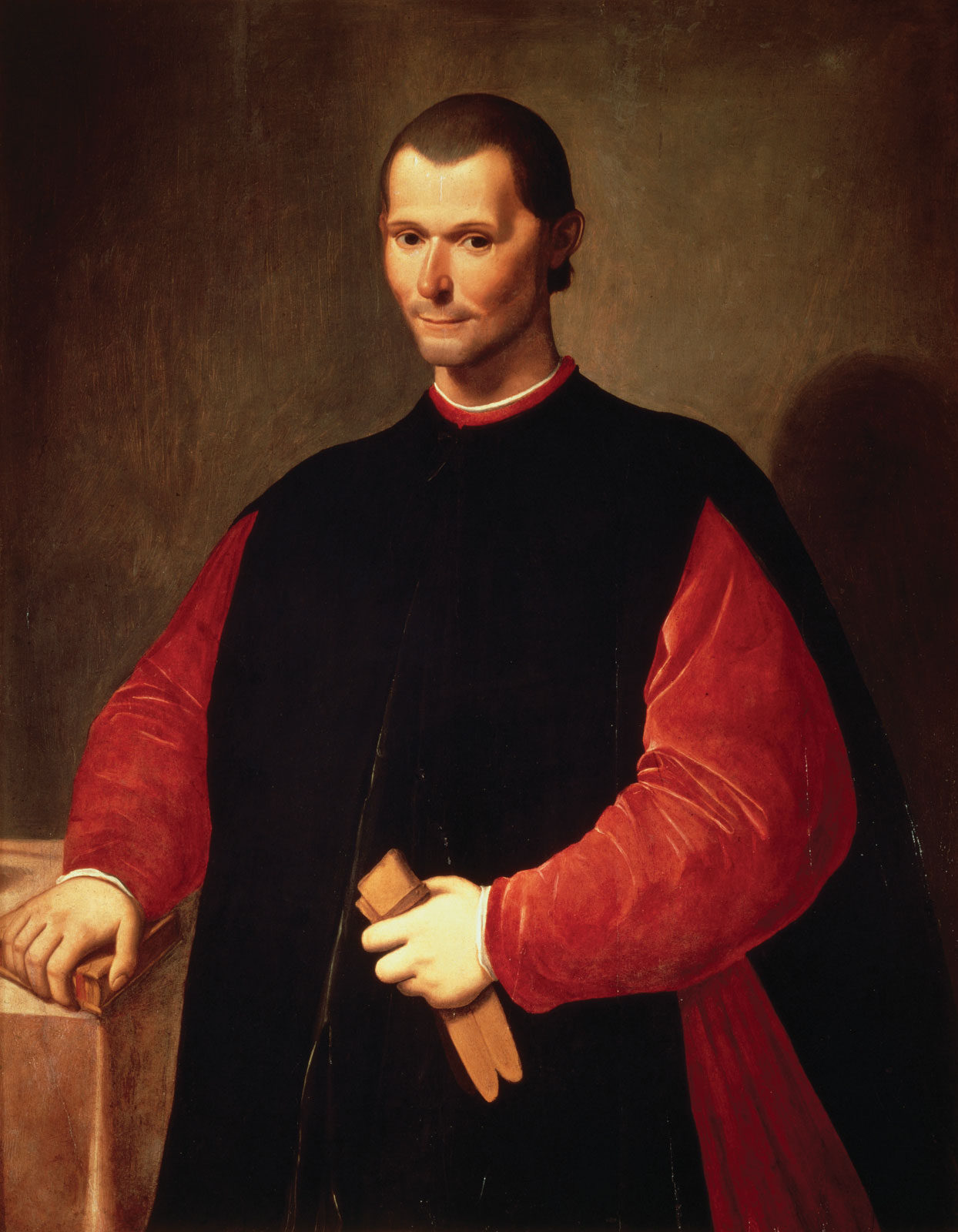
Portrait of Niccolò Machiavelli by Santi di Tito

Machiavelli conceptualizes fortune as random and ever-changing. For example, he writes that “time brings with it all things, and it can bring with it the good as well as the evil, and the evil as well as the good” (13). In other words, time does not guarantee progress towards a favourable endpoint, and so, contrary to “what is always on the lips of our wise men today,” a successful prince does not wait idly by to “reap the benefits of time” (12-3). On the contrary, there is no way of knowing whether there will be any benefits. The only certainty of time is the flux between good fortune and bad fortune. So, if a prince has good fortune now, the question is when his fortune will change, not whether it will change. Thus, fortune has no upward trend and is altogether unpredictable. 

As a result, a prince’s success and the security of his state are always at a certain level of risk from the vicissitudes of fortune; however, the risk can be mitigated through what Machiavelli calls “virtue.” But, before continuing with this discussion, some clarification is in order. First, the significance of virtue in the text could be an essay of its own, so for the scope of this essay, virtue will only be discussed concerning its relationship with fortune. Second, a working definition of virtue may be helpful since Machiavelli does not follow the usual understanding of the term. His sense of the word virtue is unconcerned with what is morally right. Instead, it is concerned with efficiency and efficacy in reaching a goal. Additionally, in contrast to fortune’s personification as a woman, virtue is gendered as masculine by Machiavelli. In short, a virtue is any characteristic of a ruler–including morally objectionable tactics such as dishonesty, cruelty, and murder–as long as it is conducive to the greater good of his principality. For “in order to maintain the state” an excellent prince “should not depart from the good if it is possible to do so, but he should know how to enter evil when forced by necessity” (61). Thus, political stability is worth whatever morally reprehensible tactics are necessary to secure it, even if only temporarily.

With the scope of the essay and a working definition of fortune in place, we can move on to the dynamic interaction between fortune and virtue–more specifically, how a prince’s virtue can be used to resist, if not control, fortune. In general, this process consists of two steps: foresight and preparation. Both stages deal with changes in fortune before they present themselves, perhaps because virtue can only defeat fortune before it has time to gain momentum. 

As for the first step in resisting fortune, foresight allows the prudent ruler to find weak spots in his state’s armour and that of his enemies. Because of fortune’s unpredictability, foresight is less about determining the most probable outcome and more about recognizing every potentiality for one’s rulership to go wrong as far in advance as possible. Machiavelli writes, “by recognizing evils in advance . . . they can be cured quickly; but when they are not recognized and are left to grow to such an extent that everyone recognizes them, there is no longer any remedy” (12). These problems are far easier to eliminate while they are only possibilities, especially because, if everyone can recognize the weakness, one’s enemies can see it too. 

As for the second step, preparation, Machiavelli also takes a blanket approach. Multiple times in the text, he advises that in everything they do, a prince should act in such a way that “no unforeseen event could arise . . . for which he did not have the remedy,” and so his people “will need the state and him at all times and in every circumstance” (37; 52). It is almost as if Machiavelli suggests that the best princes can have a backup plan for every turn of events and always channel fortune in their favour. However, if this is the case, it is an extreme response, and one might wonder how well this would fare for a ruler in real life or if it is even possible. This seems a fair critique for an author concerned with taking a realistic approach towards statecraft. To sum up Machiavelli’s advice, there are two general steps for the virtuous ruler to deal with fortune in advance of its catastrophes: foresight to assess weaknesses and preparation to correct those weaknesses before fortune, or one’s enemies, takes advantage of them.

It should be noted, however, that fortune and virtue are not always opposing forces, and both are required for a ruler’s success. For instance, in his discussion of those who rose to power through virtue, Machiavelli writes that, “[w]ithout that opportunity the strength of their spirit would have been exhausted, and without that strength, their opportunity would have come in vain” (21). In other words, even the princes who gained their principalities through virtue needed a bit of good fortune in the form of an initial opportunity to exercise it. 

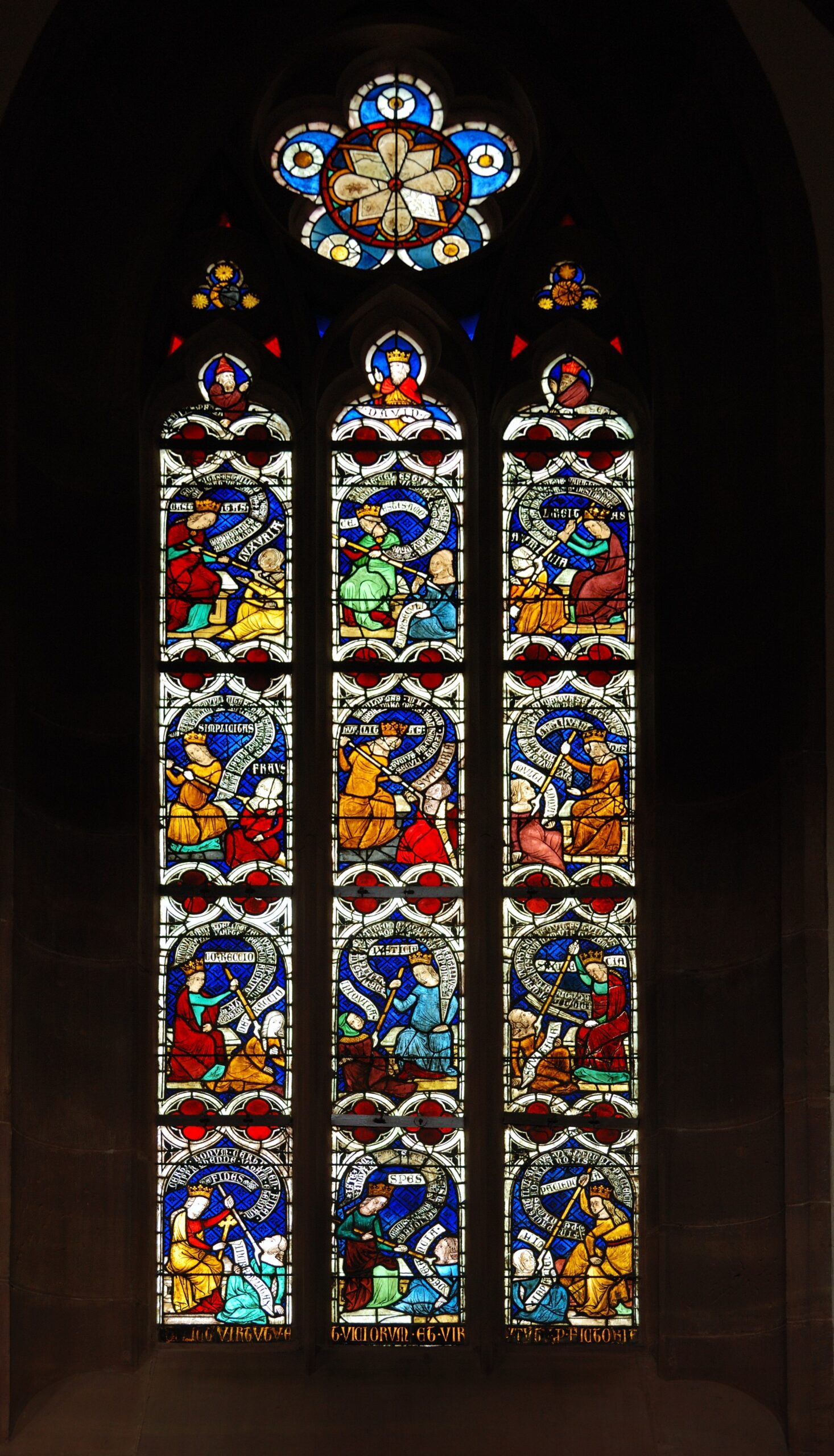
Virtues fighting vices, stained glass window (14th century) in the Niederhaslach Church

One may object and say that this is not a fair example because it is one where good fortune and virtue work together for a prince’s success. This is a fair point, but there are also examples of bad fortune and virtue working together for a prince’s benefit. For “without a doubt, princes become great when they overcome difficulties and obstacles imposed on them. And therefore, Fortune . . . creates enemies for him, and has them undertake enterprises against him so that he will have the chance to overcome them” (73-4). In this example, what we might consider bad fortune is transformed into good fortune through the prince’s virtue. Another way to think of fortune is as neutral until a prince fails or succeeds in his management of it through his virtue. In other words, whether fortune is good or bad is based on the outcome and remains undetermined until then. In any case, the relationship between fortune and virtue is a dynamic one—sometimes they are enemies, and other times they are friends, but either way, both interact to determine the success or failure of a prince and his state.

Thus far, the concept of fortune and the actions taken in response to it align with the common expectation: fortune encompasses all circumstances beyond human control, while virtue lies within the scope of human agency. In this way, fortune and virtue are the two forces working behind the outcome of a prince and his principality. However, major tensions, and, perhaps, contradictions in Machiavelli’s understanding of fortune’s relationship with virtue arise in Chapter 25. Machiavelli does not directly state whether virtue or fortune has the greater influence on history, but “in order not to wipe out our free will,” Machiavelli asserts that “Fortune is the arbiter of one half of our actions, but that she still leaves the control of the other half, or almost that, to us” (84; emphasis added). To be blunt, this is a weak defence of the power of virtue against fortune and of free will in general. As its final topic, this essay will look at two major tensions in Machiavelli’s conception of fortune and its relationship with virtue: the limitations of virtue by human nature, which, arguably, give fortune the last laugh, as well as why, considering the previous concern, a state should be cautious, but a ruler should be impetuous. 

The strange passage containing Machiavelli’s infamous image of fortune as a woman is where we will begin our analysis of Fortune’s personification. On the first reading, the treatment of fortune is simply misogynistic—it draws on imagery of violence against women and presents that as effective and even admirable; it relies on gender stereotypes by portraying femininity as something that needs to be subdued through violence; and it legitimizes coercion through force and aggression. However, with subsequent readings, it becomes far more complicated and suggests that fortune has more power than the violent virtue used against her. He writes, “It is better to be impetuous than cautious, because Fortune is a woman, and if you want to keep her under it is necessary to beat her and force her down” (87; emphasis added). This is not an imperative statement, but a declarative one, and it is unclear whether Machiavelli really thinks that it is possible to subjugate fortune. Continuing the previous quote: “It is clear that she more often allows herself to be won over by impetuous men than by those who proceed coldly” (87; emphasis added). If fortune is only won over when she consents to be, for that is the implication, then she is not conquered through force. Instead, she only yields when she uses her agency and chooses to do so. To be clear, the passage is still problematic, even with this reading. However, it would be a shame for what is of value and interest in the passage to be completely passed over if the reader’s initial offence leads to a hasty reading of the text instead of a well-examined one. In any case, this reading suggests that, ultimately, fortune is not at the mercy of virtue but vice versa.

A further limitation of virtue by fortune is found within the very nature of a prince, even the most successful ones. On this subject, Machiavelli writes, “[I] believe that the man who adapts his method of procedure to the nature of the times will prosper, and likewise, that the man who establishes his procedures out of tune with the times will come to grief” (85). Perhaps this is an additional reason why princes should not be encumbered with moral considerations – they would impair their adaptability to the times, which may call for moral behaviour, such as “patience,” or immoral behaviour, such as “violence,” indiscriminately (85). Whatever action the circumstances call for, the prince must act accordingly. Yet, despite how crucial adaptability is, “no man can adapt himself to this fact, both because he cannot deviate from that to which he is by nature inclined, and also because he cannot be persuaded to depart from a path after having always prospered by following it” (85-6; emphasis added). It is a thought-provoking idea that one’s capacity for self-cultivation is inherently unalterable. In addition, it is interesting that one’s success is the ultimate source of one’s downfall by calcifying flexibility. In the context of the text, the source of a prince’s ruin is not that he did not fully cultivate the virtue of adaptability, but that even this was not enough, since he cannot change his nature.

Perhaps it is because of this limit that a prince should be impetuous rather than cautious in his dealings with fortune. To clarify, impetuousness—acting boldly, aggressively, and without hesitation— is not inherently better than caution. In the example of Pope Julius II, although he was blessed with times necessitating an approach suited to his nature, he would have been brought to ruin just as swiftly as the cautious man if the opposite circumstances arose (86).  Although the author never provides an unvarnished, non-metaphorical explanation for why he believes with such certainty that “it is better to be impetuous than cautious,” perhaps it is because acting impetuously pushes the limits of virtue more than caution, or it pushes the limits of one’s enemy’s (87). Although admittedly somewhat beyond the scope of this essay, it is still worth mentioning another potential reason: Machiavelli values glory for a ruler, and glory rarely comes from being cautious. 

Yet, just before giving his views on the superiority of impetuousness, Machiavelli provides a compelling metaphor for the importance of being cautious and fortifying against fortune at the state level. How do we reconcile these two imperatives for a prince to be impetuous but for state to be cautious? In comparing fortune to a “destructive” and “enraged” river, he tells of how “everyone flees before it; everyone yields to its impetus, unable to oppose it in any way” (84). Further, fortune “shows her power where there is no well-ordered virtue to resist her, and therefore turns her impetus towards where she knows no dikes and dams have been constructed to hold her in” (84-5; emphasis added). Here, fortune’s agency takes on an intentionally malevolent character that we might contrast with her personification as a woman. It seems that there are different rules for fortune’s game at the level of the state and the level of the ruler. It does not seem that fortune can be won over in this case, so the only course of action is to be cautious and take precautions. What precautions, exactly? Given that Machiavelli is addressing fortune at the general state level, as in Italy’s failure to prepare compared to Germany, Spain, and France, perhaps the dikes and dams are state institutions, such as an autonomous military (85). In any case, fortune operates differently between the state and the prince, and so Machiavelli recommends distinct and, interestingly, opposing approaches.

Overall, if fortune sets her sights on a ruler’s destruction, there does not seem to be much remedy for virtue to offer, especially if human nature is predetermined to be resistant to adaptation. According to Machiavelli, fortune always has the advantage, although, in his personification, she may choose to stay her hand. Just as some rulers must face a no-win scenario, there are also those given challenges to rise above. Fortune is by nature unpredictable, but if it destroyed all of virtue’s order, there would be no need to write the text in the first place – there would be no states to govern. 

In closing, and for the sake of interest, I offer a highly speculative lens through which to read The Prince. In examining the theme, one cannot help but notice the similarities between Fortune and Machiavelli’s ideal prince. They are both unpredictable, unconstrained by morals, constantly searching for and exploiting weaknesses, and violent, among other characteristics. Even the words used to describe them are all but the same, like the “impetus” of fortune and the “impetuous” prince (84; 86). Thus, perhaps, in the eyes of Machiavelli, the most excellent and virtuous exemplar for an aspiring prince is fortune herself.

Work Cited

Machiavelli, Niccolò. The Prince. Translated by Peter Bondanella. Oxford World Classics, 2008.