By Maggie Velisek
Artist’s Statement
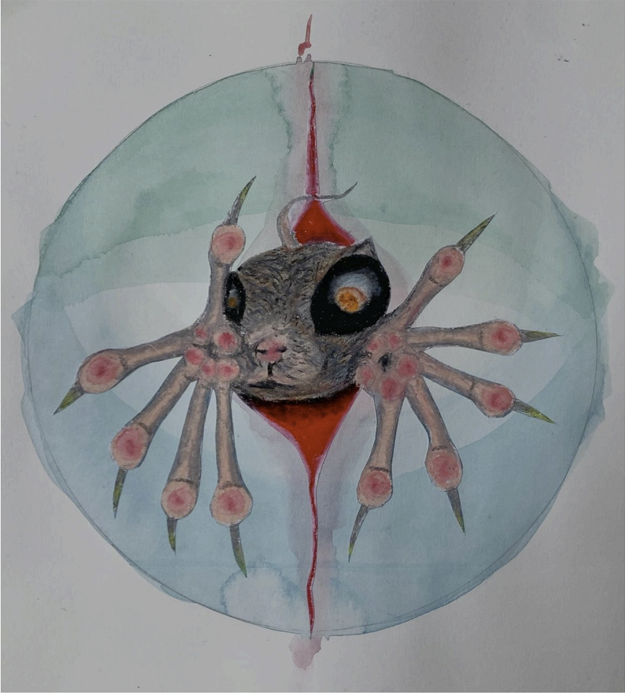
In this artwork, someone in the form of a mouse climbs up a thin red line from the earth world into the sky world. This is the main character from Haida mythteller Ghandl’s story “In His Father’s Village, Someone Was Just About to Go Out Hunting Birds” (translated to English and published in Robert Bringhurst’s book A Story as Sharp as a Knife: The Classical Haida Mythtellers and Their World)—he is a hunter, a “child of good family” (line 1), who falls in love with and marries a goose
woman. At this point in the story, the hunter’s goose wife has gone back to her world, and the hunter has been given a selection of tools and items that will aid him along his journey to find her. The hunter has slipped into the hunting skin that Mouse Woman has given him. Readers of Ghandl’s myth will recall the following quoted passage in which this item (the mouse skin), in combination with the salmon roe, will enable the hunter to scale the red pole up from his world into the home world of his wife. He saw no way of going up.
Then he entered the mouse skin.
Pushing the salmon roe ahead of him, he climbed.
He went up after it.
(line 204-207)
The artwork is circular, and the mouse’s sharp claws curve with the frame, the proportions distorted in the circle. The mouse head and paws occupy the foreground of the image, and the thin red line is thick where it is closest to the focal point but is foreshortened dramatically in the upwards and downwards directions. A fish-eye lens effect is intended and will turn out to be instrumental to the connection that this artwork is trying to communicate. This 180 degree field of view gives the viewer a feeling of immersion in this magnification of a scene from between the worlds in Ghandl’s story. Ghandl’s story is riddled with cultural references and Haida mythtelling motifs that an audience embedded within that culture will be familiar with—in this way, the story flourishes when engaged with by a reader familiar with this myth world. Likewise, there is an aspect of the artwork that blooms under the eye of one familiar with the source content.
The essential aspect to being in relationship with this artwork is the perspective from which the scene is viewed. The scene viewed is the aforementioned one of the hunter climbing into the sky world, but it takes having interacted with the myth to notice that the artwork is made from the perspective of the salmon roe. The orange egg is reflected in the big dark eye of the mouse head—as the viewer sees the mouse, they see reflected what the mouse is seeing. There are two main cues that encourage the viewer to identify with the salmon roe. The first is that though the roe is reflected in the mouse eye, it itself is not
pictured. The second cue is the fish-eye effect that the proportions of the artwork have. Beginning to identify with the salmon roe illuminates a whole new way for the viewer to interact with the artwork—an active, participatory engagement, rather than the removed gaze of the viewer who does not see themselves as part of the narrative process unfolding in the artwork. The salmon roe occupies a curious role in Ghandl’s story. As mentioned above, in order for the hunter to climb up into the sky world, he must slip into the mouse skin and push the salmon roe up in front of him.
Robert Bringhurst has not only translated into English Ghandl’s story but has also provided the reader with some helpful context, analysis, and commentary in the chapter in which the myth is published (“Goose Food”) as well as the following chapter, “Spoken Music”. As Bringhurst notes, each of the helpful items that the hunter collects are to be used in pairs as the need arises—for example, he must deploy the comb in combination with the oil to help the lice-infested person he encounters in his world (stanza 4.2).
Bringhurst illuminates some important conventions of Haida mythtelling that readers of Ghandl’s story should recognize, one of these conventions being the symmetry of the plot. Bringhurst draws attention to several moments in Ghandl’s telling of the myth that define a symmetrical plot structure, one of these instances being the red “pole that links earth and sky” (p. 51)—the pole that also functions in the story as a divider between symmetrical sets of encounters and situations that the hunter faces. Looking at the artwork, there is symmetry above and below the hunter, just as in the story in that moment of the story he is midway through his encounters.
This artwork is a response to both Ghandl’s story and Robert Bringhurst’s commentary on the story. The images are from Ghandl’s telling of “In His Father’s Village, Someone Was Just About to Go Out Hunting Birds”—mouse woman’s hunting skin, the salmon roe, the “big round eyes” (line 159) of mouse woman, the “slender and red” (line 201) thing that connects the two worlds. The way the images and themes are represented in this artwork draws from Bringhurst’s commentary—specifically his discussion of Diego de Silva y Velázquez’s 1618 painting “Kitchen Maid with the Supper at Emmaus”. Bringhurst says that “a myth is a story, and it is a story that insistently recurs: a piece of timelessness
caught like an eddy in narrative time. Once the story is known, a single image or even a single word can evoke it” (p. 48). The artwork is an attempt to, using an image from Ghandl’s story, evoke the whole story, in a way similar to Velázquez’s representation of the moment from the gospel of St. Luke. Bringhurst involves the viewer of the painting in his analysis of how the story is revealed in the painting’s elements. He says that which dawns on the viewer as they take in Velázquez’s painting is what dawns on the woman in the foreground of the painting. The “Goose Food”-inspired artwork is intended to similarily transform the viewer into a participator, using the reflection in the eyes of the Mouse Woman’s hunting skin. Ideally, this artwork will trigger an aha! moment in the viewer—provided the viewer is familiar with Ghandl’s story.
Materially, the contrast between the main subjects—the mouse and red thing, coloured with oil pastels—and the watercolour background gradient creates a striking difference in textures. Watercolour paints and oil pastels do not mix harmoniously, and do not make for an impression that everything pictured is happening in the same world. Oil and water shy away from each other. Just as each the hunter and his goose wife are out of place in the other’s home world, so does oil fail to integrate into water and vice versa. The hunter cannot subsist on goose food; the goose wife cannot eat what the hunter eats. An artist has a difficult time trying to pick up oil pastel on wet paintbrush, and trying to make a wash of colour on a page by rubbing dry watercolour paint over it is similarly ineffective.
The use of different media in the artwork reflects the theme of relationship between different worlds in Ghandl’s myth. The hunter falls in love with his prey, and there are insurmountable differences between the couple and their respective lifestyles, though they make efforts to survive in each other’s worlds. Though the hunter is married to the goose woman at the point in the story that this artwork depicts, he is still pursuing her like a hunter pursues prey. He wears Mouse Woman’s hunting skin—with long, sharp claws. He reaches towards the viewer, almost seeming to be pouncing.
The viewer and the relating that happens between the viewer and the artwork is an important part of the artwork. In Ghandl’s myth, the salmon roe (used in combination with the mouse skin) is necessary—and the viewer is the salmon roe. The artwork contains a representation of the mouse skin
being used, and the viewer is meant to be the salmon roe. In this way, this piece of art needs the viewer—the story needs a listener. Not only does the artwork need a viewer, it flourishes under the gaze of someone who is familiar with Ghandl’s story. And as illuminated by Bringhurst’s notes on the Hadia mythtelling tradition that Ghandl is part of—the symmetry, the significance of certain numbers, the “undissipated energies” (52) that must be resolved, the music of it all; Ghandl’s story blooms when read or listened to by someone who is familiar with the greater themes and structures of Haida mythtelling.
As illuminated by Bringhurst’s notes on the Haida mythtelling tradition that Ghandl is part of, in which he discusses elements such as symmetry, the significance of certain numbers, the “undissipated energies” (p. 52) that must be resolved, and the musicality of the telling, Ghandl’s story blooms when read or listened to by someone who is familiar with the greater themes and structures of Haida myth telling. Similarly, the relationship between the viewer and the artwork is an important part of the artwork as object—in fact it constitutes its main meaning. In Ghandl’s myth the salmon roe is a necessary, balancing, element, and positioning the salmon roe as reflection in the artwork confirms the symmetrical necessity of a viewer. In this artwork the viewer is reminded how the paired items of roe and mouse skin work inside the myth—it is also apparent how these items are used to specifically employ the viewer’s ability to not only hear the story but to imagine an immersion in the mythic world(s) of that story. As a material object, the artwork can be understood by any viewer, but only truly flourishes under the gaze of someone who is familiar with Ghandl’s story.
Works Consulted
Bringhurst, Robert. “Goose Food” and “Spoken Music”. from A Story as Sharp as a Knife: The Classical Haida Mythtellers and Their World. Second Edition, Douglas & McIntyre, 2011, pp 29-63.