By Antje Bitterberg and Summer Lin
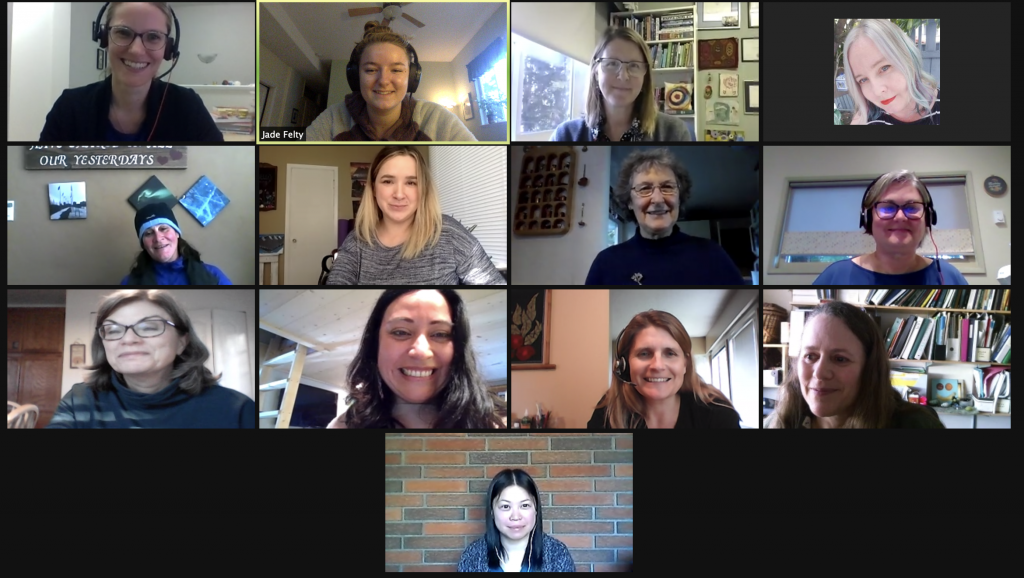
In the Spring of 2020, soon after the announcement that most courses in post-secondary institutions would be moved online because of the pandemic, we had the opportunity of co-teaching a group of ECEC students from VIU’s Cowichan, Powell River, and Nanaimo campuses. With students from several communities, and the sudden shift from face-to-face classes to online classes, we wanted to focus on creating an online community for thinking and learning together. How might we cultivate collaborative, generative, and collegial modes of being teachers?
We welcomed the invitation to think together and found much joy in the process of becoming co-teachers. We oriented ourselves toward this process of creating a space for co-teaching. On a day-to-day basis we committed to teaching together. As colleagues, we actively resisted the lure of efficiency. We did not divide the work among ourselves evenly allowing us to get things done. Instead we made time to slow down and to begin our days with dialogue. As roommates on zoom we lived and breathed the course together.

In our daily conversations within the context of our course and beyond, we became curious about the power of language. We wondered, ‘How might language shape what is possible/ measurable/ observable/ visible/ valued in early childhood spaces?’ To think about/with language, we introduced the concept of binary (paired) oppositions, where “[e]ach word…relies for its meaning on the other. We need the word fat to define slim. The same is so for straight and gay, black and white, etc. A pair always has two” (MacNaughton, 2005, p. 62). We have included more pairs below, some are borrowed from Glenda MacNaughton, others we brainstormed with the students.
- complete/ incomplete
- predictable/ unpredictable
- normal/ abnormal
- boy/ girl
- developed/ underdeveloped
- rich/ poor
- efficient/ inefficient
It is important to note that these “pairs are always ranked, so one part of the pair always has higher value in the ranking and is privileged over the ‘other’. So, using binary oppositions places some meanings in a secondary, subordinate position and often an aberrant position” (Mac Naughton, 2005, p. 63). Mac Naughton (2005, p. 118) offers the following questions:
- “How does binary thinking enter your everyday discussions in early childhood studies?”
- “What is silenced or othered through the hierarchical thinking in these binaries?”
- “What everyday words could you put under erasure to help you wonder new meanings and actions for social justice in your classroom?”
Rejuvenated and transformed by our process of thinking together, we invite you to join us by sharing your (in)complete engagement with these questions, your own wonderings, or connections to the Early Learning Framework (Government of BC, 2019) by responding to this post!
References
Government of British Columbia. (2019). British Columbia early learning framework (2nd ed.). Victoria: Ministry of Education, Ministry of Health, Ministry of Children and Family Development, & British Columbia Early Learning Advisory Group. https://www2.gov.bc.ca/gov/content/education-training/early-learning/teach/early-learning-framework
Mac Naughton, G. (2005). Doing Foucault in early childhood studies: Applying poststructural ideas. Routledge.